
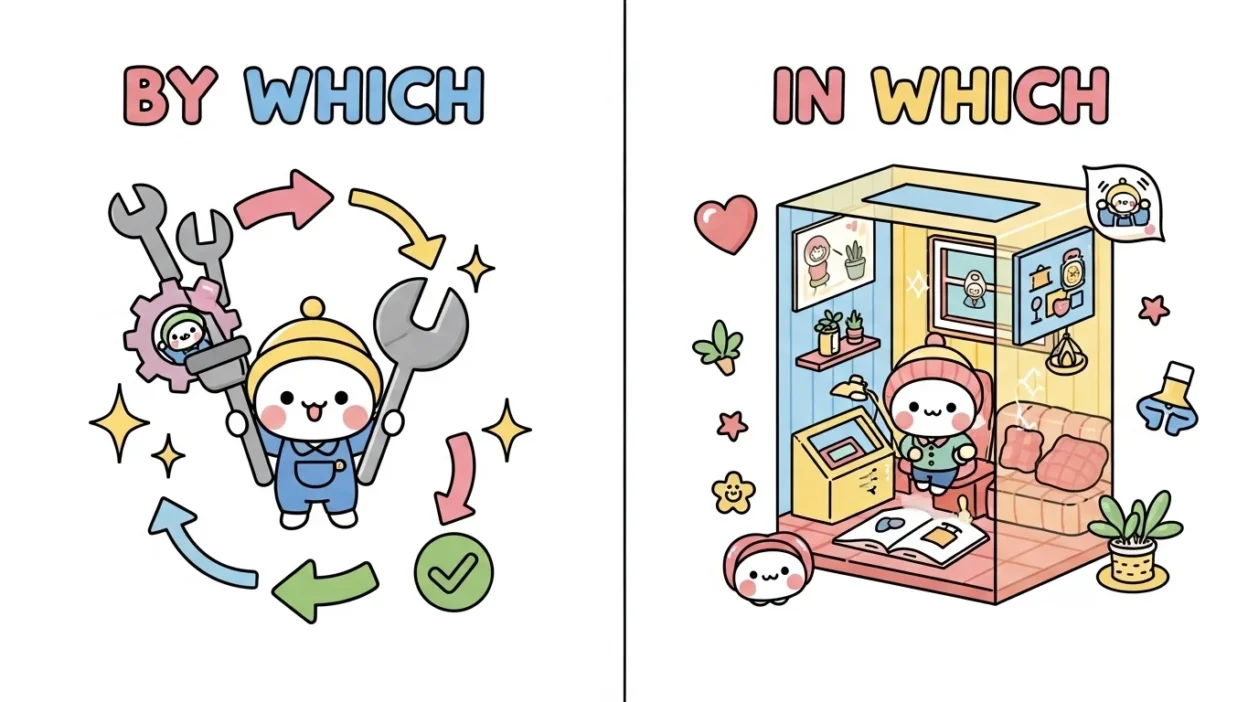
Small phrases like “by which” and “in which” can be confusing, but they are very useful in formal and clear English.
Both are relative phrases used to connect ideas, yet they have different meanings based on how something happens or where it happens.
Once you understand their roles, you’ll use them naturally and confidently.
Quick Answer
- ✅ By which = Method, means, or process
- ✅ In which = Place, situation, or condition
👉 Simple rule:
By = how something happens
In = where/within something
What Does “By Which” Mean?
By which is used to explain the method, way, or process something happens.
Examples of “By Which”
- This is the method by which we solve the problem.
- The system by which data is collected is efficient.
- He explained the process by which the machine works.
👉 Focus = how something is done
What Does “In Which” Mean?
In which is used to describe a place, situation, or condition where something happens.
Examples of “In Which”
- This is the room in which we study.
- The situation in which he found himself was difficult.
- She described a case in which the law was applied.
👉 Focus = where or in what situation
Key Difference Between By Which and In Which
The difference is based on function:
- By which → explains the method or means
- In which → explains the place or context
Quick Comparison Table
| Phrase | Meaning | Use |
|---|---|---|
| By which | Method or process | How |
| In which | Place or situation | Where |
Common Mistakes to Avoid
Incorrect:
- The room by which we study. ❌
Correct:
- The room in which we study. ✅
Incorrect:
- The method in which we solve this. ❌
Correct:
- The method by which we solve this. ✅
Easy Memory Trick
Think of this:
👉 By = way/method 🛠️
👉 In = place/space 📦
So:
- By which → how
- In which → where
When to Use Each
Use “By Which” When:
- Explaining a method
- Talking about a process
- Describing how something works
Use “In Which” When:
- Talking about a place
- Describing a situation
- Referring to a condition or context
Formal vs Informal Use
These phrases are more common in formal writing, such as:
- Academic writing
- Reports
- Professional communication
In casual speech, people often replace them with simpler forms:
- “The way we do this” instead of “the way by which we do this”
- “The place where” instead of “the place in which”
Frequently Asked Questions (FAQs)
What is the difference between by which and in which?
“By which” refers to method or process, while “in which” refers to place or situation.
Can I replace “in which” with “where”?
Yes, in many informal situations.
Is “by which” formal?
Yes, it is mostly used in formal or structured writing.
Can I use “by which” for place?
No. It is used for method, not location.
Which is more common in daily speech?
“In which” (or “where”) is more common than “by which.”
Are both grammatically correct?
Yes, both are correct when used in the right context.
Final Thoughts
The difference between “by which” and “in which” is all about understanding how vs where. By which explains the method or process something happens, while in which describes the place or situation where it occurs.
A simple way to remember is: “by” is for method, “in” is for location or context. Once you keep this idea in mind, choosing the correct phrase becomes much easier.
Mastering these small grammar details can make your writing sound more professional, clear, and polished—so keep practicing and enjoy improving your English!

Narelle Merindah is a passionate author committed to delivering thoughtful, engaging, and well-structured content. With a keen eye for detail and a love for storytelling, Narelle creates informative articles that resonate with readers. Her dedication to clarity, creativity, and authenticity ensures meaningful and impactful writing.