English can be tricky, especially when words look or sound similar but mean different things. That’s where homophones, homographs, and homonyms come in. These terms often confuse learners, but once you understand them, everything becomes much clearer and even fun!
Let’s break them down in a simple and easy way.
Quick Answer
- ✅ Homophone = Same sound, different meaning/spelling
- ✅ Homograph = Same spelling, different meaning (may sound different)
- ✅ Homonym = Same spelling OR same sound, different meaning
What Is a Homophone?
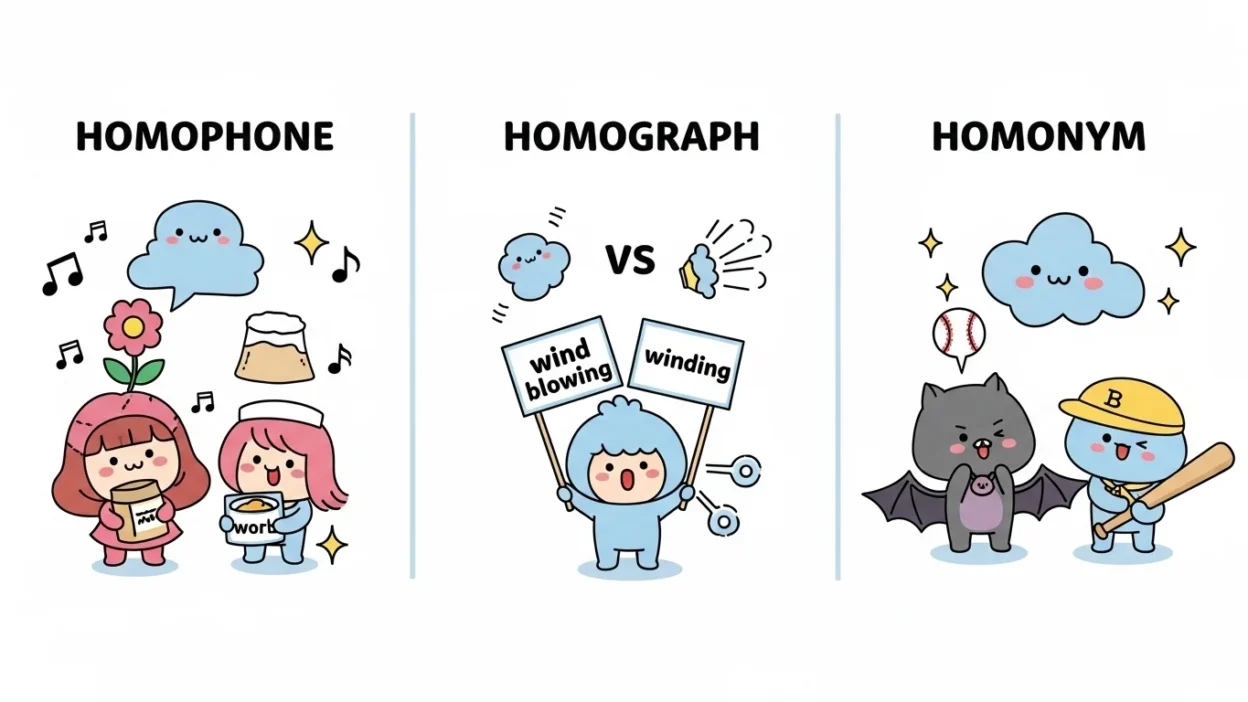
A homophone is a word that sounds the same as another word but has a different meaning and often different spelling.
Examples of Homophones
- to / too / two
- flower / flour
- right / write
- sea / see
Example Sentences
- I want to go too.
- She bought a flower and some flour.
👉 They sound the same but mean different things.
What Is a Homograph?
A homograph is a word that is spelled the same but has different meanings. Sometimes, the pronunciation is also different.
Examples of Homographs
- lead (to guide) / lead (a metal)
- tear (rip) / tear (from crying)
- wind (air) / wind (to twist)
Example Sentences
- Please lead the way.
- The pipe is made of lead.
👉 Same spelling, different meanings (and sometimes different pronunciation).
What Is a Homonym?
A homonym is a broader term. It refers to words that are either spelled the same OR sound the same but have different meanings.
👉 This means:
- All homophones are homonyms
- All homographs are homonyms (in many definitions)
Examples of Homonyms
- bat (animal) / bat (sports equipment)
- bank (river edge) / bank (financial place)
Example Sentences
- The bat flew at night.
- He hit the ball with a bat.
Key Differences Made Simple
| Type | Same Sound | Same Spelling | Example |
|---|---|---|---|
| Homophone | ✅ Yes | ❌ Not always | to / too |
| Homograph | ❌ Not always | ✅ Yes | lead / lead |
| Homonym | ✅ or ✅ | ✅ or ❌ | bat / bat |
Easy Way to Remember
Here’s a fun trick:
- 🎧 HomoPHONE → think sound (phone = sound)
- ✍️ HomoGRAPH → think writing (graph = write)
- 🔁 HomoNYM → think general name group
Common Mistakes to Avoid
- Mixing up to / too / two (homophones) ❌
- Misreading words like lead (homograph) ❌
- Assuming all similar words are the same ❌
Take a second to check meaning and context!
Why These Matter
Understanding these helps you:
- Improve spelling
- Avoid confusion
- Write clearly
- Understand English better
They are very common in exams, writing, and daily communication.
Frequently Asked Questions (FAQs)
What is the difference between homophone and homograph?
Homophones sound the same, while homographs are spelled the same.
Are homonyms the same as homophones?
Not exactly. Homophones are a type of homonym.
Can a word be both a homophone and a homograph?
Sometimes, yes—depending on how it’s used.
Why are homophones confusing?
Because they sound identical but have different meanings and spellings.
What is the easiest way to remember them?
Think: phone = sound, graph = writing.
Are these used in everyday English?
Yes! You use them all the time, often without noticing.
Final Thoughts
Understanding homophones, homographs, and homonyms doesn’t have to be confusing. These word types simply describe how words can sound the same, look the same, or both while having different meanings. Once you learn the basic differences, you’ll start spotting them everywhere in everyday English.
The key is to focus on sound vs spelling vs meaning. With a little practice, you’ll not only avoid mistakes but also become more confident in reading, writing, and speaking. And honestly, once you get the hang of it, these tricky word groups become pretty fun to play with!