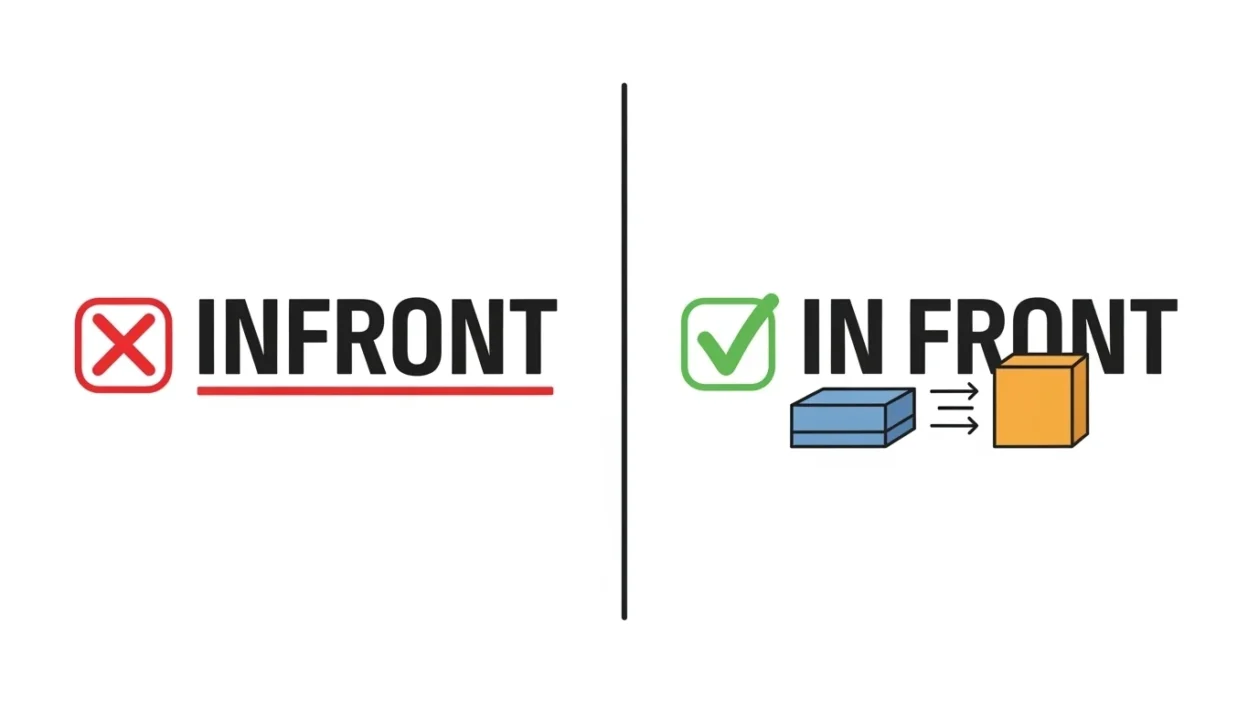
It’s very common to see people write “infront” as one word, but is that correct?
This small spacing mistake can affect how natural and accurate your English looks, especially in formal writing.
Let’s clear it up simply so you always use the correct form.
Quick Answer
- ❌ Infront = Incorrect
- ✅ In front = Correct
The correct form is always two words: “in front.”
What Does “In Front” Mean?
In front is a phrase that means ahead of something or someone—in a position that is before another object or person.
Examples of “In Front”
- The car is parked in front of the house.
- She stood in front of the class.
- There is a tree in front of my window.
- He sat in front of me.
This phrase is used to describe position or location.
Why “Infront” Is Incorrect
The word infront (one word) is not standard English and is considered a spelling mistake.
Incorrect:
- The dog is infront of the door. ❌
Correct:
- The dog is in front of the door. ✅
Even though it may appear in informal writing or online, it is not accepted in proper grammar.
Understanding the Phrase
In front is made of:
- In → a preposition
- Front → a noun (position)
Together, they form a prepositional phrase.
“In Front of” vs “Before”
Sometimes, in front of and before are similar, but not always identical.
Examples
- He stood in front of me. (physical position)
- He arrived before me. (time or order)
So:
- In front of → place
- Before → time or sequence (often)
Quick Comparison Table
| Word/Phrase | Meaning | Correct Usage |
|---|---|---|
| In front | Ahead of something | ✅ Correct |
| Infront | Misspelling | ❌ Incorrect |
Common Mistakes to Avoid
Incorrect:
- She is standing infront of the mirror. ❌
- The shop is infront of the school. ❌
Correct:
- She is standing in front of the mirror. ✅
- The shop is in front of the school. ✅
Easy Memory Trick
Think of this:
👉 You can’t “combine positions” into one word here
So remember:
In + Front = Two words
Always keep them separate.
American vs British English
There is no difference between American and British English.
Both use:
- In front ✅
- Not infront ❌
Frequently Asked Questions (FAQs)
Is “infront” a correct word?
No. It is a spelling mistake in standard English.
Should “in front” be written as one or two words?
It should always be written as two words.
What does “in front of” mean?
It means being ahead of something or someone in position.
Can I use “before” instead of “in front of”?
Sometimes, but only when referring to time or sequence, not physical position.
Is “in front” formal or informal?
It is used in both formal and informal English.
Why do people write “infront”?
Because they assume it is a single word, but grammatically it is not.
Final Thoughts
The difference between infront and in front is simple but important. In front is the correct form and should always be written as two separate words.
It is used to describe position being ahead of something or someone.
On the other hand, infront is a common spelling mistake that should be avoided in both formal and informal writing.
By remembering to keep the words separate in + front you can ensure your writing is clear, correct, and professional.

Lutana Maroochy is a creative author recognized for delivering engaging and well-researched content. With a passion for clear communication and storytelling, Lutana focuses on producing informative, reader-centered articles across various subjects. Dedicated to quality and originality, Lutana consistently connects with audiences through thoughtful insights and compelling narratives.