If you’ve ever typed “to bad” and wondered whether it should be “too bad,” you’re definitely not alone. These two phrases sound exactly the same when spoken, which makes them easy to mix up in writing.
In this complete guide, we’ll break down to bad vs too bad, explain the correct spelling, provide clear examples, highlight common mistakes, cover American vs British English usage, and answer frequently asked questions. By the end, you’ll never confuse them again.
Quick Answer: To Bad vs Too Bad
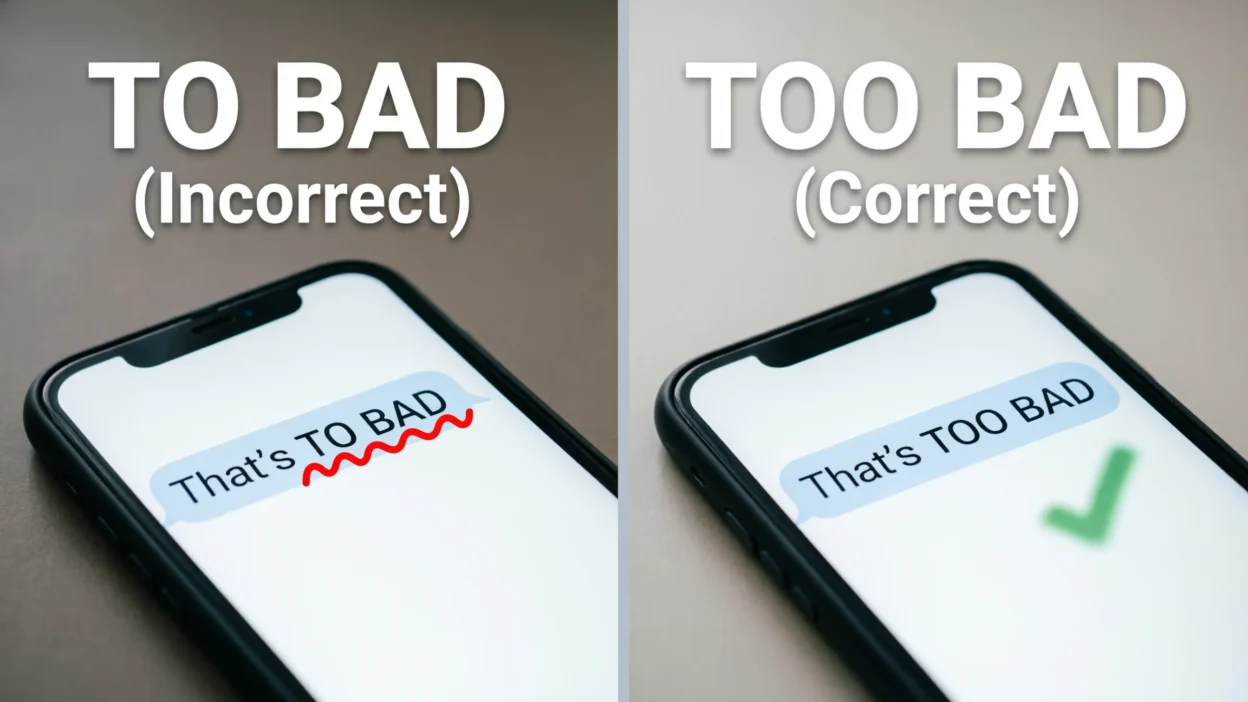
- ❌ To bad = Incorrect
- ✅ Too bad = Correct
The correct phrase is “too bad.”
It means: unfortunate, disappointing, or expressing mild regret.
What Does “Too Bad” Mean?
Too bad is an expression used to show:
- Disappointment
- Sympathy
- Mild regret
- Indifference (depending on tone)
The word too means “excessively” or “also,” but in this phrase, it functions as an intensifier.
Examples of “Too Bad”
- It’s raining? That’s too bad.
- You missed the deadline? Too bad.
- It’s too bad we couldn’t meet earlier.
- That’s too bad, I was really looking forward to it.
The meaning changes slightly depending on tone:
- Gentle sympathy → “Oh, that’s too bad.”
- Slight indifference → “Too bad.”
Why “To Bad” Is Incorrect
The word to is a preposition used for direction, purpose, or infinitives.
Examples of correct “to” usage:
- I’m going to the store.
- I want to learn.
- She gave the book to him.
But “to bad” does not form a grammatically correct phrase.
Incorrect:
- That’s to bad.
Correct:
- That’s too bad.
Understanding Too vs To
This mistake happens because too and to are homophones (they sound the same).
Here’s a quick comparison:
| Word | Part of Speech | Meaning | Example |
|---|---|---|---|
| To | Preposition | Direction or purpose | Go to school |
| Too | Adverb | Excessively / also | Too cold |
| Two | Number | 2 | Two apples |
Memory trick:
- Too = Extra O = Extra meaning
- If you can replace it with “very” or “also,” use too.
Example:
- It’s very bad → It’s too bad (intensifier)
Different Meanings of “Too Bad”
1. Expressing Sympathy
- That’s too bad about your exam.
- It’s too bad your trip was canceled.
2. Showing Mild Disappointment
- It’s too bad we couldn’t finish on time.
3. Indifference (Tone Matters)
- You didn’t study? Too bad.
Tone changes everything. Written communication may not always show emotional intent clearly.
Common Mistakes to Avoid
1. Writing “To Bad” in Text Messages
Because both words sound identical, autocorrect may not catch the error.
Incorrect:
- That’s to bad.
Correct:
- That’s too bad.
2. Confusing “Too” With “Very”
Remember, “too” often means “excessively,” but in this expression, it works idiomatically.
3. Mixing Up Too, To, and Two
These are among the most commonly confused words in English writing.
American vs British English Differences
Good news: There is no difference between American and British English for this phrase.
Both use:
- Too bad (correct)
- “To bad” is incorrect in both dialects.
Spelling and meaning remain the same.
Related Phrases and Synonyms
If you want alternatives to “too bad,” consider:
- What a shame
- That’s unfortunate
- That’s disappointing
- That’s a pity
- Regrettably
Each phrase carries slightly different emotional weight.
Real-Life Examples in Context
In Casual Conversation
- You missed the movie? Too bad.
- It’s too bad you couldn’t come.
In Professional Settings
- It’s too bad the proposal wasn’t approved.
- That’s too bad, but we can try again next quarter.
In Emails
- It’s too bad we couldn’t connect this week. Let’s reschedule.
FAQs About To Bad vs Too Bad
1. Is “to bad” ever correct?
No. It is grammatically incorrect in standard English.
2. Why do people make this mistake?
Because “to” and “too” sound exactly the same.
3. Can “too bad” be rude?
Yes, depending on tone. It can sound dismissive if used carelessly.
4. What does “too” usually mean?
“Too” means excessively or also.
Example:
- It’s too hot.
- I want to come too.
5. Is “too bad” formal?
It’s more conversational but acceptable in informal professional writing.
6. How can I remember the difference?
Remember: Too has an extra “o” for extra meaning.
Final Summary: To Bad vs Too Bad
The correct phrase is “too bad.” The spelling “to bad” is incorrect in standard English. “Too bad” expresses disappointment, sympathy, or mild regret, depending on tone.
Because “to” and “too” sound the same, this mistake is extremely common. But once you remember that too has an extra “o” for extra meaning, you’ll avoid the error easily.
Actionable Takeaway
Before writing the phrase:
- Ask: Am I expressing regret or disappointment? → Use too bad
- Check your spelling carefully
- Remember: Extra “o” = extra emphasis
Master this small distinction, and your writing will instantly look more polished and professional.