
If you’ve ever typed “puting” and wondered whether it should be “putting,” you’re not alone.
This is one of the most common spelling mistakes in English, especially because the verb put is so short and simple.
In this complete guide, we’ll break down puting vs putting, explain the correct spelling, share grammar rules, give real examples, highlight common mistakes, and answer frequently asked questions. By the end, you’ll never second-guess it again.
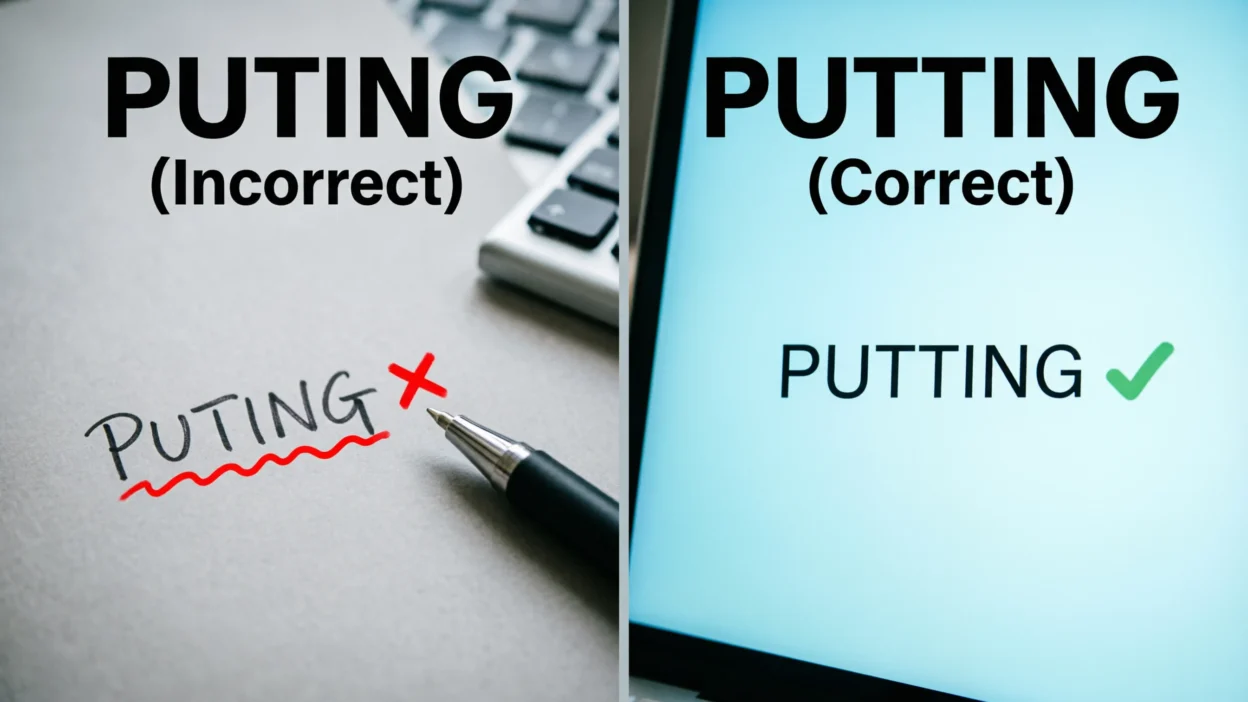
Quick Answer: Puting vs Putting
- ❌ Puting = Incorrect
- ✅ Putting = Correct
The correct spelling is putting (with double “t”).
Why Is “Putting” Spelled With Double T?
The verb put follows a common English spelling rule when adding -ing:
When a verb ends in:
- One vowel + one consonant
- And the final syllable is stressed
👉 You double the final consonant before adding -ing.
Since put ends in:
- One vowel (u)
- One consonant (t)
It becomes:
- Put + ing → Putting
This is called the consonant doubling rule.
Examples of “Putting” in Sentences
Here are common examples of correct usage:
- She is putting the books on the shelf.
- I’m putting my phone on silent.
- They are putting effort into the project.
- He keeps putting things off.
All of these require the double “t.”
Why “Puting” Is Incorrect
The spelling puting ignores the consonant doubling rule.
Incorrect:
- She is puting on her jacket.
Correct:
- She is putting on her jacket.
Even though it may look simpler, it is grammatically wrong in standard English.
Spell check tools usually catch this mistake, but not always.
Understanding the Consonant Doubling Rule
Here are other verbs that follow the same rule:
| Base Verb | + ing Form |
|---|---|
| Run | Running |
| Sit | Sitting |
| Get | Getting |
| Put | Putting |
| Stop | Stopping |
Each ends with:
- One vowel
- One consonant
So the consonant doubles.
Exceptions to the Rule
Not all verbs double the final consonant.
For example:
- Read → Reading (no doubling)
- Cook → Cooking (two consonants already)
- Open → Opening (more than one syllable, stress not on last syllable)
The doubling mainly happens in short, single-syllable verbs.
Putting vs Pudding: Don’t Confuse Them
Another common mix-up is:
- Putting (verb form of put)
- Pudding (a dessert)
Example:
- I am putting the spoon down.
- I am eating chocolate pudding.
They look similar but mean completely different things.
Putting in Different Contexts
1. Everyday Actions
- She’s putting on her shoes.
- I’m putting my keys in my bag.
2. Idiomatic Expressions
- Putting off (delaying)
- Putting up with (tolerating)
- Putting together (assembling)
- Putting out (extinguishing)
Example:
- Stop putting off your homework.
- I can’t keep putting up with this behavior.
3. Sports: Golf
In golf, putting refers to gently hitting the ball toward the hole.
Example:
- His putting skills are excellent.
Even here, the spelling always uses double “t.”
American vs British English Differences
Good news: There is no spelling difference between American and British English.
Both use:
- Putting (correct)
- “Puting” is incorrect in both dialects.
The spelling rule is universal across English variants.
Common Mistakes to Avoid
1. Forgetting the Double T
Incorrect:
- I’m puting my bag down.
Correct:
- I’m putting my bag down.
2. Typing Quickly and Skipping a Letter
This often happens in informal texting or fast typing.
3. Overcorrecting
Sometimes people mistakenly think every verb needs doubling. That’s not true. Only short vowel + single consonant verbs typically follow this rule.
Memory Trick to Remember
Think of it this way:
Put is short.
It needs extra support.
So it gets an extra “t.”
Or remember:
Short word → double the final consonant before -ing.
Frequently Asked Questions
Is “puting” ever correct?
No. It is always incorrect in standard English spelling.
Why do we double the “t” in putting?
Because of the consonant doubling rule for short verbs ending in vowel + consonant.
Does this rule apply to all verbs?
No. It mainly applies to short, single-syllable verbs with one vowel followed by one consonant.
Is “putting” used in formal writing?
Yes. It is completely standard in both formal and informal English.
Is the spelling different in British English?
No. Both American and British English use “putting.”
Why is English spelling so inconsistent?
English has evolved from multiple language influences (Germanic, Latin, French), which makes spelling rules complex.
Final Summary: Puting vs Putting
The correct spelling is putting, with two “t’s.” The form “puting” is incorrect and does not follow standard English spelling rules.
The double “t” follows the consonant doubling rule used for short verbs ending in a vowel plus a consonant.
Whether you’re writing an email, essay, blog post, or message, always use putting. It’s a small detail, but getting it right improves your writing instantly.
Actionable Takeaway
Before writing:
- Check if the verb ends in one vowel + one consonant.
- If yes, double the consonant before adding -ing.
- Remember: Put → Putting (double “t”).
Master this rule once, and you’ll avoid dozens of common spelling mistakes.

Narelle Merindah is a passionate author committed to delivering thoughtful, engaging, and well-structured content. With a keen eye for detail and a love for storytelling, Narelle creates informative articles that resonate with readers. Her dedication to clarity, creativity, and authenticity ensures meaningful and impactful writing.