If you’ve ever paused mid-sentence and wondered whether it’s “take effect” or “take affect,” you’re not alone. These two phrases sound identical when spoken, which makes them easy to confuse in writing.
In this complete guide, we’ll explain the correct phrase, define both words clearly, provide examples, highlight common mistakes, compare American vs British English usage, and answer frequently asked questions. By the end, you’ll know exactly which one to use and why.
Quick Answer: Take Effect vs Take Affect
- ✅ Take effect = Correct
- ❌ Take affect = Incorrect
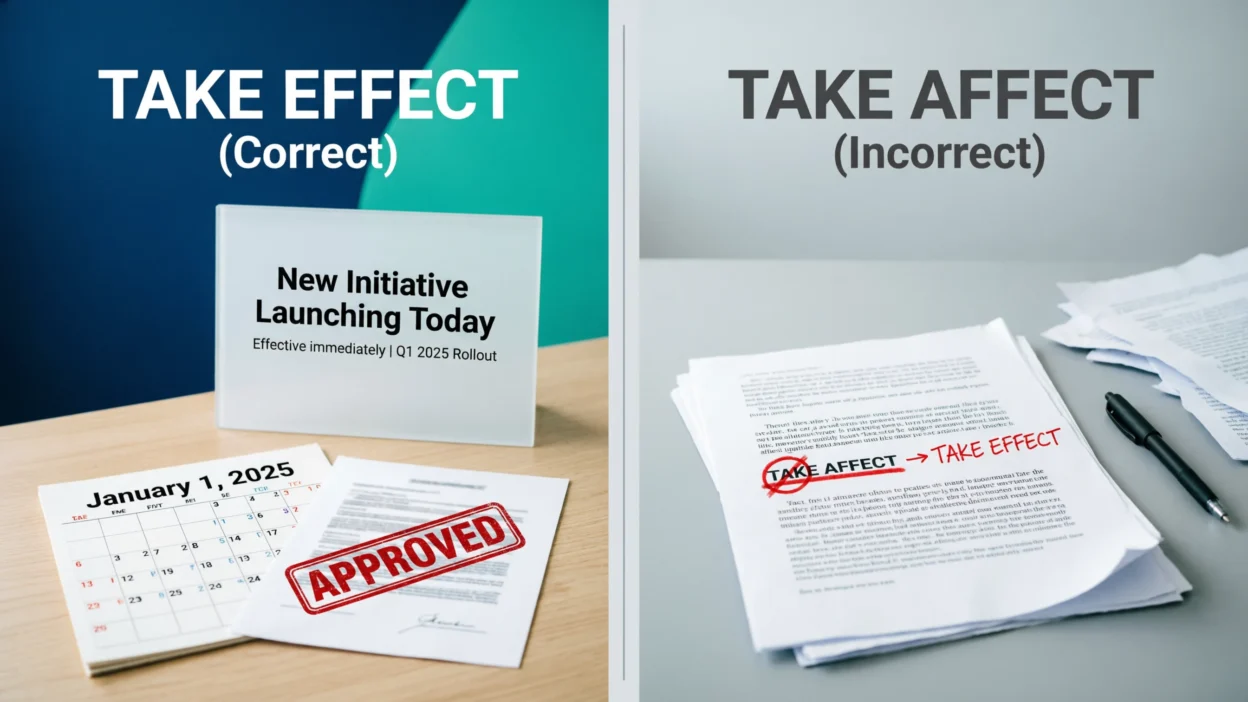
The correct phrase is “take effect.”
It means: to become active, operational, valid, or start producing results.
What Does “Take Effect” Mean?
Take effect is a verb phrase that means something officially begins or starts to produce a result.
It’s commonly used with:
- Laws
- Policies
- Rules
- Medications
- Changes
- Decisions
Simple Definition
Take effect: To begin to work, apply, or produce a result.
Examples of “Take Effect”
- The new law will take effect next month.
- The policy changes take effect immediately.
- The medicine should take effect within 30 minutes.
- The updated pricing will take effect on January 1st.
In all these examples, something is beginning to operate or produce results.
Why “Take Affect” Is Incorrect
The word affect is typically a verb meaning “to influence.”
Examples of affect (correct usage):
- Stress can affect your health.
- Weather may affect travel plans.
- The decision affected everyone.
But in the phrase “take effect,” we need a noun, not a verb.
So:
❌ The rule will take affect tomorrow.
✅ The rule will take effect tomorrow.
Understanding Affect vs Effect
This confusion usually comes from mixing up affect and effect in general.
Here’s a clear breakdown:
| Word | Part of Speech | Meaning | Example |
|---|---|---|---|
| Affect | Usually a verb | To influence | The noise affected my sleep |
| Effect | Usually a noun | A result or outcome | The change had a positive effect |
Memory trick:
- Affect = Action (both start with A)
- Effect = End result
In “take effect,” we’re referring to the result or activation of something—so we use effect.
When Do We Use “Take Effect”?
1. Laws and Regulations
- The new tax rules will take effect next year.
- The ban takes effect immediately.
2. Contracts and Agreements
- This agreement shall take effect upon signing.
- The terms take effect once payment is received.
3. Medicine and Treatment
- The painkiller should take effect soon.
- The vaccine will take effect after two weeks.
4. Policy or Workplace Changes
- The new dress code takes effect Monday.
- Salary adjustments will take effect next quarter.
It’s a very common phrase in formal, legal, medical, and professional contexts.
Common Mistakes to Avoid
1. Writing “Take Affect” in Formal Documents
Because both words sound the same, spell check may not catch the error.
Incorrect:
- The changes will take affect immediately.
Correct:
- The changes will take effect immediately.
2. Confusing It With “Affect Change”
Here’s something interesting:
- Affect change (verb + noun) is correct in formal writing.
- The organization aims to affect change.
But:
- Take affect is incorrect.
- Take effect is correct.
3. Assuming “Affect” Can Work as a Noun Here
Although “affect” can be a noun in psychology (referring to emotional expression), that meaning does not apply in this phrase.
American vs British English Differences
Good news: There is no spelling difference between American and British English for this phrase.
Both use:
- Take effect (correct)
- “Take affect” is incorrect in both dialects.
Usage and meaning remain the same across regions.
Related Phrases and Synonyms
If you want alternatives to “take effect,” consider:
- Come into effect
- Go into effect
- Become effective
- Become active
- Be implemented
- Start operating
Example:
- The law will go into effect next month.
- The changes will be implemented soon.
Real-Life Usage Examples
In Legal Writing
- This contract shall take effect upon signature.
In Corporate Communication
- The restructuring plan takes effect immediately.
In Government Announcements
- The emergency measures will take effect tonight.
In Healthcare
- The medication may take effect within an hour.
It’s a highly practical phrase used in everyday professional communication.
FAQs About Take Effect vs Take Affect
1. Is “take affect” ever correct?
No. It is grammatically incorrect in standard English.
2. Why do people confuse effect and affect?
Because they sound identical and both are real words.
3. What does “take effect” mean exactly?
It means to begin working, operating, or producing results.
4. Can “effect” ever be a verb?
Yes, in formal contexts.
Example:
- The company plans to effect change.
But that is different from “take effect.”
5. Is “take effect” formal?
It’s commonly used in formal and professional writing but also appears in everyday language.
6. What’s an easy way to remember the correct phrase?
Remember: If something starts working, it creates an effect.
Final Summary: Take Effect vs Take Affect
The correct phrase is “take effect.” It means something begins to operate, apply, or produce results. The version “take affect” is grammatically incorrect because “affect” is usually a verb, and the phrase requires a noun.
Understanding the difference between affect and effect eliminates one of the most common writing mistakes in English.
Whether you’re drafting a contract, writing an email, or explaining a policy, always choose take effect.
Actionable Takeaway
Before using the phrase:
- Ask: Is something starting to work or apply? → Use take effect
- Remember: Affect = Action, Effect = End result
- Double-check formal documents for this common mistake
Master this distinction, and your writing will immediately sound clearer and more professional.

Narelle Merindah is a passionate author committed to delivering thoughtful, engaging, and well-structured content. With a keen eye for detail and a love for storytelling, Narelle creates informative articles that resonate with readers. Her dedication to clarity, creativity, and authenticity ensures meaningful and impactful writing.