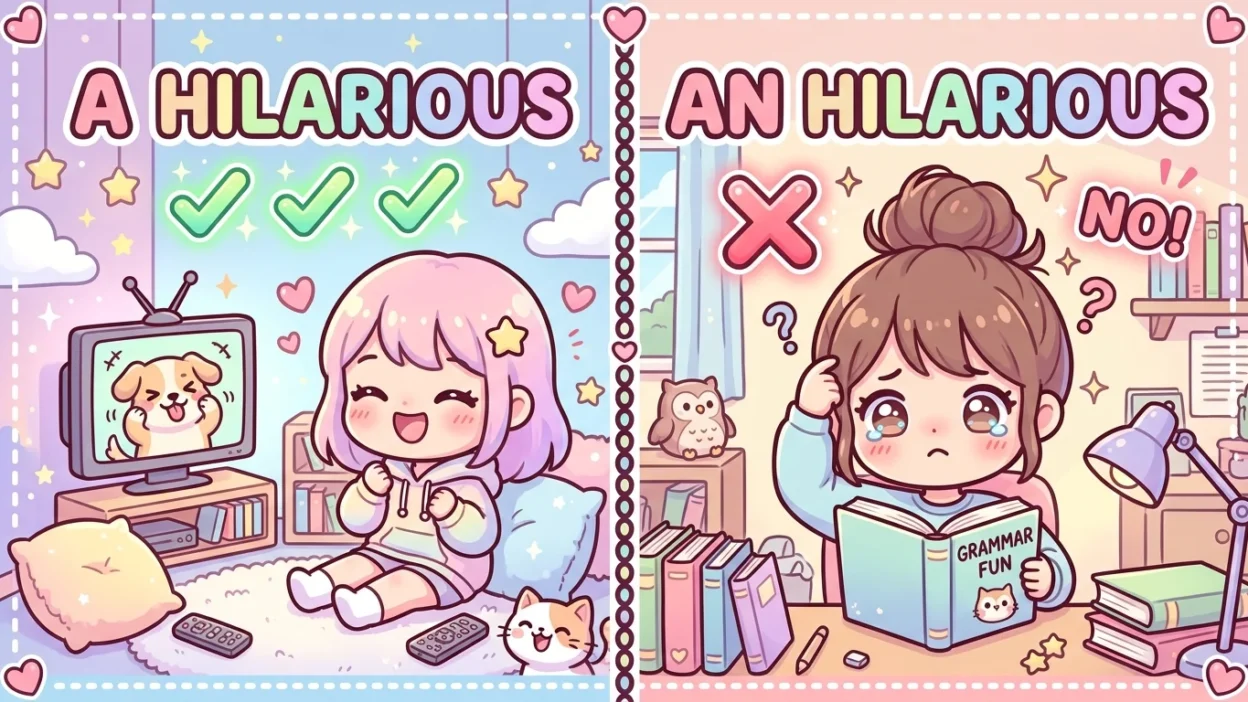
Many English learners feel confused between “an hilarious” and “a hilarious.” Since the word “hilarious” starts with the letter H, some people think “an” should come before it. However, English articles depend on sound, not just spelling.
So, if you want natural and grammatically correct English, you need to know which form sounds right. In this guide, you’ll learn the rule, examples, and an easy trick to remember it.
Quick Answer
✨ Here’s the simple rule:
- ✅ A hilarious = correct
- ❌ An hilarious = usually incorrect in modern English
👉 Easy trick:
- Use “a” before words starting with a clear H sound
🌟 Examples:
- That was a hilarious joke. ✔
- That was an hilarious joke. ❌
Why “A Hilarious” Is Correct
First of all, “hilarious” begins with a strong H sound (“hi-LAIR-ee-us”). Therefore, English uses “a” before it.
👉 Because:
- A comes before consonant sounds
- Hilarious starts with the consonant sound /h/
Correct Examples:
- She told a hilarious story.
- It was a hilarious movie.
- He made a hilarious comment.
👉 So, in modern English, “a hilarious” is the natural and correct choice.
Why “An Hilarious” Sounds Incorrect
On the other hand, “an” normally comes before vowel sounds, not strong H sounds.
Examples of Correct “An” Usage:
- An apple ✔
- An hour ✔ (silent H)
However:
- An hilarious joke ❌ sounds unnatural today
👉 Because the H in “hilarious” is pronounced clearly.
Key Difference Between “A Hilarious” and “An Hilarious”
| Phrase | Correctness | Reason |
|---|---|---|
| A hilarious | ✅ Correct | Strong H sound |
| An hilarious | ❌ Usually incorrect | “An” needs vowel sound |
Common Mistakes to Avoid
Even though the rule seems simple, many learners still make mistakes. So, let’s fix them:
❌ Incorrect:
- It was an hilarious scene.
✔ Correct: It was a hilarious scene.
❌ Incorrect:
- She shared an hilarious meme.
✔ Correct: She shared a hilarious meme.
👉 So, always listen to the sound, not just the first letter.
Easy Trick to Remember
Whenever you feel unsure, remember:
- A → consonant sound
- An → vowel sound
👉 Since hilarious starts with a clear H sound, use:
- A hilarious
Because of this trick, you will choose correctly every time.
American vs British English
Interestingly, modern American and British English both strongly prefer “a hilarious.” Although older British English sometimes used “an” before H words, that style now sounds outdated in most situations.
Real-Life Examples
In Daily Life:
- That was a hilarious video.
- He gave a hilarious response.
In Entertainment:
- We watched a hilarious comedy.
- She wrote a hilarious caption.
Why This Matters
Although this looks like a tiny grammar detail, correct article usage improves fluency a lot. When you choose the right article:
- You sound more natural
- You improve readability
- You avoid awkward phrasing
As a result, your English becomes smoother and more confident.
FAQs
Which is correct: an hilarious or a hilarious?
“A hilarious” is correct in modern English.
Why is an hilarious incorrect?
Because “hilarious” starts with a clear H consonant sound.
Does English use a or an based on spelling?
No, English chooses articles based on sound.
Why do we say an hour but a hilarious?
Because “hour” has a silent H, while “hilarious” has a pronounced H.
Is an hilarious old-fashioned?
Yes, it sounds outdated in modern English.
What is the easiest way to remember this?
Listen to the sound—clear H sound means use “a.”
Final Thoughts
Now you clearly understand that “a hilarious” is the correct and natural form, while “an hilarious” sounds outdated and incorrect in modern English.
Because of this simple sound rule, you can avoid a very common article mistake easily.
As you continue practicing, you will naturally choose the correct article without hesitation. So, instead of guessing, you will speak and write clearly every time.

Euroa Alinta is a dedicated author known for crafting engaging and insightful content. With a strong passion for storytelling and digital publishing, Euroa specializes in creating informative, reader-friendly articles. Her work reflects creativity, clarity, and authenticity, connecting audiences with meaningful ideas across diverse topics and interests.