
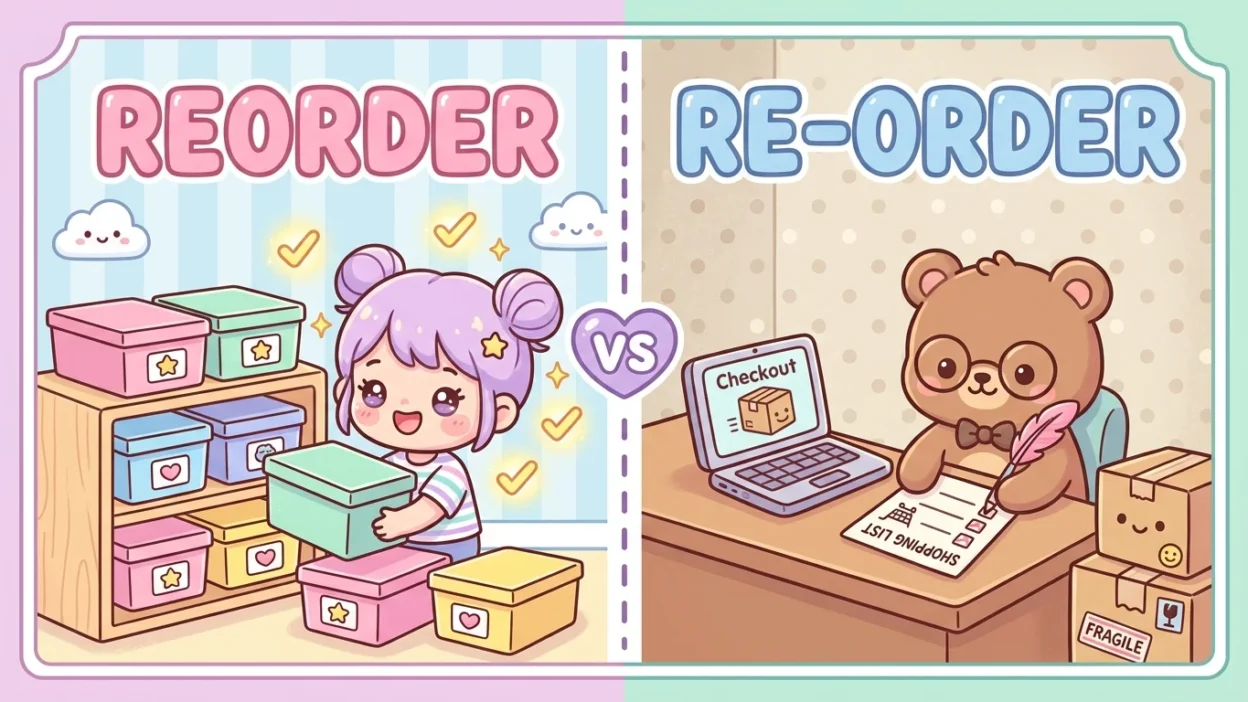
Many writers feel confused between “reorder” and “re-order.” Since both versions appear online, choosing the correct spelling can feel tricky.
However, modern English usually prefers one form over the other.
So, if you want clean and professional writing, you need to know which spelling works best. In this guide, you’ll learn the difference, examples, and the easiest way to remember the correct form.
Quick Answer
✨ Here’s the simple rule:
- ✅ Reorder = preferred modern spelling
- ✅ Re-order = older or less common variation
👉 Easy trick:
- Modern English usually removes unnecessary hyphens
🌟 Examples:
- Please reorder the items. ✔
- Please re-order the items. ✔ (less common)
What Does “Reorder” Mean?
First of all, “reorder” means to arrange again or order again. Therefore, people use it in shopping, organization, and planning.
Common Uses:
- Buying again
- Rearranging items
- Organizing differently
Examples:
- I need to reorder these products.
- Please reorder the list alphabetically.
- She reordered the files.
👉 So, in modern writing, “reorder” is the standard spelling.
Why “Re-Order” Is Less Common
On the other hand, “re-order” is not wrong. However, modern English often drops hyphens in common words over time.
👉 Because:
- Language becomes simpler
- Dictionaries now prefer closed forms like “reorder”
Correct but Less Preferred:
- Re-order ✔
- Reorder ✔✔
When a Hyphen Might Still Appear
Sometimes, writers still use a hyphen for:
- Extra clarity
- Formal style
- Avoiding awkward reading
Example:
- The manager asked them to re-order the sequence.
👉 However, most modern style guides still prefer “reorder.”
Key Differences Between “Reorder” and “Re-Order”
| Feature | Reorder | Re-Order |
|---|---|---|
| Correctness | ✅ Preferred | ✅ Acceptable |
| Style | Modern | Older/traditional |
| Common Usage | Very common | Less common |
| Readability | Cleaner | More formal-looking |
Common Mistakes to Avoid
Even though both forms are correct, inconsistency can confuse readers. So, let’s simplify it:
⚠ Less Modern:
- I will re-order the package.
✔ Better: I will reorder the package.
⚠ Inconsistent Writing:
- Using both spellings in one article ❌
👉 So, choose one style and stay consistent.
Easy Trick to Remember
Whenever you feel unsure, remember:
- Modern English loves simpler closed words
👉 Examples:
- Rebuild
- Reuse
- Reorder
Because of this pattern, you will naturally choose the preferred spelling.
American vs British English
Interestingly, both American and British English prefer “reorder.” However, British English sometimes keeps hyphens slightly more often in formal writing.
Real-Life Examples
In Shopping:
- I need to reorder the supplies.
- They reordered the product online.
In Organization:
- Please reorder the paragraphs.
- She reordered the photos.
Why This Matters
Although this looks like a tiny spelling detail, consistency improves readability a lot. When you use the preferred spelling:
- You sound more modern
- You improve clarity
- You avoid unnecessary punctuation
As a result, your writing becomes smoother and more professional.
FAQs
Which is correct: reorder or re-order?
Both are correct, but “reorder” is more common and preferred today.
Is re-order wrong?
No, it is acceptable but less modern.
Why does English remove hyphens?
Modern English often simplifies commonly used words.
Which spelling sounds more professional?
“Reorder” usually looks cleaner and more modern.
Is reorder used in US and UK English?
Yes, both use it widely.
What is the easiest way to remember this?
Modern English prefers fewer hyphens, so choose “reorder.”
Final Thoughts
Now you clearly understand that “reorder” is the preferred modern spelling, while “re-order” remains an acceptable but less common variation.
Because of this simple rule, you can write more naturally and consistently.
As you continue practicing, you will naturally choose the cleaner modern form without hesitation. So, instead of guessing, you will write correctly and confidently every time.