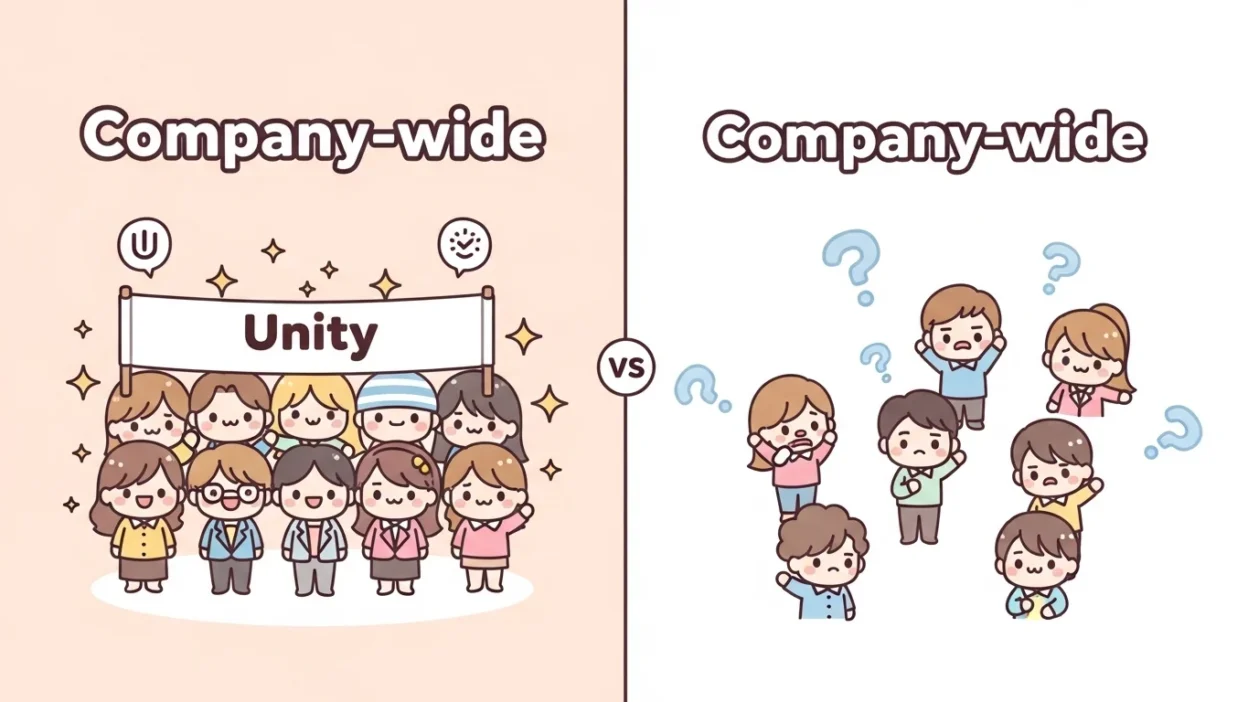
Many writers pause at “company-wide” vs “companywide.” Both forms appear in real writing, so confusion makes sense. However, one form works better in most situations, especially when you want clarity and a polished tone.
So, if you want clean, professional English, you need a simple rule. In this guide, you’ll learn the difference, see examples, and choose the right form every time.
Quick Answer
✨ Here’s the simple rule:
- ✅ “Company-wide” = preferred and most common
- ⚠️ “Companywide” = acceptable but less common
👉 Easy trick:
- Add a hyphen for clarity → company-wide
🌟 Examples:
- The company-wide meeting starts at 10. ✔
- The companywide meeting starts at 10. ⚠️ (okay, but less clear)
What Does “Company-wide” Mean?
First of all, “company-wide” means something that affects the entire company. Therefore, people use it often in business and workplace communication.
Common Uses:
- Meetings and announcements
- Policies and updates
- Changes affecting all employees
Examples:
- The company-wide policy improves safety.
- They announced a company-wide holiday.
- We held a company-wide meeting.
👉 So, whenever something applies to everyone in a company, you should use “company-wide.”
What About “Companywide”?
On the other hand, “companywide” carries the same meaning but appears less frequently. Some modern styles accept it, especially in informal writing.
👉 Because:
- Language evolves, and closed compounds sometimes appear
- However, clarity still favors the hyphenated form
Examples:
- They announced a companywide update. (acceptable)
👉 So, although it works, most writers still prefer “company-wide.”
Key Differences Between “Company-wide” and “Companywide”
| Feature | Company-wide | Companywide |
|---|---|---|
| Correctness | ✅ Preferred | ⚠️ Acceptable |
| Clarity | High | Slightly lower |
| Usage | Formal & standard | Informal/modern |
| Example | Company-wide policy | Companywide policy |
Common Mistakes to Avoid
Even though both forms exist, mistakes still happen. So, let’s fix them:
❌ Less Clear:
- We had a companywide meeting.
✔ Better: We had a company-wide meeting.
❌ In Formal Writing:
- Companywide changes are coming.
✔ Better: Company-wide changes are coming.
👉 So, always choose clarity first.
Easy Trick to Remember
Whenever you feel unsure, remember:
- Wide = needs a hyphen when combined
- So, write company-wide
Because of this trick, you will avoid confusion instantly.
American vs British English
Interestingly, both American and British English prefer “company-wide.” Although “companywide” appears occasionally, the hyphenated version remains more standard.
Real-Life Examples
In Business:
- The company-wide strategy improved performance.
- They introduced company-wide training.
In Daily Work:
- A company-wide email was sent.
- Everyone joined the company-wide event.
Why This Matters
Although this looks like a small formatting choice, it matters more than you think. When you use the correct form:
- You improve readability
- You sound more professional
- You avoid confusion
As a result, your writing becomes cleaner and more effective.
FAQs
Which is correct: company-wide or companywide?
“Company-wide” is preferred, while “companywide” is acceptable but less common.
Why is company-wide better?
Because the hyphen improves clarity and readability.
Can I use companywide in formal writing?
You can, but “company-wide” sounds more standard.
Do both mean the same?
Yes, both refer to something affecting the entire company.
Is company-wide used in US and UK English?
Yes, both prefer the hyphenated form.
What is the easiest way to remember this?
Think “wide needs a hyphen,” so use company-wide.
Final Thoughts
Now you clearly understand the difference between “company-wide” and “companywide.”
While both forms carry the same meaning, “company-wide” remains the clearer and more widely accepted choice. Because of this, you should prefer it in most writing situations.
As you keep practicing, you will naturally choose the better form without hesitation. So, instead of guessing, you will write clearly and confidently every time.

Narelle Merindah is a passionate author committed to delivering thoughtful, engaging, and well-structured content. With a keen eye for detail and a love for storytelling, Narelle creates informative articles that resonate with readers. Her dedication to clarity, creativity, and authenticity ensures meaningful and impactful writing.