
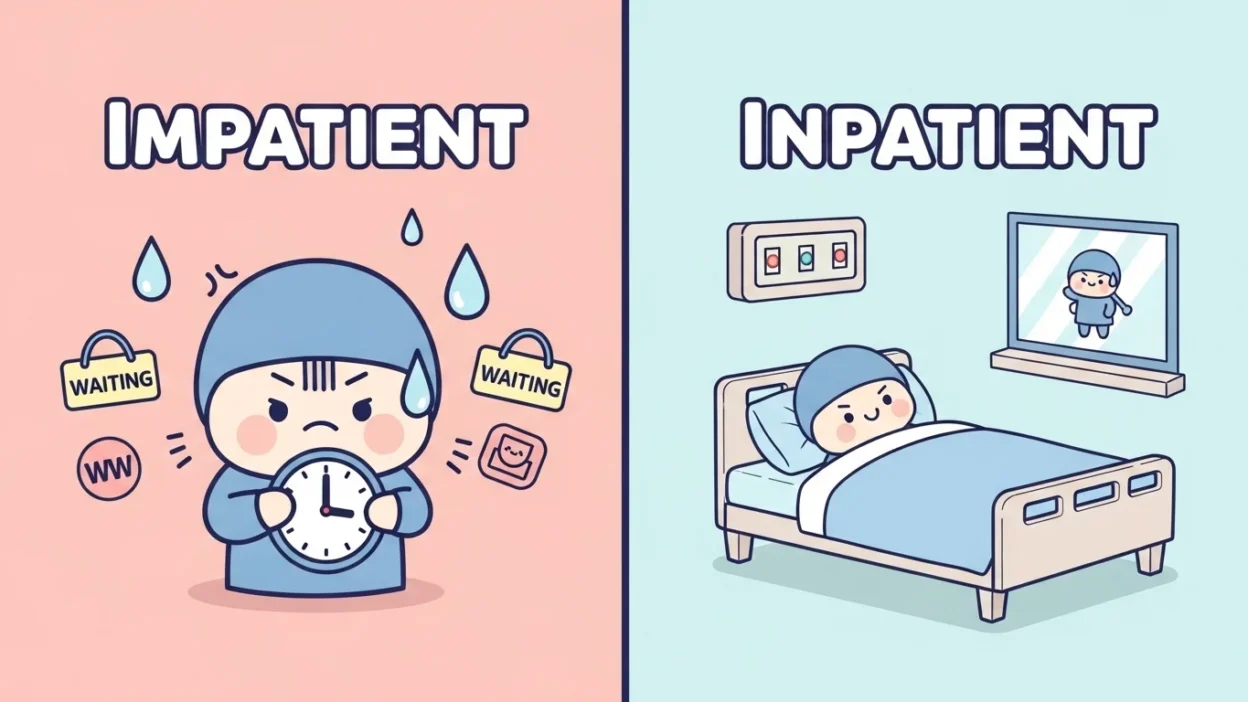
Many learners confuse “impatient” and “inpatient” because they look almost identical.
However, they carry completely different meanings, so using the wrong one can quickly change your sentence and confuse readers.
So, if you want to write clearly and confidently, you need to understand this small but important difference. In this guide, you’ll learn the meanings, examples, and easy tricks to use each word correctly.
Quick Answer
✨ Let’s make it super simple:
- Use “impatient” when you describe someone who cannot wait or feels restless
- Use “inpatient” when you talk about a person staying in a hospital for treatment
👉 Easy trick:
- Impatient = no patience
- Inpatient = in hospital
🌟 Examples:
- She felt impatient during the delay.
- The doctor treated an inpatient.
What Does “Impatient” Mean?
First of all, “impatient” describes a feeling. In other words, it shows that someone feels annoyed or restless because they must wait.
Common Uses:
- Emotions and behavior
- Waiting situations
- Frustration
Examples:
- He became impatient in the long queue.
- She felt impatient waiting for results.
- Kids often get impatient quickly.
👉 So, whenever someone cannot wait calmly, you should use “impatient.”
What Does “Inpatient” Mean?
On the other hand, “inpatient” refers to a person who stays in a hospital for medical care. Therefore, it belongs to healthcare context.
Common Uses:
- Hospitals and clinics
- Medical treatment
- Patient care
Examples:
- The hospital admitted the inpatient.
- Doctors monitored each inpatient carefully.
- The inpatient received daily treatment.
👉 So, whenever you talk about someone inside a hospital, you should use “inpatient.”
Key Differences Between “Impatient” and “Inpatient”
| Feature | Impatient | Inpatient |
|---|---|---|
| Meaning | No patience | Hospital patient |
| Context | Emotions | Medical |
| Usage | Daily life | Healthcare |
| Example | Impatient person | Inpatient care |
Common Mistakes to Avoid
Even though the difference is clear, many people still mix them up. So, let’s fix common mistakes:
❌ Incorrect:
- The impatient stayed in the hospital.
✔ Correct: The inpatient stayed in the hospital.
👉 Because it refers to a patient.
❌ Incorrect:
- She felt inpatient while waiting.
✔ Correct: She felt impatient while waiting.
👉 Because it describes emotion.
Easy Trick to Remember
Whenever you feel confused, try this:
- Talking about feelings or waiting? → Use impatient
- Talking about hospital care? → Use inpatient
Because of this simple trick, you can quickly choose the right word.
American vs British English
Interestingly, both American and British English use these words the same way. So, you don’t need to worry about regional differences.
- Impatient behavior ✔
- Inpatient treatment ✔
Real-Life Examples
In Daily Life:
- He grew impatient during the delay.
- She sounded impatient on the call.
In Healthcare:
- The inpatient received proper care.
- Doctors checked every inpatient daily.
Why This Difference Matters
Although these words look similar, they create completely different meanings. So, when you choose correctly:
- You avoid confusion
- You improve clarity
- You sound more natural
As a result, your writing becomes stronger and more professional.
FAQs
What is the difference between impatient and inpatient?
“Impatient” describes lack of patience, while “inpatient” refers to a hospital patient.
Which is correct: impatient or inpatient while waiting?
“Impatient” is correct because it describes a feeling.
Can inpatient describe emotion?
No, it only refers to someone receiving hospital care.
Why do people confuse these words?
Because they look and sound very similar.
Is impatient always negative?
Usually yes, because it shows frustration or restlessness.
What is the easiest way to remember this?
Think “impatient” for feelings and “inpatient” for hospital.
Final Thoughts
Now you clearly understand the difference between “impatient” and “inpatient.”
While one describes a feeling of restlessness, the other refers to a person receiving medical care. Because of this difference, choosing the correct word becomes simple.
As you continue practicing, you will naturally pick the right word without confusion. So, instead of guessing, you will write clearly and confidently every time.

Narelle Merindah is a passionate author committed to delivering thoughtful, engaging, and well-structured content. With a keen eye for detail and a love for storytelling, Narelle creates informative articles that resonate with readers. Her dedication to clarity, creativity, and authenticity ensures meaningful and impactful writing.