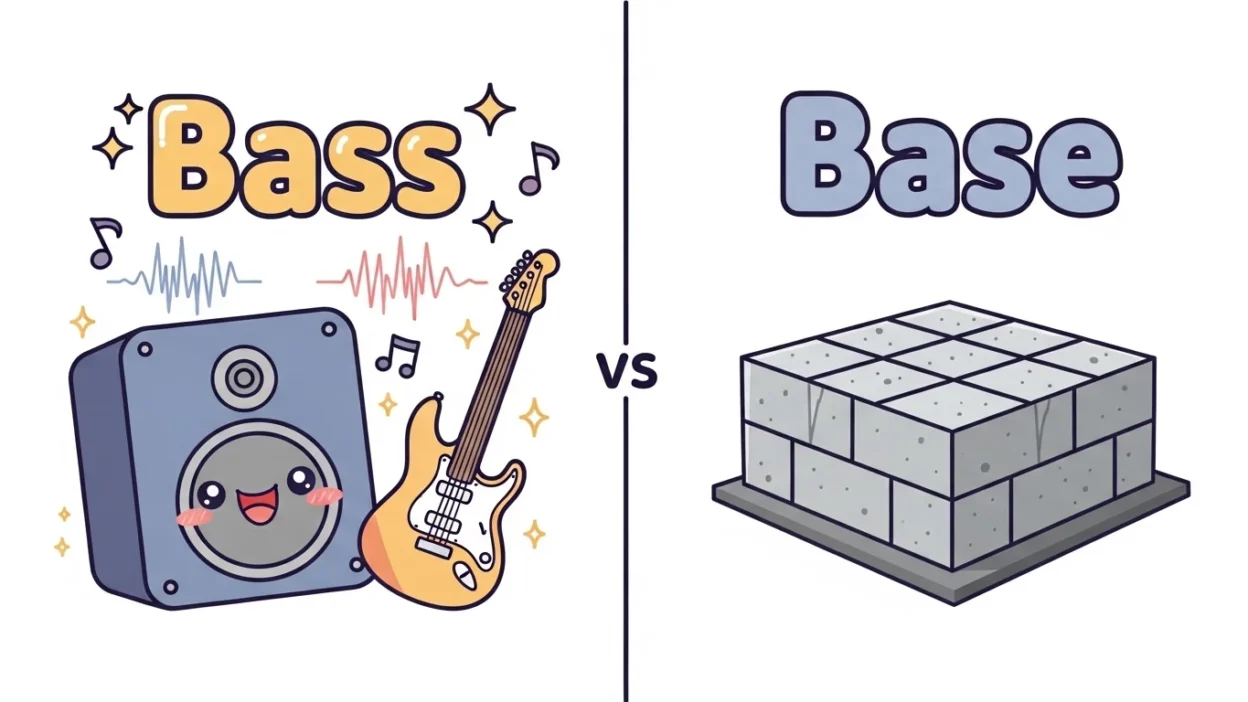
Many writers confuse “bass” and “base” because they sound similar. However, their meanings differ completely, so using the wrong one can quickly confuse your reader.
So, if you want to write clearly and avoid awkward mistakes, you need to understand how each word works. I
n this guide, you’ll learn the exact difference, see simple examples, and remember the correct usage بسهولة.
Quick Answer
✨ Here’s the quickest way to understand:
- Use “bass” when you talk about music (low sound) or a type of fish
- Use “base” when you talk about foundation, bottom, or starting point
👉 Easy memory trick:
- Bass = sound (music)
- Base = bottom (foundation)
🌟 Examples:
- I love deep bass in songs.
- This table has a strong base.
What Does “Bass” Mean?
First of all, “bass” mainly relates to music and sound. It refers to low-frequency tones that you feel more than hear.
Common Uses:
- Music and audio
- Instruments (like bass guitar)
- Fish species
Examples:
- The speaker produces strong bass.
- He plays the bass guitar.
- They caught a large bass in the lake.
👉 So, whenever you talk about deep sound or fish, you should use “bass.”
What Does “Base” Mean?
On the other hand, “base” refers to a foundation, bottom, or starting point. It appears in many contexts, so it’s more commonly used in everyday English.
Common Uses:
- Foundation or support
- Starting level
- Military or business locations
Examples:
- The statue stands on a solid base.
- We need a strong base for success.
- The team returned to their base.
👉 So, whenever you mean foundation or bottom, you should use “base.”
Key Differences Between “Bass” and “Base”
| Feature | Bass | Base |
|---|---|---|
| Meaning | Low sound or fish | Foundation or bottom |
| Context | Music, audio, nature | General, structure, ideas |
| Pronunciation | “Baas” (long sound) | “Bays” |
| Example | Bass in music | Base of a building |
Common Mistakes to Avoid
Even though the difference seems clear, many learners still mix them up. So, let’s fix common errors:
❌ Incorrect:
- The base in this song sounds amazing.
✔ Correct: The bass in this song sounds amazing.
👉 Because it refers to sound.
❌ Incorrect:
- This chair has a strong bass.
✔ Correct: This chair has a strong base.
👉 Because it refers to structure.
❌ Confusion:
- He plays base guitar.
✔ Correct: He plays bass guitar.
👉 Always use bass for music.
Easy Trick to Remember
Whenever you feel unsure, try this:
- Talking about music or fish? → Use bass
- Talking about foundation or bottom? → Use base
Because of this trick, you can quickly avoid confusion.
American vs British English
Interestingly, both American and British English follow the same rules. So, you don’t need to worry about regional differences.
- Bass guitar ✔
- Base structure ✔
However, pronunciation may vary slightly, but meaning stays the same.
Real-Life Examples
In Music:
- The bass makes the song powerful.
- She adjusted the bass on her headphones.
In Structure:
- The lamp has a heavy base.
- This plan builds a strong base for growth.
In Daily Life:
- He caught a bass while fishing.
- The base of the mountain looks wide.
Why This Difference Matters
Although these words sound similar, they create completely different meanings. So, when you choose the correct word:
- You avoid confusion
- You improve clarity
- You sound more natural
As a result, your writing becomes stronger and more professional.
FAQs
What is the difference between bass and base?
“Bass” relates to music or fish, while “base” refers to a foundation or bottom.
Which is correct: bass or base in music?
“Bass” is correct because it refers to low sound.
Can base be used in music?
No, “base” does not relate to sound in music.
Why do people confuse bass and base?
Because they sound similar but have different meanings.
Is bass only used for music?
No, it also refers to a type of fish.
What is the easiest way to remember this?
Think “bass” for sound and “base” for bottom.
Final Thoughts
Now you clearly understand the difference between “bass” and “base.” While one connects to music and sound, the other relates to structure and foundation. Because of this difference, choosing the correct word becomes much easier.
As you practice more, you will naturally pick the right word without thinking twice. So, instead of guessing, you will write with clarity and confidence every time.

Narelle Merindah is a passionate author committed to delivering thoughtful, engaging, and well-structured content. With a keen eye for detail and a love for storytelling, Narelle creates informative articles that resonate with readers. Her dedication to clarity, creativity, and authenticity ensures meaningful and impactful writing.