If you are choosing between invision and envision, the correct word in standard English is usually envision. Because the two spellings sound similar, especially in quick speech, writers sometimes type invision when they actually mean envision. However, their status in ordinary English is not the same.
Envision is a verb that means to imagine, picture, or mentally visualize something, especially a future possibility. For example, you can say, “I envision a successful future.” Likewise, a company might envision expanding into new markets.
Meanwhile, invision is not the standard spelling of this verb. However, InVision can appear as a proper name or brand name, so you may encounter it with capitalization in specific contexts. Therefore, when you mean imagine or picture something mentally, choose envision.
Quick Answer: Invision or Envision?
Envision is the correct standard English verb when you mean to imagine, visualize, or form a mental picture of something. For example, write “She envisions a better future.” Invision is generally incorrect for this meaning, although InVision may appear as a proper name or brand.
Why Do People Confuse Invision and Envision?
People primarily confuse invision and envision because the words can sound very similar in natural speech.
When people hear envision, they may associate its first syllable with the familiar word in. Consequently, they may assume that the spelling begins with in-.
Moreover, the word relates closely to vision, which can make in + vision look logical. After all, envisioning something involves creating a kind of mental vision.
However, English spelling does not always follow the structure that initially seems most obvious.
The standard verb is:
envision
Therefore:
envision ✓
invision ✗ for the ordinary verb meaning imagine
Additionally, proper names can complicate matters because you may encounter InVision with capitalization. Nevertheless, a proper name does not change the spelling of the standard verb envision.
What Does Envision Mean?
Envision means to imagine something, picture it mentally, or think about a future situation as if you could see it.
For example:
“She envisions herself running a successful business.”
Here, she mentally pictures herself becoming a successful business owner.
Similarly:
“The architect envisioned a bright, open living space.”
In this sentence, the architect formed a mental picture of the space before it existed.
Therefore, envision often appears when discussing:
- future plans
- possibilities
- goals
- designs
- imagined situations
- desired outcomes
- long-term changes
- creative ideas
For instance:
“Can you envision living here?”
The question asks whether you can mentally picture yourself living in that place.
Is Invision a Word?
If you mean to imagine or visualize something, invision is not the standard spelling. Instead, use envision.
Incorrect:
❌ I invision myself becoming a doctor.
Correct:
✅ I envision myself becoming a doctor.
Likewise:
❌ They invision a brighter future.
Correct:
✅ They envision a brighter future.
However, you may encounter InVision as a proper name. Proper names follow their own capitalization and spelling conventions.
Therefore, avoid making the overly broad claim that the letter sequence InVision can never appear. Instead, remember that in ordinary English prose, the verb meaning “imagine” is envision.
Invision vs Envision: Comparison Table
| Feature | Envision | Invision |
|---|---|---|
| Standard English verb? | Yes | Generally no for this meaning |
| Means “imagine”? | Yes | No, use envision |
| Means “visualize mentally”? | Yes | No, use envision |
| Common in formal writing? | Yes | Not as the intended verb |
| Correct example | I envision a better future. | — |
| Common error | — | I invision a better future. ❌ |
| Can appear as a proper name? | Not relevant to the verb | InVision can |
| Best choice for “imagine” | Envision | Avoid |
Therefore, if your intended meaning involves mentally picturing something, envision is almost certainly the word you need.
When Should You Use Envision?
Use envision when you imagine, mentally picture, or anticipate something.
For example:
“I envision a peaceful future.”
Here, the speaker mentally pictures what that future could look like.
You can also use envision when discussing plans:
“The developers envision a larger community center.”
Likewise, you can use it when imagining yourself in a particular situation:
“She couldn’t envision herself living anywhere else.”
Therefore, envision works naturally when discussing both realistic plans and imagined possibilities.
When Should You Use Invision?
Do not use lowercase invision as a substitute for envision when you mean imagine, visualize, or mentally picture.
For example:
❌ I invision us working together.
Write:
✅ I envision us working together.
However, if InVision forms part of an official proper name, title, product name, or organization name, preserve that official spelling.
This distinction matters because a proper noun and an ordinary dictionary word follow different rules.
Therefore, remember:
Ordinary verb → envision
Specific proper name → use its official spelling
How Do You Use Envision in a Sentence?
You can use envision with a noun phrase:
“They envision a new future.”
You can also use it with an -ing construction:
“I envision working from home.”
Additionally, you can use envision + object + -ing:
“She envisions herself traveling around the world.”
Depending on the sentence, you can also describe what someone imagined:
“The designer envisioned the room as a relaxing space.”
Therefore, envision works flexibly in sentences about imagination, plans, and possibilities.
Invision or Envision: 18 Examples
Here are 18 natural examples using envision correctly:
- I envision a brighter future for our community.
- Can you envision yourself living in another country?
- She envisions becoming a successful entrepreneur.
- They envision a world with cleaner energy.
- We envision the project growing significantly next year.
- He envisioned a beautiful garden behind the house.
- The architect envisioned a spacious and modern building.
- I cannot envision life without my closest friends.
- The team envisions launching the product next year.
- She envisioned herself standing on the stage.
- The planners envision a safer city center.
- He envisions his business expanding internationally.
- We envisioned the room as a comfortable reading area.
- Can you envision how the finished design will look?
- The author envisioned an entirely fictional world.
- They envision technology making the process easier.
- I always envisioned myself working in a creative field.
- The organization envisions a more sustainable future.
In every example, envision relates to imagining, visualizing, or mentally considering something.
Incorrect vs Correct Examples
Consider these common spelling mistakes:
❌ I invision a better future.
✅ I envision a better future.
❌ She invisions herself becoming a teacher.
✅ She envisions herself becoming a teacher.
❌ We invisioned a completely different design.
✅ We envisioned a completely different design.
❌ Can you invision living there?
✅ Can you envision living there?
❌ They invision the company becoming successful.
✅ They envision the company becoming successful.
Therefore, changing in- to en- fixes the spelling when you intend the standard verb.
Common Mistakes With Envision
Mistake 1: Writing Invision
The most obvious mistake involves replacing en- with in-.
Incorrect:
❌ invision
Correct:
✅ envision
Remember that the standard word begins with en-.
Mistake 2: Writing Invisioned
If the base word is misspelled, its past tense will also become incorrect.
Incorrect:
❌ invisioned
Correct:
✅ envisioned
For example:
“She envisioned a different outcome.”
Mistake 3: Writing Invisions
Similarly:
❌ He invisions a better future.
Correct:
✅ He envisions a better future.
The third-person singular form is envisions.
Mistake 4: Confusing Envision With Vision
Vision commonly functions as a noun:
“She has a clear vision for the project.”
Meanwhile, envision functions as a verb:
“She envisions a successful project.”
Therefore, although the words relate in meaning, they perform different grammatical roles.
Mistake 5: Treating Every Appearance of InVision as a Spelling Error
Capitalized InVision may be an intentional proper name. Therefore, check the context before correcting a brand, company, product, title, or other proper noun.
However, when someone writes:
“I invision a better life.”
the standard correction is:
“I envision a better life.”
A Simple Memory Trick
Remember:
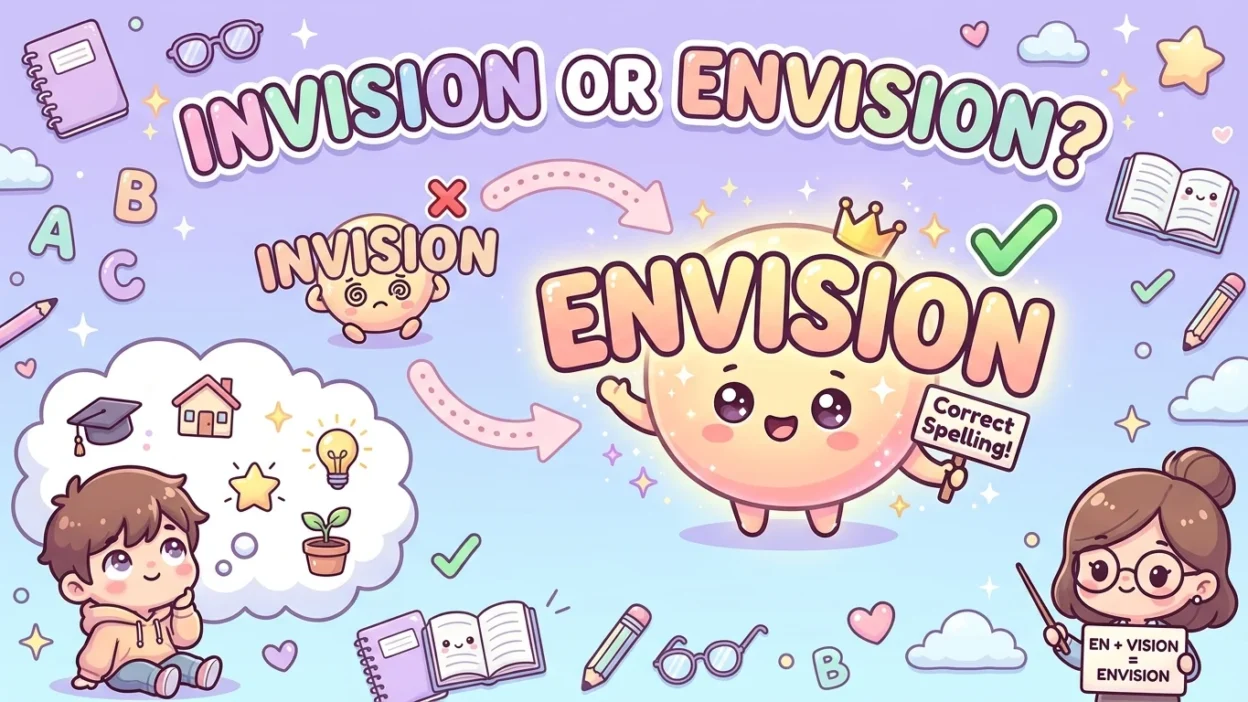
ENVISION = EN + VISION
The word contains VISION because you create a mental vision of something.
Then remember the opening letters:
ENvision = imagine
You can also connect it with another familiar word:
ENvision → ENvisioned → ENvisions
Therefore:
I envision success. ✓
I invision success. ✗
A second easy reminder is:
Want to picture it? ENvision it.
Envision vs Imagine
Envision and imagine have similar meanings, but they are not always identical in tone.
Imagine is broad. It can describe creating almost any idea, image, possibility, or fictional situation in your mind.
For example:
“Imagine a dragon flying over the city.”
Meanwhile, envision often suggests forming a relatively clear mental picture, especially of a possible situation, plan, or future outcome.
For example:
“We envision the company expanding internationally.”
Therefore, imagine works in a wider range of situations, while envision often sounds particularly natural when discussing goals, possibilities, and future plans.
Envision vs Visualize
Envision and visualize can also overlap.
For example:
“She envisioned herself winning.”
“She visualized herself winning.”
Both sentences involve forming a mental image.
However, visualize often emphasizes creating a visual image in your mind. Meanwhile, envision can include a broader conception of how a situation, future, or plan might develop.
Therefore, context determines which word sounds more natural.
Envision vs Vision
Vision commonly works as a noun referring to sight, a mental image, or an idea of a desired future.
For example:
“The founder has a clear vision for the company.”
Meanwhile, envision is a verb:
“The founder envisions a successful future for the company.”
Therefore:
vision → usually a noun
envision → a verb
Remembering their grammatical roles can help you choose the right word.
Envision vs Foresee
Envision involves imagining or mentally picturing something.
Meanwhile, foresee means to anticipate or predict that something may happen.
For example:
“I envision a larger office.”
This sentence describes a mental picture or idea.
However:
“I foresee several problems.”
This sentence means the speaker anticipates those problems.
Therefore, envision emphasizes mental conception, while foresee emphasizes anticipation or prediction.
Envision vs Envisage
Envision and envisage can have very similar meanings. Both can describe imagining or contemplating a future situation.
For example:
“We envision significant growth.”
“We envisage significant growth.”
Both can work.
However, usage preferences can vary by region, context, and writing style. Consequently, you should not treat envisage as an incorrect form of envision.
Most importantly, neither word supports spelling envision as invision when you mean “imagine.”
American vs British English
Both American and British English recognize envision as a standard spelling.
Therefore, you can write:
“I envision a better future.”
in either American or British English.
British English also uses envisage, which often overlaps with envision in meaning. Nevertheless, envision itself remains valid.
Most importantly, changing from American to British English does not turn the standard verb into invision.
Therefore, for the meaning imagine or mentally picture, envision remains the safe standard spelling.
Similar Words to Envision
Several words relate closely to envision, although their meanings can differ slightly:
- imagine
- visualize
- envisage
- picture
- foresee
- anticipate
- conceive
- contemplate
- dream of
- project
- conceptualize
For example, instead of:
“I envision a successful future.”
you might say:
“I imagine a successful future.”
or:
“I picture a successful future.”
However, envision remains especially useful when describing a mental picture of a future possibility, goal, plan, or outcome.
Frequently Asked Questions
Is it invision or envision?
Envision is the standard English verb when you mean imagine, visualize, or mentally picture something. Therefore, write “I envision a better future,” not “I invision a better future.”
Is invision a correct spelling?
Not as the standard spelling of the verb meaning to imagine. For that meaning, use envision. However, capitalized InVision can occur as a proper name, so context matters.
What does envision mean?
Envision means to imagine, visualize, or form a mental picture of something. It often appears when people discuss future plans, possibilities, goals, designs, or desired outcomes.
Is it envision or invision the future?
Write envision the future. For example, “She envisions a future where everyone has access to education” uses the standard spelling.
Is envisioned a correct word?
Yes. Envisioned is the standard past-tense and past-participle form of envision. For example, “The designer envisioned a more modern space” is correct.
What is the difference between envision and imagine?
Both words involve forming ideas mentally. However, envision often suggests forming a relatively clear conception of a possible situation or future outcome, while imagine has a broader range of uses.
Can I use envision in formal writing?
Yes. Envision works naturally in formal, academic, professional, and everyday writing when its meaning fits the context. For example, a strategic plan might explain what an organization envisions for its future.
Is envision American or British English?
Envision is valid in both American and British English. British writers may also use envisage in contexts where American writers might prefer envision, but both words are standard.
Final Verdict: Invision or Envision?
If you mean to imagine, visualize, or mentally picture something, choose envision. It is the standard English verb, as in “I envision a successful future” or “She envisioned herself becoming a doctor.”
Meanwhile, invision is generally a misspelling when writers intend this meaning. However, InVision may appear intentionally as a proper name, so context still matters. Therefore, for ordinary sentences about imagining possibilities, plans, goals, or future outcomes, remember that envision is the correct spelling.
Remember This
Use this simple memory trick:
EN + VISION = ENVISION
If you create a mental vision of something, you envision it.
Therefore:
I envision my future. ✓
I invision my future. ✗
Also remember:
envision → envisions → envisioned → envisioning
Keeping the en- at the beginning will help you spell every form correctly.
Conclusion
Ultimately, envision is the word you need when you mean to imagine, visualize, or mentally picture something. Whether you envision a new career, a successful project, a different design, or a better future, the standard verb begins with en-, not in-.
Although you may encounter InVision as a proper name, that usage does not change the spelling of the ordinary English verb. Therefore, remember the simple connection EN + VISION = ENVISION, and choosing between invision or envision becomes much easier.

Narelle Merindah is a passionate author committed to delivering thoughtful, engaging, and well-structured content. With a keen eye for detail and a love for storytelling, Narelle creates informative articles that resonate with readers. Her dedication to clarity, creativity, and authenticity ensures meaningful and impactful writing.