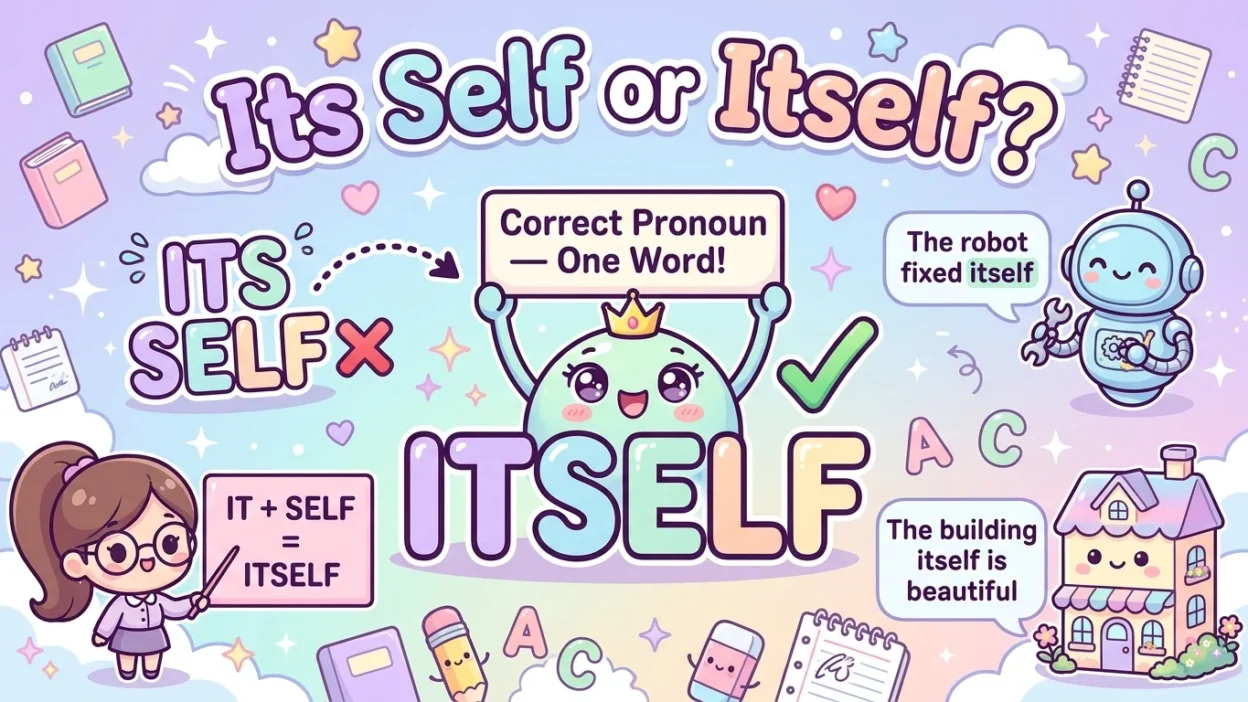
If you have ever wondered whether to write its self or itself, you are dealing with a common spacing and grammar question. Because its, self, and itself are all recognizable English forms, separating the word may seem logical at first. However, when you need the reflexive or intensive pronoun connected with it, standard English normally requires one word.
In most everyday sentences, itself is correct. For example, “The door closed itself” uses itself as a reflexive pronoun, while “The building itself is impressive” uses it for emphasis. Therefore, you should not normally replace itself with its self.
However, the separate phrase its self can occasionally make sense when self functions as an independent noun meaning identity, nature, or essential character. Such uses are unusual and context-dependent. Consequently, if you simply need the pronoun, choose itself.
Quick Answer: Its Self or Itself?
Use itself as the standard reflexive or intensive pronoun for it. For example, write “The machine turned itself off” and “The machine itself is expensive.” The separate phrase its self can occur when self acts as an independent noun, but that construction is uncommon in everyday English.
Why Do People Confuse Its Self and Itself?
People often confuse its self and itself because several English reflexive pronouns contain possessive-looking elements.
For example:
- myself
- yourself
- herself
- itself
- ourselves
- yourselves
- themselves
Therefore, a writer may look at its and self and assume that a space belongs between them.
Additionally, its is already a valid possessive determiner:
“The dog wagged its tail.”
Meanwhile, self is also a valid noun:
“She wants to understand her self more deeply.”
Consequently, its self may look grammatically plausible even when the sentence actually requires the pronoun itself.
However, standard English writes the reflexive and intensive pronoun as one word: itself.
What Does Itself Mean?
Itself is a pronoun that refers back to a singular thing, animal, situation, organization, or other entity represented by it.
Most commonly, itself functions as either a reflexive pronoun or an intensive pronoun.
For example:
“The machine shut itself down.”
Here, itself refers back to the machine. The machine performs an action that affects the same thing.
Similarly:
“The machine itself is not dangerous.”
Here, itself emphasizes the machine.
Therefore, itself can serve two major purposes:
Reflexive use: the action returns to the same thing.
Intensive use: the pronoun adds emphasis to the thing already mentioned.
Itself as a Reflexive Pronoun
Use itself reflexively when the subject and the object refer to the same thing.
For example:
“The cat cleaned itself.”
The cat performs the cleaning, and the cleaning affects the same cat.
Similarly:
“The program automatically updates itself.”
The program performs or undergoes an updating process involving the same program.
Other examples include:
- The machine turned itself off.
- The door opened itself.
- The company reinvented itself.
- The system protects itself from certain threats.
- The robot positioned itself beside the table.
In each sentence, itself refers back to the subject.
Itself as an Intensive Pronoun
You can also use itself to emphasize the noun or pronoun that comes before it.
For example:
“The building itself is beautiful.”
Here, itself emphasizes the building rather than acting as the object of an action.
Similarly:
“The idea itself is not new.”
The word itself directs attention specifically toward the idea.
Other examples include:
- The problem itself is easy to solve.
- The phone itself works perfectly.
- The organization itself issued the statement.
- The story itself is fascinating.
- The product itself costs very little.
Therefore, when you want to emphasize the actual thing under discussion, itself can provide that emphasis.
What Does Its Self Mean?
Unlike itself, its self consists of two separate words:
its = possessive determiner
self = noun
Therefore, the phrase can theoretically mean its identity, its nature, or its individual self.
For example, in philosophical, literary, psychological, or highly abstract writing, a writer might discuss an entity and its self as a concept.
However, this construction is relatively unusual. Moreover, it does not replace the ordinary reflexive or intensive pronoun itself.
Compare:
❌ The machine turned its self off.
✅ The machine turned itself off.
However, in an unusual context where self genuinely functions as an independent noun, a writer may have a grammatical reason to separate the words.
Therefore, the practical rule remains simple: if you need the pronoun, write itself as one word.
Its Self vs Itself: Comparison Table
| Feature | Itself | Its Self |
|---|---|---|
| Standard pronoun | Yes | No |
| Number of words | One | Two |
| Reflexive use | Yes | No |
| Intensive use | Yes | No |
| Common in everyday English | Yes | No |
| Can self function as a separate noun? | Not in this form | Yes, in unusual contexts |
| Example | The cat cleaned itself. | Context-dependent and uncommon |
| Best general choice | Itself | Use only when self truly acts as a noun |
Therefore, itself is the form most writers need.
When Should You Use Itself?
Use itself when referring back to something represented by the pronoun it.
For example:
“The device restarted itself.”
Here, the device performs an action involving the same device.
Additionally, use itself when emphasizing a noun:
“The device itself works fine.”
You can therefore use itself with objects, animals, organizations, ideas, situations, systems, and many other singular nouns.
For example:
- The company changed itself completely.
- The dog scratched itself.
- The system repaired itself.
- The problem solved itself.
- The town itself is quite small.
- The proposal itself seems reasonable.
In all these cases, one-word itself provides the standard form.
When Should You Use Its Self?
You will rarely need its self in ordinary writing.
However, it may appear when self functions as a genuine noun rather than as part of a reflexive pronoun.
For instance, academic or philosophical writing may discuss the concept of a thing’s self, identity, or essential nature.
In that type of construction, its modifies the noun self, just as it might modify identity:
its identity
its nature
its self
Nevertheless, such usage differs fundamentally from the pronoun itself.
Therefore, do not write:
❌ The computer restarted its self.
Write:
✅ The computer restarted itself.
Likewise, do not write:
❌ The building its self looks old.
Write:
✅ The building itself looks old.
Its Self or Itself: 18 Practical Examples
Here are 18 examples showing the standard use of itself.
- The cat cleaned itself after eating.
- The machine automatically turned itself off.
- The company successfully reinvented itself.
- The door seemed to open by itself.
- The computer restarted itself overnight.
- The organization found itself facing a difficult decision.
- The robot positioned itself near the entrance.
- The system can protect itself from certain errors.
- The problem eventually resolved itself.
- The dog scratched itself behind the ear.
- The building itself remains in excellent condition.
- The idea itself deserves further discussion.
- The product itself works extremely well.
- The city itself has changed considerably.
- The story itself is quite simple.
- The website itself loads quickly.
- The company itself confirmed the announcement.
- The process itself takes only a few minutes.
Therefore, whether you use the word reflexively or for emphasis, spell itself as one word.
Common Mistakes With Its Self and Itself
Although the rule is straightforward, several mistakes can cause confusion.
Mistake 1: Separating Itself Into Two Words
Incorrect:
❌ The dog hurt its self.
Correct:
✅ The dog hurt itself.
Because the pronoun refers back to the dog, you need itself.
Mistake 2: Writing “It’s Self”
Another common mistake involves an apostrophe.
Incorrect:
❌ The machine turned it’s self off.
Correct:
✅ The machine turned itself off.
Remember, it’s means it is or it has.
Therefore, it’s self would not produce the required reflexive pronoun.
Mistake 3: Using Its Self for Emphasis
Incorrect:
❌ The building its self is beautiful.
Correct:
✅ The building itself is beautiful.
Here, itself emphasizes the building, so one word is correct.
Mistake 4: Assuming Its Self Can Never Appear
Although its self usually represents an error when someone intends the pronoun, the two words can appear separately when self genuinely functions as a noun.
Therefore, avoid saying that the letter sequence its self can never occur under any circumstances.
Mistake 5: Confusing Itself With By Itself
Itself and by itself can communicate different ideas.
For example:
“The machine repaired itself.”
Here, the machine undergoes or performs an action involving itself.
Meanwhile:
“The machine operates by itself.”
Here, by itself means independently or without assistance.
Therefore, context determines which construction you need.
A Simple Memory Trick
Remember this simple rule:
Pronoun = one word → ITSELF
Think about other familiar forms:
myself
yourself
herself
himself
itself
Therefore, if you are referring back to it, keep the pronoun together:
IT + SELF = ITSELF
For example:
“The phone turned itself off.”
Additionally, remember:
its normally comes before a separate noun:
its screen
its battery
its color
However, when you need the reflexive or intensive pronoun, write:
itself
Itself vs It’s Self
This distinction becomes even easier when you remember what it’s means.
It’s is a contraction of it is or it has.
For example:
It’s raining. = It is raining.
It’s been a long day. = It has been a long day.
Therefore, it’s self cannot replace itself in sentences such as:
❌ The cat cleaned it’s self.
Instead:
✅ The cat cleaned itself.
So remember:
itself = reflexive/intensive pronoun
it’s = it is / it has
its = possessive form
Itself vs Its
Its and itself perform different grammatical functions.
Its shows possession:
“The dog wagged its tail.”
Here, the tail belongs to the dog.
Meanwhile, itself refers back to the subject or adds emphasis:
“The dog scratched itself.”
Therefore:
its + noun
but:
itself = pronoun
Compare:
“The phone lost its signal.”
“The phone restarted itself.”
Understanding this distinction can prevent several common spelling errors.
Itself vs By Itself
Itself refers back to the subject or emphasizes something.
For example:
“The machine repaired itself.”
However, by itself often means alone, independently, or without outside help.
For example:
“The machine can operate by itself.”
Similarly:
“The child sat by itself.”
Depending on context, this means the child sat alone.
Therefore, adding by can change the meaning considerably.
Itself vs Themselves
Use itself with a singular thing referred to as it:
“The machine turned itself off.”
Meanwhile, use themselves with plural subjects:
“The machines turned themselves off.”
Therefore:
it → itself
they → themselves
Matching the pronoun with its antecedent helps maintain grammatical agreement.
American vs British English
Both American and British English use itself as the standard reflexive and intensive pronoun associated with it.
For example, writers in both varieties can say:
“The system updated itself.”
Likewise:
“The building itself is impressive.”
Therefore, the basic spelling rule does not change between American and British English.
In both varieties, its self remains unusual and only makes sense when self genuinely functions as a separate noun.
Consequently, for ordinary writing, itself remains the correct choice regardless of which major variety of English you follow.
Similar Reflexive Pronouns
English contains several related reflexive and intensive pronouns:
- myself — refers back to I
- yourself — refers back to singular you
- himself — refers back to he
- herself — refers back to she
- itself — refers back to it
- ourselves — refers back to we
- yourselves — refers back to plural you
- themselves — refers back to they
For example:
“I taught myself.”
“She introduced herself.”
“The cat cleaned itself.”
“They prepared themselves.”
Therefore, learning itself as part of the larger reflexive-pronoun family makes the one-word spelling easier to remember.
Frequently Asked Questions
Is it its self or itself?
Use itself when you need the reflexive or intensive pronoun connected with it. For example, “The machine fixed itself” and “The machine itself is valuable” both require one word.
Is itself one word or two?
Itself is one word when it functions as the standard reflexive or intensive pronoun. Therefore, do not separate it into its self in ordinary sentences such as “The cat cleaned itself.”
Is “its self” ever correct?
The two words can occasionally appear together when self functions as an independent noun meaning identity, nature, or essential character. However, this usage is uncommon and does not replace the standard pronoun itself.
Is “it’s self” correct?
Not when you mean itself. The contraction it’s means it is or it has. Therefore, write “The machine turned itself off,” not “The machine turned it’s self off.”
What is the difference between its and itself?
Its shows possession and normally modifies a noun, as in “The dog wagged its tail.” Meanwhile, itself refers back to something represented by it or adds emphasis, as in “The dog scratched itself.”
Is “the problem itself” correct?
Yes. In “the problem itself,” itself functions intensively and emphasizes the problem. Therefore, the one-word spelling is correct.
Is “by itself” correct?
Yes. By itself commonly means alone, independently, or without outside assistance. For example, “The device can operate by itself” means the device can operate independently.
Can itself refer to a company?
Yes. When a company takes singular it in your chosen style and context, itself can refer back to it. For example, “The company reinvented itself” is natural and grammatically correct.
Final Verdict: Its Self or Itself?
For normal English writing, itself is the correct choice when you need the reflexive or intensive pronoun associated with it. Therefore, write “The computer restarted itself,” “The cat cleaned itself,” and “The building itself is beautiful.”
Meanwhile, its self can occasionally appear when self functions as an independent noun, particularly in abstract, philosophical, or literary contexts. However, that unusual construction does not replace itself. Consequently, when you are simply referring back to it or adding emphasis, always write itself as one word.
Remember This
Use this simple formula:
IT + SELF = ITSELF
Therefore:
The machine fixed itself. ✓
The machine fixed its self. ✗
Also remember:
its = possession → its screen
it’s = it is or it has
itself = reflexive or intensive pronoun
So, if you mean the thing itself, keep itself together as one word.
Conclusion
Ultimately, the choice between its self and itself is easy in most everyday sentences. When you need a pronoun that refers back to it, or when you want to emphasize the thing already mentioned, itself is the standard one-word form. Therefore, sentences such as “The system repaired itself” and “The system itself works well” use the correct spelling.
However, its self can occasionally make sense when self acts as a genuine independent noun. Because that construction remains uncommon, most writers will rarely need it. Consequently, remember the simple rule IT + SELF = ITSELF, and you will choose the correct form in nearly every ordinary situation.

Narelle Merindah is a passionate author committed to delivering thoughtful, engaging, and well-structured content. With a keen eye for detail and a love for storytelling, Narelle creates informative articles that resonate with readers. Her dedication to clarity, creativity, and authenticity ensures meaningful and impactful writing.