
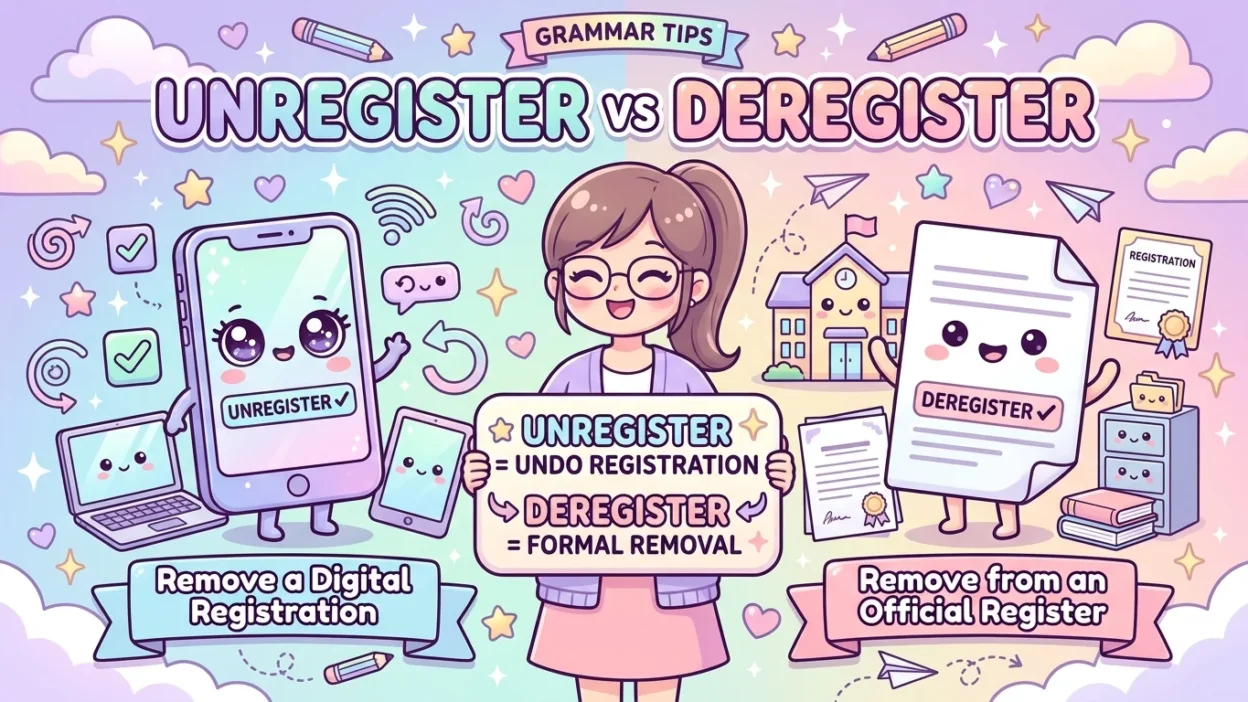
Have you ever wondered whether to write unregister or deregister? Both words exist in English, and both can describe removing someone or something from a registration. However, their preferred use can depend on the situation, the type of registration, and the terminology of a particular organization or system.
Generally, unregister means to remove a previous registration or reverse the action of registering. You commonly encounter it in software, online accounts, devices, and digital services. Meanwhile, deregister often refers to officially removing a person, organization, vehicle, business, or item from an official register. For example, you might unregister a device from an application but deregister a company from an official government register.
Nevertheless, these words sometimes overlap. Therefore, understanding their context will help you choose the most natural and appropriate word.
Quick Answer: Unregister or Deregister?
Both unregister and deregister are correct English words. Use unregister when reversing a registration, especially in software, accounts, and digital systems. Use deregister when officially removing something from a formal register, list, or regulatory system. However, follow the terminology of the organization or platform involved.
Why Do People Confuse Unregister and Deregister?
People confuse these words because both contain the prefix un- or de-, followed by register. Additionally, both can describe the removal or cancellation of an existing registration.
For example:
- You can unregister a device from an application.
- You can deregister a vehicle with a relevant authority.
In both situations, someone removes an existing registration. Consequently, the meanings can overlap.
However, context often determines which word sounds more natural. Software developers frequently use unregister when reversing a technical registration process. In contrast, government agencies, professional organizations, and regulatory bodies may use deregister for formal removal from an official register.
Therefore, although both words are valid, they do not always suit the same situations.
What Does Unregister Mean?
Unregister means to remove, cancel, or reverse a previous registration.
It commonly appears in technology, software, online services, and administrative processes.
For example:
“Please unregister your device before selling it.”
Here, the person must remove the device’s existing registration.
Similarly:
“You can unregister from the online service through your account settings.”
This sentence means that the user can reverse their previous registration.
You can use unregister in situations involving:
- online accounts
- software applications
- electronic devices
- digital services
- websites
- event registrations
- computer systems
- registered components
Therefore, unregister often sounds natural when someone removes a previous registration from a system or service.
What Does Deregister Mean?
Deregister means to officially remove a person, organization, vehicle, or other item from a register or registration system.
It often appears in formal, administrative, legal, regulatory, and professional contexts.
For example:
“The company decided to deregister its business.”
Here, the company intends to remove its official registration.
Similarly:
“The vehicle owner must deregister the car before exporting it.”
This sentence refers to an official administrative process.
You may encounter deregister in situations involving:
- companies
- businesses
- vehicles
- professional registrations
- educational institutions
- government records
- regulated organizations
- official registers
Therefore, deregister often emphasizes formal removal from an established register.
Unregister vs Deregister: Comparison Table
| Feature | Unregister | Deregister |
|---|---|---|
| Correct English word? | Yes | Yes |
| Main meaning | Reverse or remove a registration | Officially remove from a register |
| Common context | Technology and digital systems | Formal and administrative systems |
| Software use | Very common | Also possible |
| Government records | Possible | Often natural |
| Professional registers | Possible | Often natural |
| Example | Unregister a device | Deregister a company |
| General distinction | Undo registration | Formal removal from a register |
The distinction is not absolute. Both words can appear in technical and administrative contexts. Therefore, consider the actual process and the terminology used by the relevant organization.
When Should You Use Unregister?
Use unregister when you want to reverse an earlier registration or remove something from a system.
For example:
“I need to unregister my phone from the application.”
Here, the speaker wants to remove the phone’s association with the application.
You can also use it when discussing digital accounts:
“Users can unregister their email addresses from the notification service.”
Other examples include:
- Unregister your device before transferring ownership.
- You can unregister from the event through the website.
- The administrator decided to unregister the software component.
- Please unregister the old account before creating a new one.
- The system allows users to unregister their devices remotely.
Therefore, unregister is particularly useful when describing the reversal of a registration process.
When Should You Use Deregister?
Use deregister when you describe formally removing something from an official register or regulatory system.
For example:
“The organization decided to deregister its subsidiary.”
Here, the organization intends to remove the subsidiary’s formal registration.
You can also use it in administrative situations:
“The owner must deregister the vehicle before completing the export process.”
Other examples include:
- The business applied to deregister its company.
- The authority decided to deregister the vehicle.
- The professional requested to deregister from the official register.
- The organization plans to deregister its inactive branch.
- The institution must follow the official deregistration procedure.
However, remember that legal and administrative processes differ between jurisdictions. Always check the terminology and requirements of the relevant authority.
Unregister or Deregister: 18 Practical Examples
Here are 18 examples showing how both words work in different contexts.
Examples With Unregister
- I need to unregister my old phone from the application.
- Please unregister your device before selling it.
- Users can unregister their accounts through the settings page.
- The administrator decided to unregister the inactive software component.
- You can unregister from the event before the deadline.
- She wants to unregister her email address from the mailing service.
- The technician will unregister the device from the system.
- We need to unregister the old account before creating another one.
- The application allows customers to unregister their connected devices.
Examples With Deregister
- The company plans to deregister its inactive business.
- The vehicle owner must deregister the car before exporting it.
- The organization requested permission to deregister its subsidiary.
- The authority decided to deregister the vehicle.
- The professional contacted the regulator to deregister from the official register.
- The business completed the required deregistration process.
- The institution plans to deregister its inactive branch.
- The owner submitted an application to deregister the organization.
- The regulatory body may deregister a company that no longer meets its requirements.
These examples illustrate common tendencies, not rigid rules. The official terminology of a particular platform or authority should take priority.
Common Mistakes With Unregister and Deregister
Mistake 1: Assuming Unregister Is Incorrect
Some writers believe that unregister is not a real word. However, it is a recognized English verb and appears frequently in technology and software contexts.
Correct: “Please unregister your device.”
Mistake 2: Assuming Deregister Is Always More Formal and Correct
Although deregister often appears in official contexts, it does not automatically replace unregister in every sentence.
For example:
“Unregister this component from the software system.”
This wording may be more natural than deregister when following technical terminology.
Mistake 3: Using the Wrong Word for the Intended Process
Consider the difference:
“Unregister the device from the application.”
“Deregister the company from the official register.”
Both sentences can be correct because their contexts differ.
Mistake 4: Confusing Unregister With Unsubscribe
These words do not always mean the same thing.
Unregister means removing a registration.
Unsubscribe means stopping a subscription, such as email updates or a recurring service.
For example:
“I want to unsubscribe from promotional emails.”
Mistake 5: Forgetting the Related Nouns
The corresponding nouns are:
- unregister → unregistration
- deregister → deregistration
For example:
“The unregistration process takes a few minutes.”
“The company completed its deregistration.”
Both nouns can be appropriate in their respective contexts.
A Simple Memory Trick
Remember this easy distinction:
UNREGISTER = UNDO A REGISTRATION
DEREGISTER = REMOVE FROM A REGISTER
Think about the situations:
- Unregister a phone from an application.
- Unregister a device from a digital system.
- Deregister a vehicle with an authority.
- Deregister a company from an official register.
This trick provides a helpful general guide, although the words sometimes overlap.
Therefore, remember that unregister often suits technical or everyday registration processes, while deregister often suits formal removal from official registers.
Unregister vs Unsubscribe
Unregister and unsubscribe can both involve removing something, but their meanings differ.
Use unregister when removing a registration:
“I want to unregister my device.”
Use unsubscribe when ending a subscription:
“I want to unsubscribe from the newsletter.”
Therefore, do not automatically use unsubscribe when you mean unregister.
Deregister vs Deactivate
These words also describe different actions.
Deregister means officially removing something from a register.
For example:
“The authority deregistered the vehicle.”
Meanwhile, deactivate means making something inactive or disabling its operation.
For example:
“The administrator deactivated the account.”
An account can be deactivated without necessarily removing its registration. Consequently, check what action the sentence actually describes.
Unregister vs Cancel Registration
Cancel registration is a straightforward alternative to both words in many everyday situations.
For example:
“I want to cancel my event registration.”
You could also say:
“I want to unregister from the event.”
However, formal organizations may prefer deregister or cancel registration in their official instructions.
Therefore, choose the wording that best matches the process.
American vs British English
Both unregister and deregister appear in American and British English.
However, the preferred term can vary according to the industry, organization, and type of registration.
For example, software documentation may use unregister to describe removing a component from a system. Meanwhile, official administrative documents may use deregister to describe removing a business or vehicle from a register.
There is no universal rule that assigns unregister exclusively to American English or deregister exclusively to British English.
Therefore, both forms are acceptable in either variety. Consistency and context matter more than nationality.
Similar Words to Unregister and Deregister
Here are several related words that can help you express the intended action more precisely:
- Register — officially record or enroll someone or something.
- Unregister — reverse or remove a registration.
- Deregister — formally remove something from a register.
- Unsubscribe — stop a subscription.
- Deactivate — make something inactive.
- Cancel — end or withdraw an arrangement.
- Withdraw — remove or take something back.
- Delete — remove information or data.
- Enrol — officially enter someone into a course or program.
- Disenrol — remove someone from an enrollment, although usage varies.
Although these words share some similarities, they do not always describe the same action.
Frequently Asked Questions
Is it unregister or deregister?
Both are correct English words. Unregister commonly describes reversing a registration in software, online services, or devices. Deregister often describes formally removing something from an official register. The best choice depends on the context.
Is unregister a real word?
Yes. Unregister is a recognized English verb meaning to remove or reverse a previous registration. For example, you can unregister a device from an application or unregister from an event.
Is deregister a real word?
Yes. Deregister is a recognized English verb that means to officially remove someone or something from a register. It commonly appears in business, vehicle, professional, and administrative contexts.
What is the difference between unregister and deregister?
Unregister often emphasizes reversing a registration, particularly in technical systems. Deregister often emphasizes formal removal from an official register. However, their meanings overlap, so context and established terminology matter.
Is deregister more formal than unregister?
Often, yes. Deregister frequently appears in official, regulatory, and administrative writing. However, unregister also works in formal technical documentation, especially when it describes reversing a software registration process.
Can I say unregister a device?
Yes. Unregister a device is a natural expression, particularly when removing a device from an application, account, or digital system.
Can I say deregister a company?
Yes. Deregister a company is a valid expression when referring to its formal removal from an official company register. However, the exact procedure and terminology depend on the relevant jurisdiction.
What is the noun form of unregister and deregister?
The related nouns are unregistration and deregistration. For example, you can discuss an unregistration process in a software system or a company’s formal deregistration.
Final Verdict: Unregister or Deregister?
Ultimately, unregister and deregister are both correct, but their contexts often differ. Use unregister when you want to reverse a registration or remove something from a digital system, application, or service. Meanwhile, use deregister when you describe formally removing a person, business, vehicle, or organization from an official register.
Nevertheless, these words can overlap, so always consider the terminology used by the relevant platform or authority. Remember the simple distinction: unregister means undo a registration, while deregister often means formally remove from a register.
Remember This
Use this quick memory trick:
UNREGISTER = UNDO REGISTRATION
DEREGISTER = REMOVE FROM AN OFFICIAL REGISTER
Examples:
Unregister a device. ✓
Deregister a company. ✓
Both words are correct. Just choose the one that fits the process and context.
Conclusion
In everyday English, unregister and deregister both describe removing an existing registration. However, unregister often appears in software, online services, applications, and device management, whereas deregister frequently appears in formal administrative, professional, and regulatory contexts.
Therefore, neither word is universally better or more correct. Instead, consider what you are removing and where the registration exists. If you are reversing a digital registration, unregister often sounds natural. If you are officially removing something from a formal register, deregister may be the better choice.