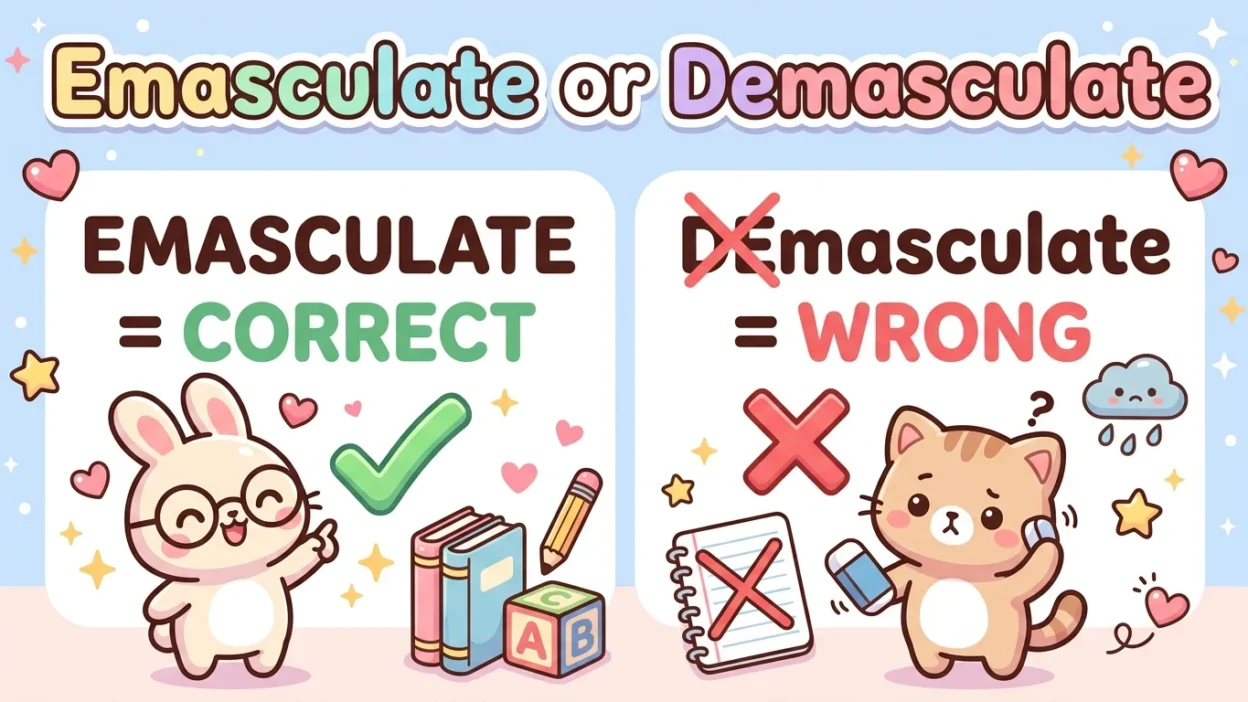
If you are wondering whether the correct spelling is emasculate or demasculate, you are not alone. These two forms look remarkably similar, and that similarity can easily cause confusion. However, standard English recognizes emasculate as the correct word. Demasculate does not function as the standard spelling for the meanings learners usually intend.
More specifically, emasculate works as a verb and can describe making someone or something less powerful, effective, confident, or traditionally masculine. Depending on the context, it can also refer to removing the male reproductive organs. Therefore, understanding the meaning and context helps you use the word accurately. In contrast, demasculate generally appears as a mistaken formation rather than a standard English word.
Quick Answer
Emasculate is the correct standard English word. It means to make someone or something less masculine, powerful, effective, or authoritative. Demasculate is generally considered incorrect when used as a spelling of emasculate. Therefore, use emasculate in standard English writing and speech.
Why People Confuse Emasculate and Demasculate
People often confuse emasculate and demasculate because the prefix de- appears in many English words. For example, words such as deactivate, devalue, and decentralize commonly use de- to indicate removal, reversal, or reduction.
However, English does not allow speakers to create a correct word simply by adding de- to another word. Consequently, although demasculate might seem logical, standard English uses emasculate.
Moreover, the beginning of emasculate can sound unfamiliar to learners. As a result, some writers may unconsciously replace e- with the more familiar de-.
Therefore, remember this simple distinction:
- Emasculate = standard English
- Demasculate = generally incorrect/nonstandard
- Emasculation = standard noun form
- Emasculated = standard past-tense/past-participle form
Emasculate: Meaning and Definition
Emasculate is a standard English verb. It has several related meanings, depending on the context.
First, it can mean to make someone feel less masculine or less confident in their traditionally masculine identity.
For example:
The criticism made him feel emasculated.
Second, emasculate can describe weakening someone’s authority, power, influence, or effectiveness.
For example:
The new restrictions emasculated the organization.
In addition, emasculate can have a literal biological meaning involving the removal of the male reproductive organs.
Because of these different meanings, context matters greatly. In everyday writing, however, the figurative meaning often appears when writers discuss confidence, authority, power, or masculinity.
Examples of Emasculate
- The constant criticism began to emasculate his confidence.
- The policy could emasculate the committee’s authority.
- He felt emasculated after losing control of the project.
- The changes may emasculate the department.
- The character felt emasculated by repeated humiliation.
- The reforms could emasculate the institution.
- The situation made him feel emasculated.
- Excessive restrictions can emasculate an organization’s ability to act.
Demasculate: Is It a Correct Word?
Demasculate does not serve as the standard English spelling for the meaning people usually intend when they say or write emasculate.
Although the formation may look logical, especially because de- appears in many English verbs, standard English does not generally recognize demasculate as the appropriate alternative.
Therefore, if you want to express the idea of reducing someone’s masculinity, weakening someone’s authority, or using the related literal meaning, choose emasculate.
For example:
❌ The experience demasculated him.
✅ The experience emasculated him.
Similarly:
❌ The restrictions demasculated the organization.
✅ The restrictions emasculated the organization.
Emasculate vs Demasculate: Comparison Table
| Word | Standard English? | Part of Speech | Meaning | Example |
|---|---|---|---|---|
| Emasculate | Yes | Verb | Make less masculine, powerful, or effective | The criticism emasculated him. |
| Demasculate | Generally no | — | Usually intended as a mistaken form of emasculate | Avoid this form in standard writing. |
| Emasculated | Yes | Verb/adjective | Made less masculine, powerful, or effective | He felt emasculated. |
| Emasculation | Yes | Noun | The act or result of emasculating | The policy caused the emasculation of the department’s authority. |
When to Use Emasculate
Use emasculate when you need a verb that expresses weakening, loss of authority, reduced effectiveness, or reduced masculinity.
Use Emasculate for Masculinity
When something makes a person feel less masculine, emasculate fits the context.
The comment made him feel emasculated.
Use Emasculate for Power or Authority
You can also use the word when something weakens a person’s authority or an organization’s effectiveness.
The new restrictions emasculated the leadership team.
Use Emasculate for the Literal Meaning
In medical, historical, or biological contexts, emasculate can refer to removing the male reproductive organs.
Because this meaning can involve sensitive subject matter, writers should choose the word carefully and make the intended meaning clear.
18 Examples of Emasculate in Sentences
- The criticism made him feel emasculated.
- The new regulations could emasculate the agency.
- He worried that losing his position would emasculate his authority.
- The repeated failures left him feeling emasculated.
- The decision significantly emasculated the team’s leadership.
- She argued that the restrictions would emasculate the organization.
- The character felt emasculated after being publicly humiliated.
- The changes threatened to emasculate the manager’s authority.
- Constant comparisons can make someone feel emasculated.
- The reforms gradually emasculated the institution.
- He described the experience as deeply emasculating.
- The policy may emasculate the department’s ability to respond quickly.
- The defeat left him feeling emasculated.
- The new structure emasculated the committee’s decision-making power.
- The character struggled with feelings of being emasculated.
- The restrictions effectively emasculated the leadership role.
- The experience did not actually emasculate his abilities.
- The article discusses how social expectations can make people feel emasculated.
Common Mistakes With Emasculate
Because emasculate contains an unusual-looking beginning, writers sometimes create incorrect alternatives.
Mistake 1: Writing Demasculate
❌ He felt demasculated.
✅ He felt emasculated.
Mistake 2: Assuming De- Must Mean Removal
Although de- frequently appears in English words, you cannot automatically add it to a word to create a valid term.
Therefore, demasculate may look logical, but standard usage favors emasculate.
Mistake 3: Confusing Emasculate With Emaciate
The words emasculate and emaciate look somewhat similar, but they have completely different meanings.
- Emasculate = weaken, reduce masculinity, or remove male reproductive organs.
- Emaciate = make or become extremely thin or weak, usually because of illness, hunger, or another cause.
Mistake 4: Using Emasculate Without Considering Context
Because emasculate can describe both masculinity and power, readers may interpret it differently depending on the sentence.
Therefore, make your context clear whenever the meaning could become ambiguous.
Memory Trick for Emasculate
Here is an easy way to remember the correct spelling:
E = Emasculate = English
Think:
E → Emasculate → English
Then remember that demasculate adds a D that the standard word does not need.
Another simple trick:
EMASCULATE = the established word
So, whenever you hesitate between emasculate and demasculate, choose emasculate.
American vs British English
Both American and British English use emasculate as the standard word.
Therefore, this spelling does not normally change between the two major varieties of English.
| Variety | Standard Form |
|---|---|
| American English | emasculate |
| British English | emasculate |
| Australian English | emasculate |
| Canadian English | emasculate |
Consequently, you do not need to change the spelling based on whether you are writing for an American or British audience.
Similar Words to Emasculate
Depending on your intended meaning, several words may work as alternatives.
If You Mean “Weaken”
- weaken
- undermine
- diminish
- reduce
- impair
If You Mean “Reduce Authority”
- undermine
- weaken
- disempower
- limit
- restrict
If You Mean “Make Someone Feel Less Masculine”
- humiliate
- undermine confidence
- diminish confidence
However, these alternatives do not always carry exactly the same meaning. Therefore, choose your replacement according to the specific context.
Emasculate vs Weaken
Although emasculate and weaken can overlap, they do not always communicate the same idea.
Weaken has a broad meaning. It can describe reducing physical strength, authority, effectiveness, or intensity.
Emasculate, on the other hand, can add a specific connection to masculinity or traditionally masculine power and authority.
For example:
The reforms weakened the organization.
This sentence simply says that the organization became less effective.
However:
The reforms emasculated the organization.
This wording can suggest a stronger sense of lost power, authority, or effectiveness.
Emasculate vs Humiliate
These words can also overlap in some contexts, but they focus on different ideas.
Humiliate means to make someone feel ashamed or embarrassed.
Emasculate can describe making someone feel less masculine or less powerful.
Therefore, humiliation can sometimes cause someone to feel emasculated, but the two words do not mean exactly the same thing.
Is “Demasculate” Ever Used?
You may occasionally encounter demasculate in informal, nonstandard, specialized, or historical-looking usage. However, that does not make it the preferred standard English form.
Therefore, when writing essays, professional documents, educational content, or formal communication, use emasculate.
If you encounter demasculate in a particular quotation or specialized source, evaluate it according to that source’s context rather than assuming it represents standard modern English usage.
Final Verdict: Emasculate or Demasculate?
The correct standard English choice is emasculate.
Use emasculate when you mean to make someone less masculine, weaken someone’s authority or effectiveness, or express the relevant literal biological meaning. Likewise, use emasculated for the past form and emasculation for the noun.
On the other hand, avoid demasculate when you need standard English. Although the form may seem logical because of the common prefix de-, it does not replace the established word emasculate.
Remember This
Emasculate = correct standard English
Demasculate = generally incorrect/nonstandard
So, when you are unsure, remember:
E comes before “masculate” → EMASCULATE
Therefore, write emasculate, not demasculate.
FAQs
Is emasculate the correct word?
Yes. Emasculate is the standard English word. It can mean making someone less masculine, weakening someone’s authority or effectiveness, or referring to the literal removal of male reproductive organs, depending on context.
Is demasculate a real English word?
You may encounter demasculate occasionally, but it does not function as the standard replacement for emasculate in ordinary modern English. Therefore, standard writing should use emasculate.
What does emasculate mean?
Emasculate means to make someone or something less masculine, powerful, authoritative, or effective. In a literal biological sense, it can also refer to removing male reproductive organs.
What is the past tense of emasculate?
The past tense and past participle are emasculated. For example, “The experience emasculated him” and “He felt emasculated” both use the correct form.
What is the noun form of emasculate?
The noun form is emasculation. It describes the act or process of emasculating someone or something.
Is emasculate offensive?
The word itself is not automatically offensive, but context matters. Because it can relate to masculinity, humiliation, power, or biological alteration, some contexts may make the word sensitive or emotionally charged. Choose wording carefully when discussing people.
What is the difference between emasculate and weaken?
Weaken has a broad meaning involving reduced strength or effectiveness. Emasculate can also mean weaken, but it may specifically suggest reduced masculinity, authority, or traditionally masculine power.
Conclusion
Ultimately, emasculate is the standard English word, while demasculate generally represents a mistaken or nonstandard formation. Although the de- beginning may look natural, English spelling does not always follow predictable prefix patterns. Therefore, remembering the established form can prevent this common mistake.
Moreover, emasculate has several meanings, so context remains important. Whether you discuss masculinity, authority, effectiveness, or its literal biological sense, use emasculate and its related forms emasculated, emasculating, and emasculation. Above all, when choosing between the two spellings, remember: emasculate is the standard choice.