
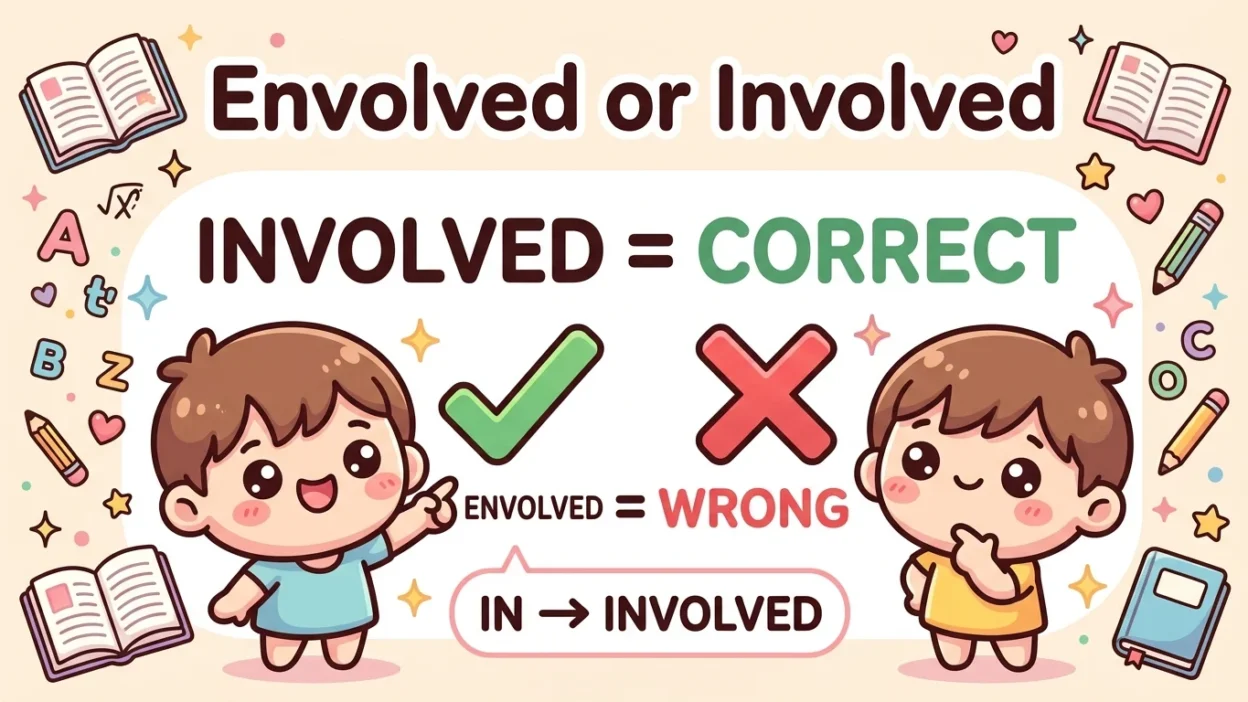
If you are wondering whether the correct spelling is envolved or involved, you are not alone. These words look quite similar, and the extra e can easily cause confusion when you type quickly or rely on pronunciation. However, when you want to describe participation, connection, or inclusion, involved is the correct standard English word.
More specifically, involved comes from the verb involve. It can describe taking part in an activity, including someone or something in a situation, or having a connection with a particular matter. In contrast, envolved does not serve as the standard spelling of involved in modern English. Therefore, if you are writing an email, assignment, article, application, or professional message, choose involved.
Quick Answer
Involved is the correct standard English word. It means participating in something, being connected to something, or including someone or something in a situation. Envolved is not the standard spelling for this meaning. Therefore, write involved, not envolved, in normal English.
Why People Confuse Envolved and Involved
People often confuse envolved and involved because both forms look plausible at first glance.
Moreover, English contains many words that begin with en-, so writers may naturally assume that envolved follows a similar spelling pattern. However, the correct word comes from involve, not envolve.
For example:
- involve → involved
- involve → involving
- involvement → noun
Therefore, the correct spelling remains connected to the original verb:
involve → involved
Not:
envolve → envolved
Involved: Meaning and Definition
Involved is the standard English form. It functions as the past tense and past participle of involve, and it can also function as an adjective.
The word has several common meanings.
1. Taking Part in Something
Involved can mean participating in an activity, event, project, or situation.
She was involved in the community project.
2. Connected With Something
It can also mean having a connection with a particular matter.
Several departments were involved in the investigation.
3. Including Someone or Something
Involve can mean to include someone in an activity or decision.
The manager involved the entire team in the discussion.
4. Complicated or Detailed
As an adjective, involved can describe something complicated or requiring considerable detail.
The process is quite involved.
Therefore, the exact meaning depends on the sentence and context.
Envolved: Is It Correct?
Envolved is generally not the correct standard English spelling when you mean involved.
For example:
❌ I was envolved in the project.
✅ I was involved in the project.
Similarly:
❌ She is envolved with the organization.
✅ She is involved with the organization.
Although envolved may appear as a spelling mistake, it should not replace involved in standard English writing.
Therefore, whenever you mean participation, connection, inclusion, or complexity, check whether involved fits your sentence.
Involved vs Envolved: Comparison Table
| Word | Standard English? | Meaning | Example |
|---|---|---|---|
| Involved | Yes | Participating, connected, included, or complicated | She was involved in the project. |
| Envolved | No, for this intended meaning | Usually a misspelling of involved | Avoid this spelling. |
When to Use Involved
Use involved whenever you want to describe participation, connection, inclusion, or complexity.
Involved in an Activity
Use involved in when someone participates in something.
He is involved in several volunteer activities.
Involved With a Person or Organization
Use involved with when someone has a connection or association with another person, group, or organization.
She is involved with a local charity.
Involved in a Situation
You can also use involved in when someone has a role or connection in a situation.
Several people were involved in the incident.
Involved as “Complicated”
You can use involved as an adjective to describe something complex.
The legal process was extremely involved.
18 Examples of Involved in Sentences
- She is involved in the school project.
- He became involved in community activities.
- Several students were involved in the competition.
- I am involved in organizing the event.
- They were deeply involved in the discussion.
- She became involved with the organization.
- The entire team was involved in the decision.
- He is actively involved in charity work.
- Many volunteers were involved in the program.
- She was involved in the planning process.
- We want everyone to feel involved.
- The manager involved the employees in the discussion.
- The teacher involved the students in the activity.
- Several departments were involved in the project.
- He was involved in the research.
- The situation became more involved than expected.
- The process requires an involved series of steps.
- Everyone should remain involved throughout the project.
Common Mistakes With Involved
Mistake 1: Writing Envolved
❌ She was envolved in the project.
✅ She was involved in the project.
This mistake usually happens because the writer expects the word to begin with en-.
Mistake 2: Adding an Extra E
The correct spelling contains:
I-N-V-O-L-V-E-D
Not:
E-N-V-O-L-V-E-D
Therefore, remember that involved starts with in-.
Mistake 3: Confusing Involve and Evolve
This confusion can also happen because involve and evolve are both common English verbs.
However, they have different meanings:
- Involve = include or participate in
- Evolve = develop or change gradually
For example:
The project involves five people.
The project evolved over several years.
Therefore, do not replace involve with evolve.
Mistake 4: Confusing Involved With Involving
These forms have different grammatical functions.
She is involved in the project.
The project is involving several departments.
The first describes someone’s participation, while the second describes something that includes or engages people.
Involved vs Involving
Because these forms look similar, learners sometimes use them incorrectly.
Involved commonly describes a person’s participation or a resulting state.
He is involved in the project.
Involving acts as the present participle of involve.
The project is involving several departments.
Therefore:
involve → involved → involving
Keeping this pattern in mind makes the spelling much easier.
Memory Trick for Involved
Here is a simple memory trick:
IN + VOLVE = INVOLVE
Then add -D:
INVOLVE → INVOLVED
Think:
I am IN the project → I am INVOLVED in the project.
This connection makes the correct spelling easier to remember.
So, whenever you are tempted to write envolved, remember:
I am IN → INvolved
American vs British English
The spelling involved remains the same in both American and British English.
| Variety | Correct Spelling |
|---|---|
| American English | involved |
| British English | involved |
| Australian English | involved |
| Canadian English | involved |
Therefore, you do not need to change the spelling based on your English variety.
Similar Words to Involved
Depending on the context, several words can express similar ideas.
If You Mean “Participating”
- participating
- engaged
- active
- contributing
- taking part
If You Mean “Connected”
- associated
- connected
- linked
- related
- concerned
If You Mean “Included”
- included
- incorporated
- engaged
- integrated
However, these words do not always carry exactly the same meaning. Therefore, involved may remain the best choice when you want to express participation or connection.
Involved vs Engaged
Involved and engaged often overlap, but they can emphasize different things.
Involved commonly highlights participation or connection.
She is involved in the project.
Engaged can emphasize active participation, attention, or commitment.
She is actively engaged in the project.
Therefore, both words can work in some contexts, but they are not always interchangeable.
Involved vs Included
These words also have related meanings.
Included means that someone or something forms part of a group, activity, or set.
Her name was included on the list.
Involved can mean that someone actively participates in something.
She was involved in organizing the event.
Therefore, included focuses more on being part of something, while involved often emphasizes participation or connection.
Final Verdict: Envolved or Involved?
The correct standard English spelling is involved.
Use involved when you mean participating in something, being connected to something, including someone in an activity, or describing something complicated.
On the other hand, envolved is not the standard spelling for these meanings. Therefore, avoid it in formal writing, academic work, professional communication, and everyday standard English.
The easiest rule to remember is:
Involve → Involved
Not:
Envolve → Envolved
Remember This
INVOLVED = CORRECT
ENVOLVED = INCORRECT for the intended meaning
Remember:
I am IN → I am INvolved.
Therefore, if you are unsure, choose involved.
FAQs
Is “envolved” a correct word?
For the meaning normally intended by speakers who write “envolved,” the standard English word is involved. Therefore, use involved when you mean participating, connected, included, or associated.
Is “involved” the correct spelling?
Yes. Involved is the correct spelling. It comes from the verb involve, as in involve → involved.
What does involved mean?
Involved can mean participating in something, connected with something, included in an activity, or complicated, depending on context.
Should I say “involved in” or “envolved in”?
Use involved in. For example, “She is involved in the project” is correct, while “She is envolved in the project” is a spelling error.
What is the difference between involved and involving?
Involved commonly describes participation or a resulting state, while involving functions as the present participle of involve. For example, “He is involved in the project” and “The project is involving several teams.”
Is “involved with” correct?
Yes. Involved with is correct when you want to describe someone’s association or connection with a person, group, organization, or activity.
What is the opposite of involved?
The opposite depends on the context. Possible alternatives include uninvolved, disengaged, unconnected, or excluded. However, the best opposite depends on what “involved” means in the specific sentence.
Conclusion
Ultimately, involved is the correct standard English word, while envolved usually represents a spelling mistake. Although the extra e may seem natural because English contains many words beginning with en-, the correct verb remains involve. Therefore, its past and participle form remains involved.
Moreover, involved has several useful meanings, including participating, being connected, being included, and being complicated. Consequently, you will encounter it frequently in everyday conversations, academic writing, professional communication, and formal documents. Above all, remember the simple pattern: involve → involved.

Euroa Alinta is a dedicated author known for crafting engaging and insightful content. With a strong passion for storytelling and digital publishing, Euroa specializes in creating informative, reader-friendly articles. Her work reflects creativity, clarity, and authenticity, connecting audiences with meaningful ideas across diverse topics and interests.