If you have ever wondered whether “He is risen” or “He has risen” is correct, you have probably noticed both expressions in religious writing, Easter messages, songs, sermons, and everyday discussions. Interestingly, both expressions can be grammatically correct, but they use different grammatical structures and can carry slightly different emphasis.
More specifically, “He has risen” uses the present perfect tense and describes a completed action with present relevance. Meanwhile, “He is risen” uses is + risen, where risen functions as a past participle in a construction that has a long history in English, particularly in religious and traditional language. Therefore, the choice depends on context, tone, and the style you want to communicate.
Quick Answer
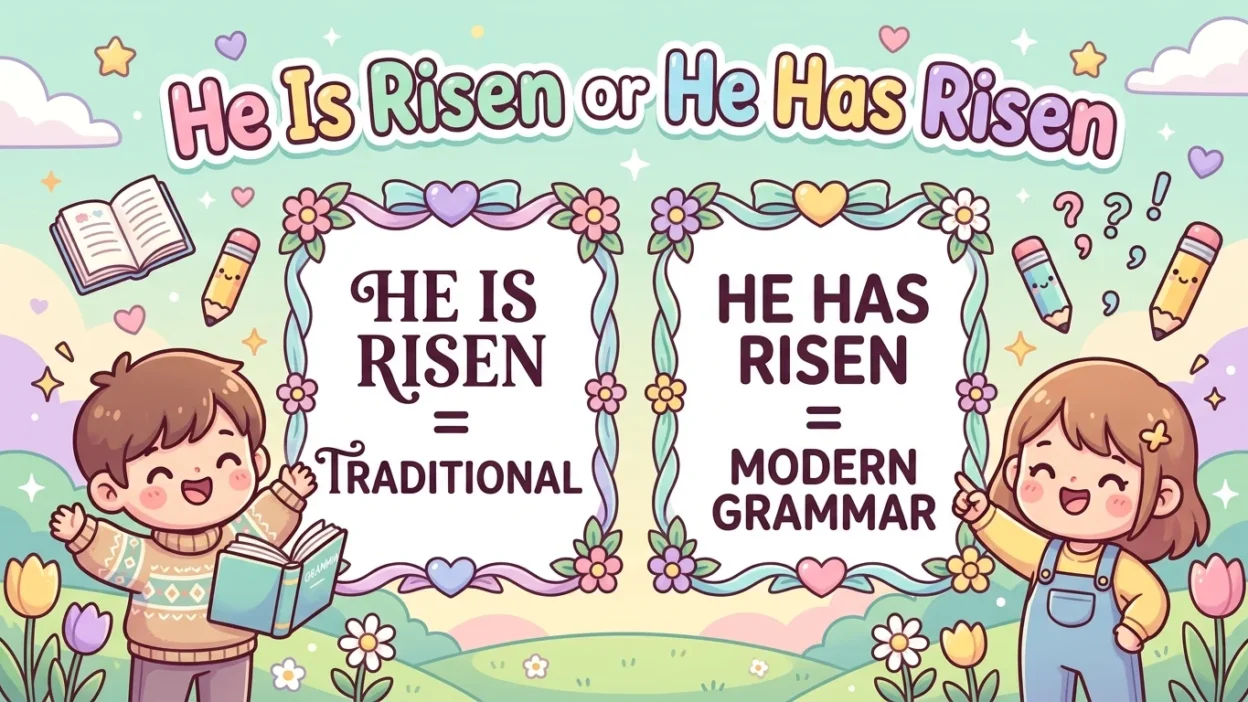
Both “He is risen” and “He has risen” can be correct. However, “He has risen” follows the modern present-perfect construction and means that he rose and remains risen. “He is risen” represents a traditional construction, especially associated with religious and biblical language. Both can communicate the resurrection of Jesus.
Why People Confuse “He Is Risen” and “He Has Risen”
People often confuse these expressions because risen serves as the key word in both.
At first, the structures may look interchangeable. However, they actually approach the same idea from slightly different grammatical perspectives.
He has risen follows this structure:
Subject + has + past participle
He has risen.
Meanwhile, he is risen follows:
Subject + is + past participle
He is risen.
The second construction may sound unusual to modern speakers because English usually uses has risen when describing someone who has completed the action of rising.
Nevertheless, “He is risen” has a long-standing place in traditional religious English. Therefore, you may encounter it frequently in Easter greetings and Christian liturgical language.
“He Has Risen”: Meaning and Grammar
He has risen uses the present perfect tense.
The structure looks like this:
He + has + risen
Here, has functions as the auxiliary verb, while risen functions as the past participle of rise.
The verb forms are:
- Rise = present/base form
- Rose = simple past
- Risen = past participle
For example:
He rises every morning.
He rose early yesterday.
He has risen already.
Therefore, “He has risen” follows a familiar modern English grammatical pattern.
What Does “He Has Risen” Mean?
The expression means that he rose, and that completed action has relevance to the present situation.
In a Christian context, “He has risen” communicates that Jesus rose from the dead and remains alive.
For example:
Jesus has risen from the dead.
The sentence focuses on the completed resurrection while connecting that event to the present.
“He Is Risen”: Meaning and Grammar
He is risen uses a different construction.
Here, is acts as the linking verb, while risen describes the resulting state.
The expression has a traditional and somewhat formal or archaic character.
In particular, “He is risen” appears in Christian religious language associated with the resurrection of Jesus.
For example:
He is risen!
This expression does not sound like ordinary modern conversation. Instead, it sounds ceremonial, traditional, and religious.
Therefore, although “he is risen” may seem unusual if you learned modern English grammar through standard tense patterns, it has a recognized historical and religious usage.
He Is Risen vs He Has Risen: Comparison Table
| Expression | Grammar | Meaning | Tone | Common Context |
|---|---|---|---|---|
| He has risen | Present perfect | He rose, with present relevance | Modern, natural | General writing and speech |
| He is risen | Traditional linking construction | He is in the risen state | Traditional, religious | Easter messages, worship, liturgy |
| He rose | Simple past | He completed the action of rising | Direct, historical | Narratives and historical writing |
| He is rising | Present progressive | He is currently rising | Literal/immediate | Physical action |
When to Use “He Has Risen”
Use “He has risen” when you want a modern English construction that follows the standard present-perfect pattern.
For example:
He has risen from the dead.
You can also use it when you want to emphasize the resurrection as a completed event that has significance now.
Examples
- He has risen!
- Jesus has risen from the dead.
- The Savior has risen, and the disciples have seen him.
- Christ has risen, bringing hope to his followers.
- He has risen just as the Scriptures foretold.
Therefore, “He has risen” works naturally in modern English while still expressing the religious meaning clearly.
When to Use “He Is Risen”
Use “He is risen” when you want a traditional, religious, ceremonial, or biblical-sounding expression.
For example:
He is risen!
This phrase commonly appears in Easter greetings and Christian worship.
A well-known Easter exchange uses:
“He is risen!”
with the response:
“He is risen indeed!”
This traditional wording gives the expression a solemn and celebratory character.
Therefore, “He is risen” remains especially appropriate when you intentionally want traditional religious language.
18 Examples of “He Has Risen”
- He has risen from the dead.
- Jesus has risen, and his followers rejoice.
- He has risen just as he promised.
- Christ has risen, bringing hope to believers.
- He has risen and conquered death.
- The message declares that he has risen.
- The disciples learned that he has risen.
- He has risen, and the tomb stands empty.
- Christians celebrate because he has risen.
- The Gospel announces that he has risen.
- He has risen from the grave.
- The Easter message proclaims that he has risen.
- The witnesses testified that he has risen.
- He has risen, and his followers celebrate his victory.
- The church announces that Christ has risen.
- He has risen according to the Christian faith.
- The congregation celebrated because he has risen.
- The Easter service proclaimed, “He has risen!”
18 Examples of “He Is Risen”
- He is risen!
- He is risen indeed!
- The Easter message begins, “He is risen!”
- The congregation proclaimed, “He is risen!”
- The pastor announced, “He is risen indeed!”
- Christians gathered to celebrate because he is risen.
- The Easter card simply read, “He is risen!”
- The traditional greeting declares, “He is risen!”
- The hymn celebrates the truth that he is risen.
- The church displayed a banner saying, “He is risen!”
- The Easter service repeated the words, “He is risen indeed!”
- The traditional message celebrates that he is risen.
- The congregation responded, “He is risen indeed!”
- The sermon centered on the declaration, “He is risen!”
- The celebration carried the message, “He is risen!”
- The Easter program featured the traditional words, “He is risen!”
- The religious artwork displayed the words, “He is risen!”
- The service concluded with the joyful declaration, “He is risen indeed!”
Common Mistakes
Mistake 1: Assuming Only “He Has Risen” Can Be Correct
Although “he has risen” follows a familiar modern grammatical pattern, “he is risen” also has an established traditional religious use.
Therefore, calling “he is risen” simply “wrong” misses its historical and stylistic context.
Mistake 2: Assuming Both Expressions Always Sound the Same
They do not.
He has risen sounds more like ordinary modern English.
He is risen sounds more traditional, ceremonial, and religious.
Consequently, your audience and purpose should influence your choice.
Mistake 3: Confusing “Risen” With “Rose”
Remember that rose and risen have different grammatical roles.
- Rose = simple past
- Risen = past participle
For example:
He rose from the dead.
He has risen from the dead.
You should not say:
He has rose.
Instead, use:
He has risen.
Mistake 4: Writing “He Has Rose”
This mistake happens when writers confuse the simple past form with the past participle.
❌ He has rose.
✅ He has risen.
The correct verb sequence is:
rise → rose → risen
Memory Trick
Here is an easy way to remember the forms:
Rise → Rose → Risen
Think:
Today: rise
Yesterday: rose
With has/have: risen
Therefore:
He rose.
He has risen.
However, when you see the traditional religious expression:
He is risen!
remember that this phrase has a special historical and ceremonial use.
Is “He Is Risen” Biblical?
The exact wording and translations can vary across Bible versions and languages. However, “He is risen” has become deeply established in Christian English, particularly through traditional Easter language and worship.
Meanwhile, modern translations may use constructions such as “He has risen.”
Therefore, the difference does not simply represent “correct versus incorrect.” Instead, it often reflects differences in translation tradition, historical English usage, and modern grammatical style.
American vs British English
Both American and British English recognize “he has risen” as a natural modern English construction.
Likewise, “he is risen” remains understandable in both varieties, especially in Christian religious contexts.
| English Variety | “He Has Risen” | “He Is Risen” |
|---|---|---|
| American English | Natural | Traditional/religious |
| British English | Natural | Traditional/religious |
| Australian English | Natural | Traditional/religious |
| Canadian English | Natural | Traditional/religious |
Therefore, the main difference involves style and context, rather than American versus British spelling.
He Has Risen vs He Rose
These expressions also differ in tense.
He rose uses the simple past.
He rose from the dead.
He has risen uses the present perfect.
He has risen from the dead.
The simple past presents the event as a completed past event.
Meanwhile, the present perfect connects the completed event with the present.
Therefore, both can describe the resurrection, but they frame the event differently.
He Is Risen vs He Rose
He rose sounds straightforward and historical.
He is risen sounds traditional and religious.
For example:
According to the Gospel account, he rose from the dead.
This sentence presents the event as a historical occurrence.
Meanwhile:
He is risen!
sounds like a proclamation or declaration of faith.
Consequently, the second expression carries a stronger ceremonial quality.
Is “He Is Risen” Grammatically Correct?
Yes, “he is risen” can be grammatically acceptable, particularly within traditional religious English.
However, modern speakers usually expect is + -ing for an ongoing action, such as:
He is rising.
That expectation can make “he is risen” sound unusual.
Nevertheless, English has historically used forms involving be + past participle to describe states or completed results. Religious language has preserved some of these constructions.
Therefore, “he is risen” should not automatically be treated as a grammatical mistake.
Final Verdict: He Is Risen or He Has Risen?
Both “He is risen” and “He has risen” can be correct, but they serve different stylistic purposes.
Use “He has risen” for a modern present-perfect construction that communicates a completed resurrection with present relevance. On the other hand, use “He is risen” when you want the traditional, ceremonial, and religious wording strongly associated with Easter.
Therefore, if you are writing a formal modern sentence, “He has risen” will usually sound more natural. However, if you are writing an Easter greeting, religious message, hymn, sermon, or traditional proclamation, “He is risen!” fits naturally.
Remember This
He has risen = modern present perfect
He is risen = traditional religious expression
And remember the verb forms:
Rise → Rose → Risen
So:
He rose.
He has risen.
He is risen! — traditional religious wording.
FAQs
Is “He is risen” correct English?
Yes. “He is risen” has an established traditional use, particularly in Christian religious language. Although it sounds less conversational than “he has risen,” it remains familiar and meaningful in Easter and worship contexts.
Is “He has risen” grammatically correct?
Yes. “He has risen” uses the present perfect correctly: has + risen. It provides a natural modern-English way to describe a completed action that has relevance to the present.
Which phrase should I use for Easter?
Both expressions can work. “He is risen!” carries a traditional, ceremonial Easter style, while “He has risen!” uses a more modern grammatical construction. Your choice can therefore depend on the tone you want.
What is the difference between “He is risen” and “He has risen”?
“He has risen” uses the present perfect and focuses on the completed action with present relevance. “He is risen” uses a traditional construction that emphasizes the resulting state and has strong religious associations.
Is “He has rose” correct?
No. The correct present-perfect form is “He has risen.” The verb forms are rise, rose, risen. Therefore, use rose for the simple past and risen after has, have, or had.
Why do Christians say “He is risen”?
The expression has become deeply established in traditional Christian English, particularly in Easter worship and greetings. It provides a short, celebratory proclamation of the resurrection.
Should I say “He is risen indeed” or “He has risen indeed”?
“He is risen indeed!” represents the traditional Easter response. “He has risen indeed!” also makes grammatical sense in modern English, but it does not carry the same traditional formulaic character.
Conclusion
Ultimately, “He is risen” and “He has risen” both have legitimate uses, although they belong to different grammatical and stylistic patterns. “He has risen” follows modern present-perfect grammar, whereas “He is risen” carries a traditional religious character that has become especially associated with Easter.
Therefore, choose according to your context. For everyday modern English, “he has risen” sounds natural. For traditional Christian language, Easter greetings, worship, and ceremonial expressions, “He is risen!” remains a familiar and meaningful choice.