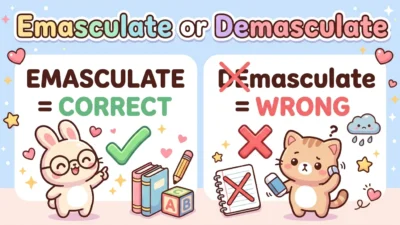
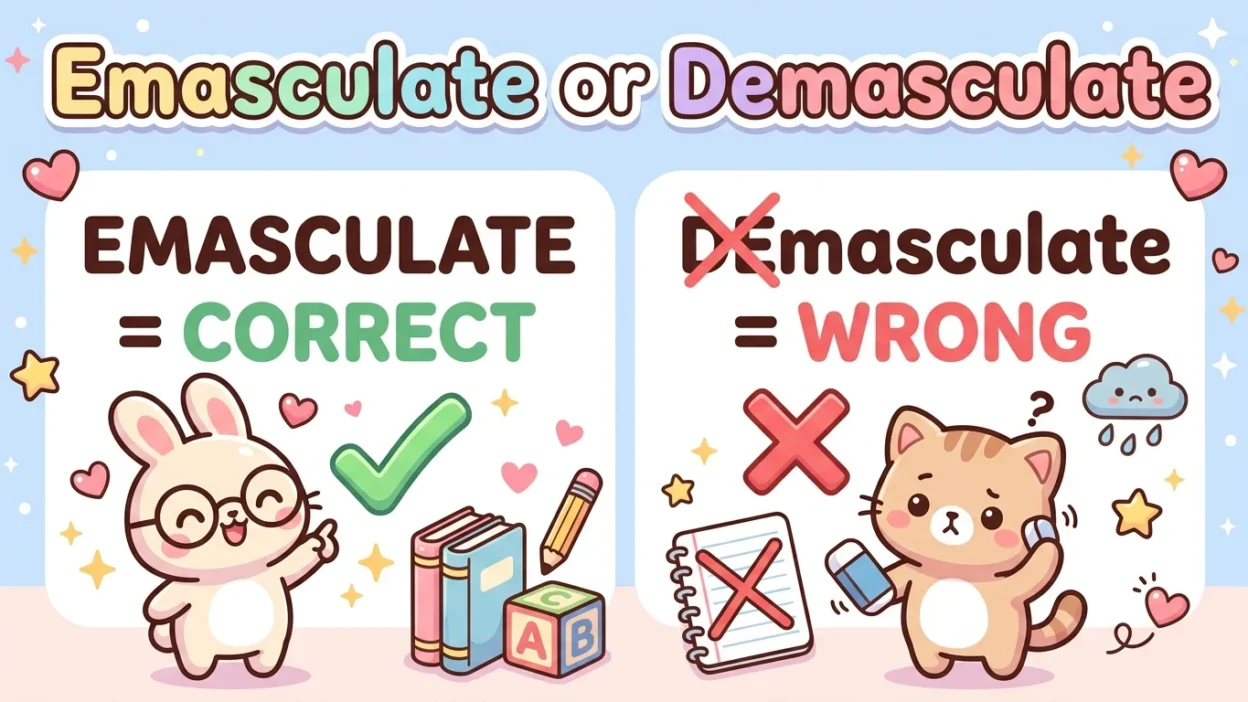
Emasculate or demasculate is a common spelling and word-choice question because both forms may look grammatically possible. However, standard English uses emasculate. The form demasculate does not function as the standard English word for this meaning. Therefore, if you want to describe something that makes a man feel less masculine or removes traditionally masculine qualities, emasculate is the correct choice.
Moreover, emasculate has several related meanings depending on context. It can describe making someone feel less masculine, depriving someone or something of strength or effectiveness, or, in a literal biological context, removing the male reproductive organs. Consequently, understanding the word’s context matters when you use it.
In everyday writing, however, you will most commonly encounter emasculate in figurative expressions. Therefore, learning its definition, pronunciation, examples, related forms, and common mistakes can help you use the word accurately and confidently.
Quick Answer
Emasculate is the correct standard English word. It can mean to make someone feel less masculine, weaken someone’s authority or effectiveness, or remove the male reproductive organs. Demasculate is not the standard word for these meanings, so use emasculate instead.
Why Do People Confuse Emasculate and Demasculate?
People may confuse these forms because English commonly uses the prefix de- to create words that express removal, reduction, or reversal.
For example:
- deactivate
- devalue
- defrost
- deconstruct
Therefore, demasculate may look logical because someone might assume that de- can combine with masculate.
However, English does not use demasculate as the standard form. Instead, the established word is emasculate.
Consequently, when you need this particular word, remember:
Correct: emasculate
Incorrect/nonstandard: demasculate
Emasculate: Meaning and Definition
Emasculate is a verb with several related meanings.
First, it can mean to make a man or male feel less masculine.
For example:
His constant criticism made him feel emasculated.
Second, it can mean to weaken someone’s authority, power, effectiveness, or strength.
For example:
The new restrictions emasculated the organization.
Third, in a literal biological sense, emasculate can mean to remove the male reproductive organs.
Therefore, the exact meaning depends on the context.
Simple Meaning of Emasculate
Emasculate = to make less masculine, weaken, or remove male reproductive organs.
The figurative meaning often relates to masculinity, confidence, power, authority, or effectiveness.
Demasculate: Is It a Correct Word?
Demasculate is not the standard English word for the meanings associated with emasculate.
Therefore, avoid using it in formal, academic, professional, or edited English when you mean emasculate.
For example:
❌ He felt demasculated by the criticism.
✅ He felt emasculated by the criticism.
Similarly:
❌ The policy demasculated the organization.
✅ The policy emasculated the organization.
Consequently, if you are deciding between these two forms, choose emasculate.
Emasculate vs Demasculate: Comparison Table
| Word | Status | Meaning | Example |
|---|---|---|---|
| Emasculate | Correct standard English | To make less masculine, weaken, or remove male reproductive organs | The criticism made him feel emasculated. |
| Demasculate | Nonstandard for this meaning | Not the standard form | Avoid this form in formal English. |
Therefore, emasculate is the form you should use in standard English.
When to Use Emasculate
Use emasculate when you want to describe an action that makes someone feel less masculine.
For example:
The character felt emasculated after losing his position.
You can also use it when describing something that weakens authority or effectiveness.
For example:
The changes emasculated the committee.
Additionally, the word can have a literal biological meaning.
For example:
The procedure emasculated the animal.
However, because this meaning can sound clinical or technical, always consider the context before using the word.
Emasculate as a Verb
The base form is:
emasculate
Common forms include:
- emasculate — present/base form
- emasculated — past tense/past participle
- emasculating — present participle
- emasculation — noun
- emasculated — adjective in many contexts
For example:
The experience emasculated him.
He felt emasculated after the incident.
The policy resulted in the emasculation of the organization’s authority.
Therefore, learning the related forms can help you recognize the word in different sentences.
Emasculate or Demasculate: 18 Examples
Correct Examples With Emasculate
- The criticism made him feel emasculated.
- He worried that losing his job would emasculate him.
- The character felt emasculated after the defeat.
- His colleagues did not intend to emasculate him.
- The experience left him feeling emasculated.
- The restrictions could emasculate the organization’s authority.
- The new rules emasculated the committee.
- The decision significantly emasculated the department.
- The leader refused to let criticism emasculate him.
- The situation made him feel emasculated and powerless.
- The policy emasculated the agency’s ability to act.
- The article discusses the social meaning of emasculation.
- He described the experience as deeply emasculating.
- The defeat was emasculating for the character.
- The changes effectively emasculated the institution.
- The procedure can emasculate a male animal.
- The story explores themes of masculinity and emasculation.
- He felt emasculated when others questioned his authority.
Common Mistakes
Mistake 1: Writing Demasculate
Incorrect:
The experience demasculated him.
Correct:
The experience emasculated him.
Therefore, use emasculate, not demasculate.
Mistake 2: Assuming Emasculate Only Means “Remove Masculinity”
Although emasculate can describe making someone feel less masculine, it can also mean to weaken power or effectiveness.
For example:
The new restrictions emasculated the organization.
Here, the word describes weakened effectiveness rather than someone’s personal masculinity.
Mistake 3: Confusing Emasculate With Emancipate
These words look somewhat similar, but their meanings differ greatly.
- Emasculate = weaken, make less masculine, or remove male reproductive organs.
- Emancipate = set someone free from legal, social, or political control.
Therefore, context matters.
Easy Memory Trick
Remember the correct spelling with:
E = Emasculate
Think:
Emasculate is the Established form.
Or simply remember:
EMASCULATE = correct
DEmasculate = avoid
Therefore, whenever you are unsure, choose emasculate.
American vs British English
Emasculate appears in both American and British English.
Moreover, the spelling remains the same in both varieties.
- American English: emasculate
- British English: emasculate
Therefore, you do not need to choose a different spelling based on whether you are writing for an American or British audience.
Similar Words
Several words can express ideas related to emasculate, although they do not have exactly the same meaning.
Weaken
Weaken means to make something less strong or effective.
The changes weakened the organization.
Undermine
Undermine means to weaken someone’s authority, confidence, or position, often gradually.
The criticism undermined his confidence.
Humiliate
Humiliate means to make someone feel deeply embarrassed or ashamed.
The public criticism humiliated him.
Castrate
Castrate has a specific literal biological meaning involving removal of the testicles. It can also appear figuratively in some contexts.
Therefore, although it can overlap with one meaning of emasculate, the two words are not always interchangeable.
Final Verdict: Emasculate or Demasculate?
Emasculate is the correct standard English word. Use it when you mean to make someone feel less masculine, weaken someone’s power or effectiveness, or describe the literal removal of male reproductive organs.
Demasculate is not the standard form for these meanings. Therefore, avoid it in formal and polished English.
The easiest rule is:
Emasculate = correct
Demasculate = not the standard form
Remember This
Use EMASCULATE, not DEMASCULATE.
Moreover, remember that emasculate can describe masculinity, strength, authority, effectiveness, or a literal biological process depending on the context.
FAQs
Is emasculate or demasculate correct?
Emasculate is the correct standard English word. Demasculate is not the standard form used for these meanings.
What does emasculate mean?
Emasculate can mean to make someone feel less masculine, weaken someone’s authority or effectiveness, or remove the male reproductive organs in a literal context.
Is demasculate a real English word?
You may encounter demasculate occasionally, but it is not the standard English form for the meanings normally expressed by emasculate. In formal writing, use emasculate.
What is the noun form of emasculate?
The noun form is emasculation.
For example:
The novel explores themes of emasculation and masculinity.
What is the adjective form of emasculate?
Emasculated commonly works as an adjective.
For example:
He felt emasculated after the criticism.
Can emasculate mean weaken?
Yes. Emasculate can mean to weaken something, particularly its power, authority, strength, or effectiveness.
Is emasculate offensive?
The word itself is not inherently offensive, but its use can sound sensitive or loaded when it describes someone’s masculinity. Therefore, consider the context and audience carefully.
Conclusion
Ultimately, emasculate is the correct standard English word, while demasculate is not the standard choice. Therefore, when you want to describe making someone feel less masculine, weakening authority or effectiveness, or referring to a literal biological meaning, use emasculate.
Moreover, the distinction becomes easy once you remember the spelling. Emasculate is the established form, whereas demasculate can result from incorrectly applying the common de- prefix. Consequently, choosing emasculate will keep your writing accurate and polished.