
Have you ever wondered whether to write extensible or extendible? Both words look correct, and both relate to the idea of making something longer, broader, or more adaptable. However, their usage can depend on context, writing style, and the field you are discussing. As a result, choosing between them can feel confusing.
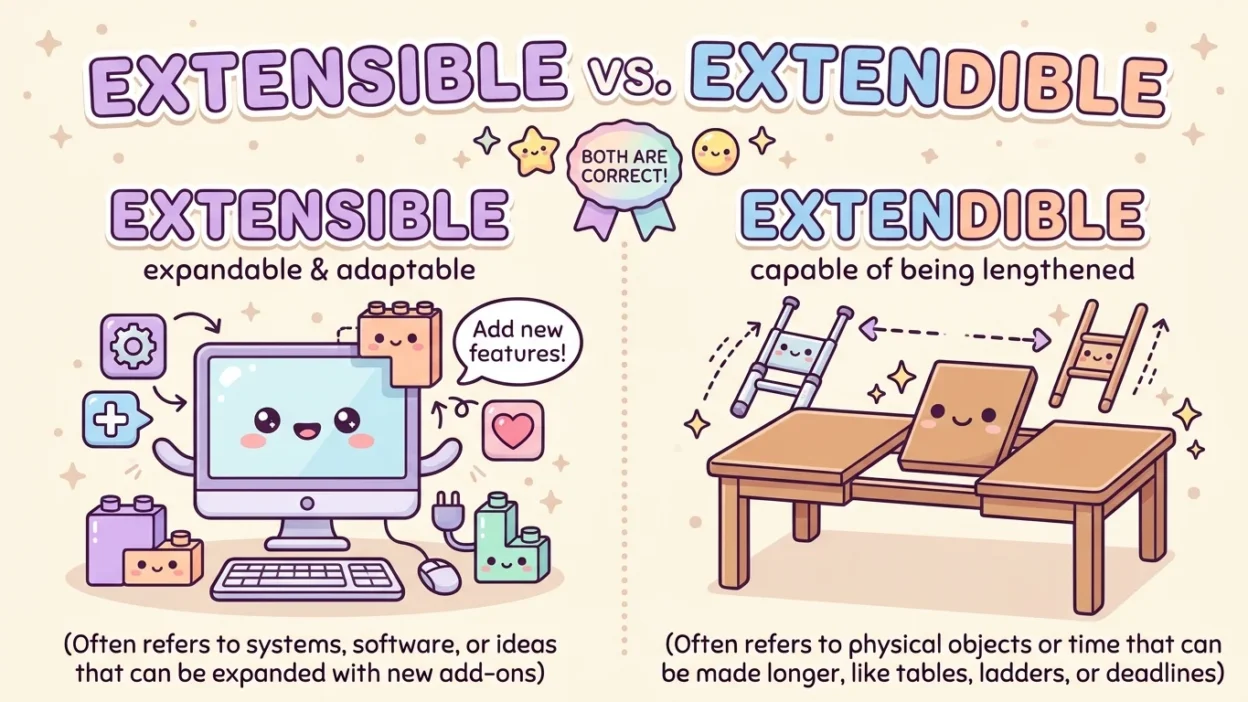
The good news is that both extensible and extendible are valid English words. They share a similar meaning, but writers often prefer one form in particular contexts. For example, extensible appears frequently in technology, software development, and discussions about adaptable systems. Meanwhile, extendible often describes something that can physically or practically be extended.
Quick Answer: Extensible vs Extendible
Both extensible and extendible are correct adjectives meaning capable of being extended, lengthened, or expanded. However, extensible often appears in technical and computing contexts, especially when something allows future additions or modifications. Extendible also works, particularly when describing something that can physically or practically become longer.
Why Do People Confuse Extensible and Extendible?
People confuse these words because they share the same root idea: extend. Moreover, both adjectives describe something that can grow, expand, or become longer.
Their spelling also creates uncertainty. One word uses the ending -sible, while the other uses -dible. Although the difference looks significant, their meanings overlap considerably.
Furthermore, dictionaries recognize both forms. Therefore, neither spelling automatically counts as incorrect. Instead, the intended meaning and context help determine which word sounds more natural.
What Does Extensible Mean?
Extensible is an adjective that describes something capable of being extended, expanded, or modified.
In particular, writers often use it when discussing systems, structures, software, designs, and plans that allow additional features or improvements.
Examples of Extensible
- The software uses an extensible architecture that supports new features.
- We need an extensible system that can accommodate future changes.
- The platform offers an extensible framework for developers.
- This design provides an extensible structure for additional components.
- The company created an extensible product that users can customize.
- An extensible database can support additional information fields.
- The application follows an extensible model.
- Our team developed an extensible solution for growing businesses.
- The programming language offers several extensible features.
- The website uses an extensible content management system.
When Should You Use Extensible?
Use extensible when you want to emphasize adaptability, expandability, or the ability to accommodate future additions.
For example, you might describe software as extensible because developers can add new functions without redesigning the entire application.
What Does Extendible Mean?
Extendible is an adjective that means capable of being extended, lengthened, or made larger.
It often describes objects, structures, arrangements, or other things that someone can physically or practically extend.
Examples of Extendible
- The table has an extendible section for extra guests.
- We purchased an extendible ladder for the renovation.
- The contract includes an extendible deadline.
- This camera has an extendible lens.
- The company offers an extendible warranty.
- The sofa includes an extendible footrest.
- They installed an extendible arm on the machine.
- The agreement contains an extendible renewal period.
- The device features an extendible handle.
- The schedule includes an extendible time frame.
When Should You Use Extendible?
Use extendible when you want to describe something that can become longer, larger, or continue for a longer period.
For instance, an extendible table can increase its length to provide additional seating. Similarly, an extendible deadline can move to a later date.
Extensible vs Extendible: Comparison Table
| Feature | Extensible | Extendible |
|---|---|---|
| Part of speech | Adjective | Adjective |
| Meaning | Capable of expansion or modification | Capable of being extended or lengthened |
| Common context | Technology, software, systems, designs | Objects, periods, agreements, structures |
| Technical usage | Very common | Less common |
| Physical extension | Possible | Common |
| Correct spelling | Yes | Yes |
When to Use Each Word
Although both words can describe something capable of expansion, their usual contexts differ.
Use extensible when:
- You describe software or technology that supports new features.
- You discuss adaptable systems or frameworks.
- You explain how a design can accommodate future additions.
- You refer to structures that allow modification or expansion.
Use extendible when:
- You describe an object that can become physically longer.
- You discuss a deadline or agreement that can continue.
- You explain how a component can extend outward.
- You refer to something that can increase in length or duration.
However, these distinctions represent common preferences rather than strict grammatical rules. Depending on the context, either adjective may work.
Common Mistakes When Using Extensible and Extendible
Even though both spellings are correct, writers sometimes use them inconsistently or misunderstand their meanings.
Here are some mistakes to avoid:
- Assuming extendible is always incorrect: Dictionaries recognize extendible as a valid adjective.
- Assuming extensible only describes software: The word can also describe other expandable or adaptable things.
- Treating the words as completely unrelated: Both communicate the ability to extend or expand.
- Choosing a spelling without considering context: Think about whether you mean adaptability, physical length, or additional duration.
- Changing spellings throughout one document: Choose the form that suits your context and use it consistently.
Extensible vs Extendible: Memory Trick
Remember this simple distinction:
- Extensible = Expandable and adaptable.
- Extendible = Able to extend or become longer.
Think of an extensible software platform that welcomes new features. Meanwhile, picture an extendible table that becomes longer when you need more space.
Although this trick helps you remember common usage, keep in mind that the meanings overlap.
American vs British English: Extensible or Extendible?
Both extensible and extendible appear in English dictionaries and are understood in American and British English.
Neither spelling belongs exclusively to one variety of English. Instead, writers choose according to context, convention, and personal or organizational style.
In technical writing, extensible often serves as the preferred choice, particularly when describing software, programming languages, and adaptable systems. Nevertheless, extendible remains acceptable when the writer wants to describe something capable of extension.
Similar Words to Extensible and Extendible
Several other adjectives communicate related meanings. Understanding them can help you choose more precise vocabulary.
- Expandable: Capable of increasing in size, capacity, or scope.
- Extendable: Capable of being extended or lengthened.
- Adaptable: Able to adjust to new conditions.
- Modifiable: Capable of being changed or adjusted.
- Scalable: Able to handle growth or increased demand.
- Expandable: Able to accommodate additional space, content, or features.
- Adjustable: Able to change according to a particular need.
For example, an adaptable software system can respond to changing requirements, whereas an extendable table can provide extra seating.
Frequently Asked Questions
Is extensible a real word?
Yes. Extensible is a standard English adjective that describes something capable of being extended, expanded, or modified. Writers frequently use it in technology, software development, and discussions about adaptable systems.
Is extendible a real word?
Yes. Extendible is also a correct English adjective. It describes something capable of being lengthened, expanded, or extended. For example, an extendible table can increase its length to accommodate additional people.
Are extensible and extendible interchangeable?
Often, yes. Both words can describe something capable of extension or expansion. However, extensible appears more frequently in technical discussions, while extendible often describes physical objects or arrangements that can become longer.
Which spelling is more common in software development?
Extensible is generally the more familiar choice in software development. Developers use it to describe systems, frameworks, and architectures that support additional features, integrations, or modifications.
Is extendable the same as extendible?
They have very similar meanings. Both describe something that can be extended or lengthened. However, extendable is another widely recognized alternative, and the best choice depends on the sentence and preferred style.
Can I use extensible for physical objects?
Yes. Extensible can describe physical things that can expand or extend. Nevertheless, extendible or extendable may sound more natural in certain everyday contexts, such as describing a table, ladder, or handle.
Which word should I use in formal writing?
Both words are acceptable in formal writing. However, choose extensible when discussing adaptable systems or technical designs, and consider extendible when describing something that can become longer or continue for a longer period.
Final Verdict: Extensible vs Extendible
The difference between extensible and extendible is not a matter of correct versus incorrect spelling. Both words are valid English adjectives, and both describe the ability to extend, expand, or become longer.
However, extensible often works better in technical contexts involving software, systems, and adaptable designs. In contrast, extendible frequently appears when describing physical objects, deadlines, agreements, and other things that can become longer.
Remember This
Extensible = capable of expansion or adaptation.
Extendible = capable of being extended or lengthened.
Both spellings are correct, so choose the one that communicates your intended meaning most naturally.
Conclusion
Ultimately, choosing between extensible and extendible depends on your context rather than a strict spelling rule. Both words describe something that can be extended, although writers often prefer extensible for technical and adaptable systems and extendible for physical or practical extensions.
Therefore, consider what you want to describe before choosing a spelling. When discussing expandable software or flexible frameworks, use extensible. Meanwhile, when describing an extendible table, deadline, or handle, that spelling works naturally. Most importantly, remain consistent throughout your writing.