
Have you ever wondered whether to write heard, herd, or hurd? These three words sound exactly the same in many English accents, so it is easy to confuse them when speaking, texting, or writing. However, their meanings and uses differ significantly. Therefore, understanding the distinction can help you avoid spelling mistakes and communicate more clearly.
First, heard is the past tense and past participle of hear. Meanwhile, herd is a noun for a group of animals and a verb that means to gather or move people or animals together. In contrast, hurd is not the standard spelling of either word in ordinary English. Consequently, choosing the correct word depends on what you want to say. Once you understand their meanings, you can easily remember when to use each spelling.
Quick Answer
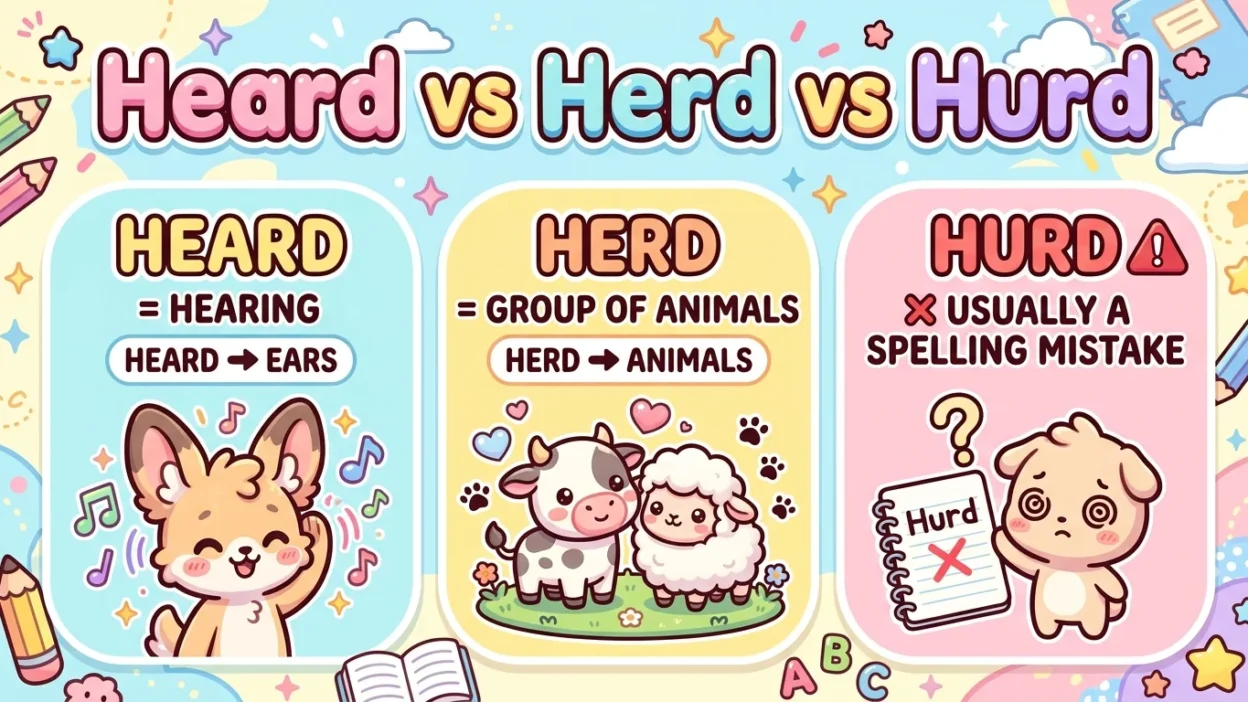
Heard means received sound or listened to something. Herd means a group of animals or the act of gathering and moving a group. Hurd is generally a misspelling when someone intends heard or herd. Therefore, choose heard for listening and herd for groups or gathering.
Why People Confuse Heard, Herd, and Hurd
People often confuse these words because they are homophones: words that sound alike but have different spellings and meanings.
Moreover, English spelling does not always follow pronunciation consistently. As a result, you might hear the same sound but struggle to choose the correct written form.
Here is the simplest distinction:
- Heard = listened to or received a sound.
- Herd = a group of animals or to gather and move a group.
- Hurd = generally an incorrect spelling of heard or herd in ordinary writing.
Therefore, always consider the meaning of your sentence before choosing a spelling.
Heard: Meaning and Definition
Heard is the past tense and past participle of the verb hear. It describes receiving a sound, listening to something, or learning information through hearing.
For example:
- I heard a strange noise last night.
- She has heard the announcement.
- We heard the news yesterday.
Additionally, people use heard in expressions such as “I heard that,” when they want to explain that someone told them something or that they learned information.
Examples of Heard in Sentences
- I heard music coming from the next room.
- She heard the phone ringing.
- We heard the announcement at school.
- He heard a bird singing outside.
- They heard the news this morning.
- I have heard that story before.
- She heard someone knocking on the door.
- The teacher heard the students talking.
- We heard an interesting explanation.
- He heard his name over the speaker.
- I heard your message yesterday.
- They have heard about the new project.
- She heard footsteps in the hallway.
- I heard that the event was cancelled.
- Everyone heard the loud explosion.
- He had heard the song many times.
- We heard the audience cheering.
- Have you heard the latest news?
Herd: Meaning and Definition
Herd has two common uses in English. First, it functions as a noun that describes a group of animals, particularly cattle, elephants, deer, or similar animals.
For example:
A herd of elephants crossed the grassland.
Second, herd functions as a verb meaning to gather, guide, or move a group of people or animals in a particular direction.
For example:
The farmer herded the sheep into the field.
Furthermore, people sometimes use herd informally when describing groups of people who move together or follow others.
Examples of Herd as a Noun
- A herd of cows grazed in the field.
- We saw a herd of elephants near the river.
- A herd of deer crossed the road.
- The farmer counted his herd of cattle.
- A large herd of buffalo moved across the plain.
- The documentary followed a herd of wild horses.
- A herd of goats climbed the hillside.
- The shepherd watched the herd carefully.
- A herd of zebras gathered near the water.
- The herd moved toward fresh grass.
Examples of Herd as a Verb
- The farmer herded the cattle into the barn.
- She herded the children toward the classroom.
- The shepherd herded the sheep across the field.
- Workers herded the crowd away from the entrance.
- The rancher herds cattle every morning.
- The guide herded the tourists onto the bus.
- He tried to herd the goats into the pen.
- The staff herded everyone toward the exit.
Hurd: Meaning and Definition
Hurd is not the standard English spelling for the listening-related meaning of heard or the group-related meaning of herd.
Therefore, if you write:
❌ I hurd a noise.
The correct sentence is:
✅ I heard a noise.
Similarly:
❌ A hurd of cows crossed the field.
The correct sentence is:
✅ A herd of cows crossed the field.
However, Hurd can appear as a surname or proper name. Consequently, do not assume that every occurrence of Hurd is a spelling mistake. In ordinary sentences about listening or groups of animals, though, use heard or herd according to the meaning.
Heard vs Herd vs Hurd: Comparison Table
| Word | Part of Speech | Meaning | Example |
|---|---|---|---|
| Heard | Verb | Past tense of hear | I heard a sound. |
| Herd | Noun | A group of animals | A herd of cows grazed nearby. |
| Herd | Verb | To gather or move a group | They herded the sheep home. |
| Hurd | Usually a proper name | A surname or other name | Mr. Hurd arrived early. |
When to Use Heard
Use heard whenever you describe a sound or information that someone received through hearing.
For example, use it when discussing music, conversations, announcements, rumours, or news.
- I heard a beautiful song.
- She heard the instructions clearly.
- We heard about the competition.
- He has heard the same explanation before.
Moreover, remember that heard can appear with auxiliary verbs such as have, has, and had.
For example:
I have heard that expression before.
Therefore, if your sentence involves listening or receiving information, heard is usually the word you need.
When to Use Herd
Use herd when you mean a group of animals or when you describe gathering and moving a group.
For example:
A herd of cattle stood near the fence.
However, when you use it as a verb, the word changes according to tense.
- Present: herd
- Past: herded
- Present participle: herding
For example:
The farmer herded the cattle yesterday.
Therefore, choose herd when your sentence describes a group or the action of moving a group together.
Common Mistakes With Heard, Herd, and Hurd
Mistake 1: Writing Hurd Instead of Heard
Incorrect: I hurd the alarm this morning.
Correct: I heard the alarm this morning.
Because heard refers to listening or receiving sound, it fits the sentence.
Mistake 2: Writing Heard Instead of Herd
Incorrect: A heard of elephants entered the forest.
Correct: A herd of elephants entered the forest.
Here, the sentence describes a group of animals, so herd is correct.
Mistake 3: Using Herd When You Mean Heard
Incorrect: I herd the announcement yesterday.
Correct: I heard the announcement yesterday.
Although the words sound alike, their meanings differ.
Mistake 4: Assuming Hurd Is Always Wrong
Hurd is generally incorrect when you intend heard or herd. However, it can be a legitimate surname or proper name. Therefore, always check the context before judging its spelling.
Memory Trick for Heard, Herd, and Hurd
Here is an easy way to remember all three words.
HEARD = EAR
Think about your ears. When you listen to a sound, you hear it. Afterward, you heard it.
HERD = ANIMALS
Think about cows, sheep, elephants, or deer standing together in a group. That group is a herd.
HURD = CHECK THE CONTEXT
In ordinary writing, hurd usually signals a spelling mistake if you mean listening or an animal group. However, it may be correct as a name.
Remember this simple formula:
- HEARD → ears and sounds
- HERD → animals and groups
- HURD → usually a misspelling in these contexts
American vs British English
The spelling and basic meanings of heard and herd remain the same in American and British English. Likewise, hurd does not replace either word in standard usage.
| English Variety | Listening | Group of Animals |
|---|---|---|
| American English | Heard | Herd |
| British English | Heard | Herd |
| Australian English | Heard | Herd |
| Canadian English | Heard | Herd |
Therefore, you do not need to change these spellings according to the variety of English you use.
Heard vs Herd: What Is the Difference?
Although heard and herd sound alike, their grammatical roles and meanings differ.
Heard relates to hearing something.
I heard the cows making noise.
Herd describes the group itself.
The herd of cows stood near the gate.
Notice that you can use both words in the same sentence:
I heard a herd of cows moving through the field.
This example provides a useful way to remember the distinction because both words appear naturally in one sentence.
Are Heard, Herd, and Hurd Homophones?
Heard and herd are homophones in many English accents because they share the same pronunciation but have different meanings and spellings.
Hurd, when used as a surname, may also share that pronunciation. However, it is not the standard spelling for the common words heard or herd.
Therefore, these words demonstrate why English spelling requires attention to meaning as well as pronunciation.
Similar Words That People Confuse
English contains many words that sound alike but have different meanings. For example:
- Hear vs here: Hear means perceive sound, while here refers to a place.
- There vs their vs they’re: These words have different grammatical functions despite similar pronunciation.
- Bare vs bear: Bare means uncovered, while bear can refer to an animal or the act of carrying something.
- Right vs write: Right can mean correct, while write means to form words.
- Sea vs see: Sea refers to a large body of salt water, while see means perceive with your eyes.
Similarly, heard vs herd vs hurd requires you to consider meaning before choosing a spelling.
Final Verdict: Heard vs Herd vs Hurd
The correct word depends on your intended meaning. Heard is the past tense and past participle of hear, while herd refers to a group of animals or the act of gathering and moving a group. In contrast, hurd is generally a misspelling when you intend either of those common words, although it can appear as a proper name.
Therefore, remember the difference: you heard a sound, you saw a herd of animals, and you should normally avoid hurd for either meaning. Once you connect each spelling with its meaning, you can use all three forms more confidently.
Remember This
HEARD = HEAR SOMETHING
HERD = A GROUP OF ANIMALS OR TO MOVE A GROUP
HURD = USUALLY INCORRECT FOR THESE MEANINGS
For example:
I heard a noise near the herd of cattle.
That single sentence helps you remember the two common words and their different meanings.
FAQs
Is heard or herd correct?
Both words are correct, but they have different meanings. Heard is the past tense of hear, while herd means a group of animals or the act of moving a group together.
Is hurd a real word?
Hurd can appear as a surname or proper name. However, it is not the standard spelling of heard or herd in ordinary English.
What is the difference between heard and herd?
Heard relates to listening or receiving sound, whereas herd refers to a group of animals or the action of gathering and moving a group.
How do you spell heard correctly?
The correct spelling is heard when you mean the past tense or past participle of hear. For example, “I heard the announcement yesterday.”
How do you spell herd correctly?
The correct spelling is herd when you mean a group of animals or the act of gathering and moving a group. For example, “A herd of cows crossed the field.”
Are heard and herd homophones?
Yes. Heard and herd sound the same in many English accents, but they have different spellings and meanings.
Can I use heard and herd in the same sentence?
Yes. For example, “I heard a herd of sheep moving across the field.” Here, heard describes listening, while herd identifies the group of sheep.
Conclusion
Ultimately, heard, herd, and hurd may sound alike, but their uses differ. Choose heard when you discuss listening, herd when you describe a group of animals or the action of moving a group, and hurd only when the context supports it as a name or another proper form.
Moreover, you can avoid these common spelling mistakes by connecting each word with a simple memory clue. Heard relates to ears, herd relates to groups, and hurd usually does not fit either meaning. Therefore, always consider what your sentence means before choosing the spelling.