Many learners confuse “invision” and “envision” because they look and sound similar.
However, only one of them works in standard English, so choosing the wrong word can weaken your writing.
So, if you want clear and professional English, you need to know the correct form. In this guide, you’ll learn the meaning, see examples, and avoid this common mistake easily.
Quick Answer
✨ Let’s make it super clear:
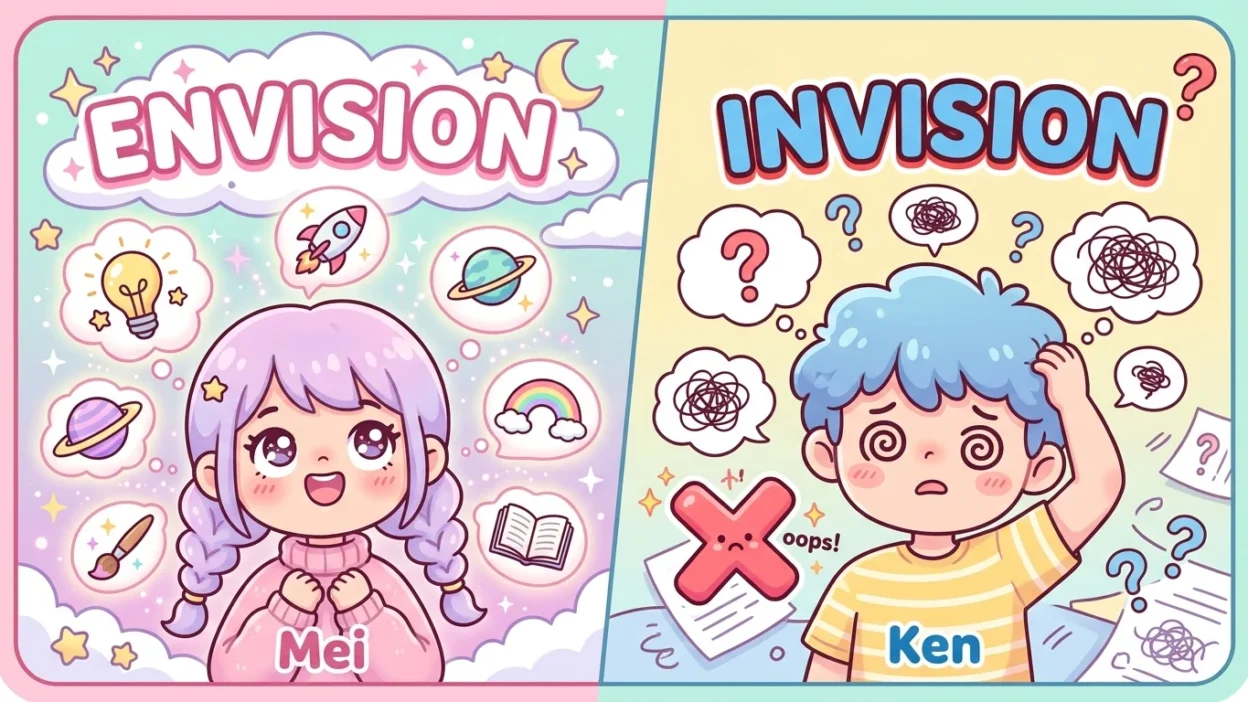
- ✅ Envision = correct spelling
- ❌ Invision = incorrect (except brand name)
👉 Easy trick:
- Think EN = imagine / see in mind
🌟 Examples:
- I envision a bright future. ✔
- I invision a bright future. ❌
What Does “Envision” Mean?
First of all, “envision” means to imagine or picture something in your mind. Therefore, people use it when talking about ideas, plans, or the future.
Common Uses:
- Goals and dreams
- Planning
- Creative thinking
Examples:
- She envisions success in her career.
- They envision a better world.
- I can envision this design working well.
👉 So, whenever you mean imagine or visualize, you should use “envision.”
Why “Invision” Is Incorrect
On the other hand, “invision” is not a correct English spelling. Although it appears sometimes, it is usually a mistake.
👉 Because:
- Standard English uses “envision”
- “Invision” does not follow correct spelling rules
⚠️ Exception:
- InVision is a brand name, so it is correct only as a proper noun.
Correct vs Wrong:
- Envision ✔
- Invision ❌ (unless brand name)
Key Difference Between “Invision” and “Envision”
| Feature | Envision | Invision |
|---|---|---|
| Correctness | ✅ Correct | ❌ Incorrect (general use) |
| Meaning | Imagine or visualize | No meaning |
| Usage | Standard English | Only brand name |
| Example | Envision success | ❌ Not used |
Common Mistakes to Avoid
Even though the words look similar, mistakes happen often. So, let’s fix them:
❌ Incorrect:
- I invision a great plan.
✔ Correct: I envision a great plan.
❌ Incorrect:
- Can you invision this idea?
✔ Correct: Can you envision this idea?
👉 So, always check the spelling.
Easy Trick to Remember
Whenever you feel unsure, remember:
- Envision = envision ideas (imagination)
👉 Think:
- EN → envision → imagine
Because of this trick, you will avoid confusion easily.
American vs British English
Interestingly, both American and British English use “envision” as the correct spelling. So, you won’t see “invision” in proper usage (except as a brand).
Real-Life Examples
In Daily Life:
- I envision a peaceful future.
- She envisions success.
In Work:
- We envision growth next year.
- The team envisions a new strategy.
Why This Matters
Although this looks like a small spelling detail, it matters a lot. When you use the correct word:
- You improve clarity
- You avoid errors
- You sound more professional
As a result, your writing becomes stronger and more effective.
FAQs
Which is correct: invision or envision?
“Envision” is correct, while “invision” is incorrect in general use.
Why is invision wrong?
Because it is not a standard English spelling.
What does envision mean?
It means to imagine or picture something in your mind.
Can invision ever be correct?
Yes, only when referring to the company InVision.
Is envision used in US and UK English?
Yes, both use it the same way.
What is the easiest way to remember this?
Think “envision = imagine,” so use “envision.”
Final Thoughts
Now you clearly understand that “envision” is the correct spelling, while “invision” is incorrect in normal usage. Because of this simple rule, you can avoid a very common mistake easily.
As you continue practicing, you will naturally choose the correct word without hesitation. So, instead of guessing, you will write clearly and confidently every time.

Narelle Merindah is a passionate author committed to delivering thoughtful, engaging, and well-structured content. With a keen eye for detail and a love for storytelling, Narelle creates informative articles that resonate with readers. Her dedication to clarity, creativity, and authenticity ensures meaningful and impactful writing.