
Many people wonder whether “unregister” or “deregister” sounds better. Although both words exist, they do not always fit the same situations.
So, choosing the right one depends on context, tone, and usage.
In this guide, you’ll learn the difference clearly, see real examples, and use each word with confidence.
Quick Answer
✨ Here’s the simple rule:
- ✅ Deregister = more formal and widely preferred
- ✅ Unregister = less common, more informal
👉 Easy trick:
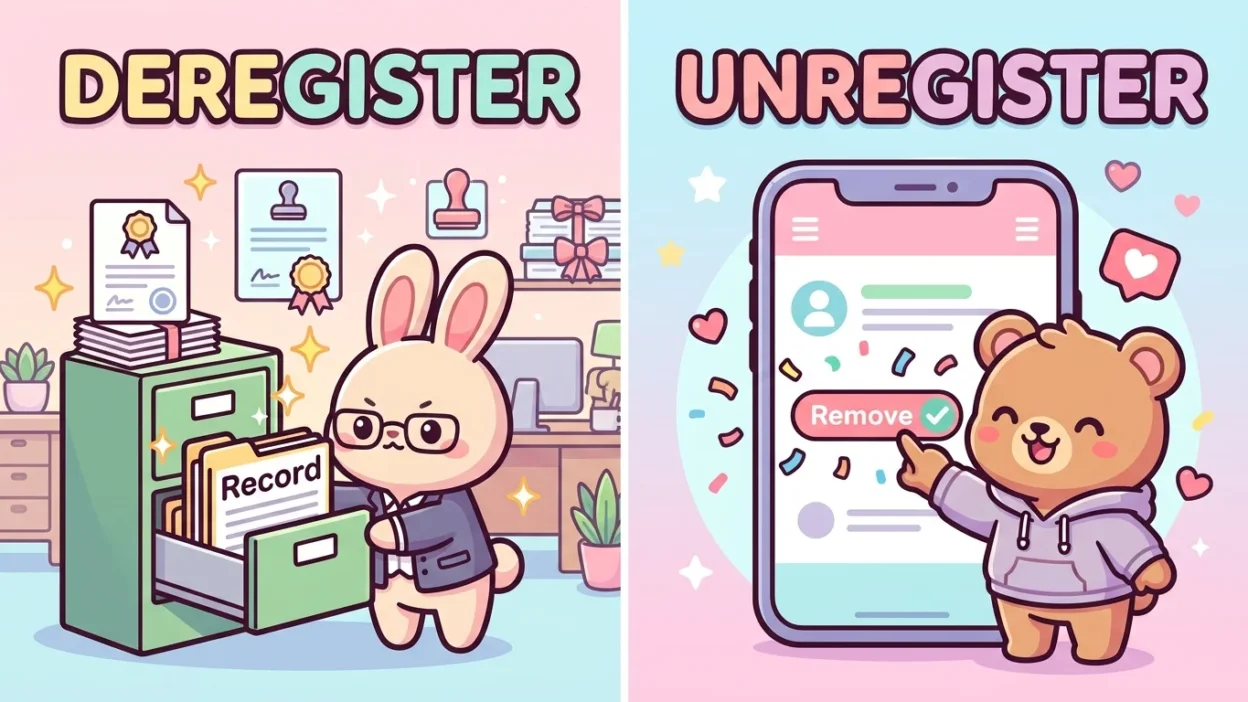
- De- = official removal
- Un- = simple reversal
🌟 Examples:
- Please deregister the device. ✔
- You can unregister from the course. ✔
What Does “Deregister” Mean?
First of all, “deregister” means to officially remove something from a register or list. Therefore, people often use it in formal, legal, or technical contexts.
Common Uses:
- Government records
- Vehicles or accounts
- Systems and databases
Examples:
- He deregistered the car.
- The company deregistered its account.
- Please deregister your device.
👉 So, whenever something is officially removed, you should use “deregister.”
What Does “Unregister” Mean?
On the other hand, “unregister” means to remove registration or sign out, but in a more informal or casual way.
Common Uses:
- Online courses
- Subscriptions
- Apps and websites
Examples:
- You can unregister from the event.
- She unregistered from the course.
- I need to unregister this app.
👉 So, in everyday situations, “unregister” can work fine.
Key Differences Between “Unregister” and “Deregister”
| Feature | Deregister | Unregister |
|---|---|---|
| Tone | Formal | Informal |
| Usage | Official removal | Casual removal |
| Context | Legal, technical | Everyday use |
| Example | Deregister a vehicle | Unregister from a course |
Common Mistakes to Avoid
Even though both words exist, confusion still happens. So, let’s fix it:
❌ Less Suitable:
- Please unregister the vehicle.
✔ Better: Please deregister the vehicle.
👉 Because it’s an official process.
❌ Too Formal:
- I will deregister from the webinar.
✔ Better: I will unregister from the webinar.
👉 Because it’s casual.
Easy Trick to Remember
Whenever you feel unsure, remember:
- De- = official / formal removal
- Un- = simple / casual removal
Because of this trick, you will choose correctly every time.
American vs British English
Interestingly, both American and British English use “deregister” and “unregister.” However, “deregister” appears more often in formal contexts worldwide.
Real-Life Examples
In Formal Context:
- The system deregistered the device.
- They deregistered the company legally.
In Casual Context:
- I unregistered from the class.
- She unregistered her email.
Why This Matters
Although both words seem similar, choosing the right one improves your writing. When you use the correct form:
- You match the tone
- You sound more natural
- You avoid confusion
As a result, your communication becomes clearer and more effective.
FAQs
Which is correct: unregister or deregister?
Both are correct, but “deregister” is more formal and widely preferred.
What is the difference between unregister and deregister?
“Deregister” is formal and official, while “unregister” is more casual.
Can I use unregister in formal writing?
You can, but “deregister” usually sounds more appropriate.
Is deregister used in US and UK English?
Yes, both use it, especially in formal contexts.
Do both words mean the same?
They are similar, but tone and usage differ.
What is the easiest way to remember this?
Think “de = official,” “un = casual.”
Final Thoughts
Now you clearly understand the difference between “unregister” and “deregister.”
While both words work, “deregister” fits formal and official contexts better, and “unregister” works in casual situations. Because of this, you can choose the right word easily.
As you continue practicing, you will naturally pick the correct term based on context. So, instead of guessing, you will write clearly and confidently every time.

Narelle Merindah is a passionate author committed to delivering thoughtful, engaging, and well-structured content. With a keen eye for detail and a love for storytelling, Narelle creates informative articles that resonate with readers. Her dedication to clarity, creativity, and authenticity ensures meaningful and impactful writing.