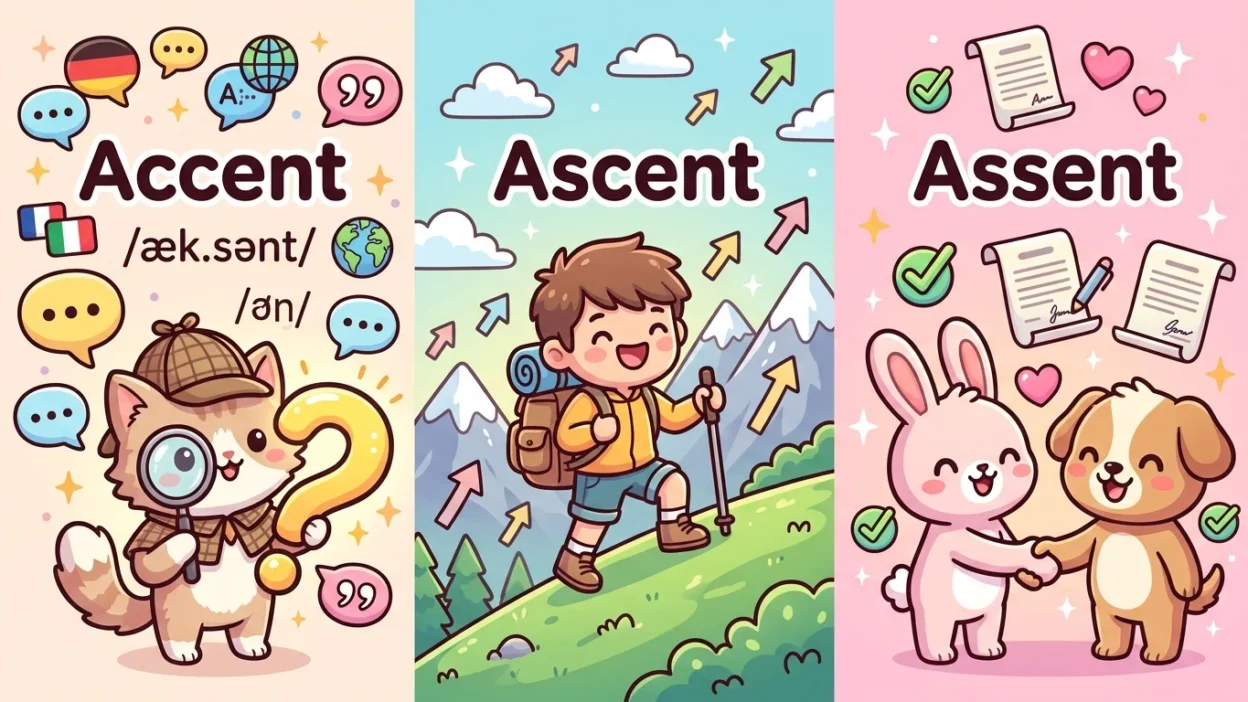
The difference between accent, ascent, and assent becomes clearer once you understand their distinct meanings. In accent vs ascent vs assent, each term serves a different purpose, helping readers avoid confusion while writing or speaking clearly. Assent refers to agreement, approval, or consent to accept something. It works as both a noun and a verb. In one example, a board gave its assent to a proposal. A useful memory trick is that assent shares the letter “s” with say and yes, which relates to giving approval.
Ascent describes climbing, rising, moving upward, or traveling along a slope toward a mountain peak. A challenging ascent may take six hours or more depending on conditions. The opposite of ascent is descent, which means going downward. This word is commonly used when discussing physical progress, elevation, or movement to a higher point.
An accent is a distinctive way of pronouncing words. It may be connected to a region or country and can affect the sound of spoken language. Someone who speaks English with a French accent may pronounce certain words differently. In language studies, accent can also refer to stress placed on a particular syllable or note for added emphasis. Although these terms may seem similar, understanding speech patterns and how people speak helps distinguish their meanings.
Quick Answer
- Accent refers to a way of speaking or emphasis on a syllable.
- Ascent means climbing, rising, or moving upward.
- Assent means agreement, approval, or consent.
Quick Examples
- She speaks with an Italian accent.
- Their ascent to the mountain summit was difficult.
- The committee gave its assent to the proposal.
Why Do People Confuse Accent, Ascent, and Assent?
These words are often mixed up because they are near-homophones. In everyday speech, they can sound almost identical, especially depending on regional pronunciation.
However, each word belongs to a completely different context:
- Accent = language and pronunciation
- Ascent = upward movement
- Assent = agreement or approval
A simple memory trick is to connect each word with its most common use.
What Does Accent Mean?
An accent is the unique way a person pronounces words. Accents are often associated with a particular country, region, or language background.
For example, someone from France may speak English with a French accent, while someone from Texas may have a distinct American accent.
In grammar and linguistics, accent can also refer to the stress placed on a specific syllable within a word.
Examples of Accent
- Her British accent was easy to recognize.
- He speaks English with a French accent.
- The accent falls on the first syllable.
- The singer added an accent to the musical phrase.
Related Terms
- Pronunciation
- Speech pattern
- Dialect
- Intonation
- Vocal stress
What Does Ascent Mean?
The word ascent refers to the act of going upward. It can describe climbing a mountain, rising into the air, or making progress toward a goal.
Whenever you think about moving higher, ascent is usually the correct choice.
Examples of Ascent
- The ascent to the peak took six hours.
- The aircraft began its ascent after takeoff.
- Her ascent in the company was remarkable.
- The steep ascent challenged every hiker.
Synonyms of Ascent
- Climb
- Rise
- Elevation
- Upward movement
- Advancement
Opposite of Ascent
The opposite of ascent is descent, which means moving downward.
What Does Assent Mean?
Assent means approval, agreement, or consent. It can function as both a noun and a verb.
The word is commonly found in legal, formal, academic, and business writing where permission or agreement is being discussed.
Examples of Assent
- The board gave its assent to the proposal.
- She nodded in assent.
- The members assented to the new rules.
- The contract required mutual assent.
Synonyms of Assent
- Agreement
- Approval
- Consent
- Acceptance
- Permission
Accent vs Ascent vs Assent: Side-by-Side Comparison
| Word | Meaning | Usage | Example |
|---|---|---|---|
| Accent | Way of speaking or syllable stress | Language and pronunciation | She has a Scottish accent. |
| Ascent | Climbing or upward movement | Physical or symbolic rise | Their ascent was exhausting. |
| Assent | Agreement or approval | Formal acceptance | The directors gave assent. |
Common Mistakes and How to Avoid Them
Many writers accidentally swap these words because they focus on pronunciation instead of meaning.
Mistake 1
❌ The manager gave his accent to the proposal.
✅ The manager gave his assent to the proposal.
Mistake 2
❌ The hikers celebrated their assent to the summit.
✅ The hikers celebrated their ascent to the summit.
Mistake 3
❌ I noticed her Irish ascent.
✅ I noticed her Irish accent.
The easiest way to avoid these errors is to identify whether you’re talking about speech, climbing, or agreement.
Easy Memory Tricks
Remember these quick associations:
- Accent → Communication and pronunciation.
- Ascent → Ascend and go upward.
- Assent → Say yes and agree.
Many English learners find these simple connections useful because they instantly link the spelling to the meaning.
American vs British English
The meanings and spellings of accent, ascent, and assent are the same in both American English and British English.
The main difference lies in pronunciation. Depending on the speaker’s regional accent, these words may sound slightly different. However, their spelling and usage remain unchanged on both sides of the Atlantic.
When Should You Use Each Word?
Use accent when discussing:
- Speech
- Pronunciation
- Language
- Syllable stress
- Regional speaking patterns
Use ascent when discussing:
- Climbing
- Rising
- Elevation
- Progress
- Upward movement
Use assent when discussing:
- Agreement
- Approval
- Permission
- Consent
- Acceptance
Real-World Examples
Imagine three different situations.
A tourist notices a strong Spanish accent while speaking with a local guide.
A group of climbers begins a difficult ascent before sunrise.
A company board gives its assent to a new expansion plan.
Although the words sound alike, their meanings are completely unrelated.
FAQs
What is the difference between accent and ascent?
Accent refers to pronunciation, speech patterns, or stress placed on a syllable. Ascent means climbing, rising, or moving upward toward a higher point.
What is the difference between ascent and assent?
Ascent relates to upward movement or climbing, while assent means agreement, approval, consent, or acceptance.
Is assent a noun or a verb?
Yes. Assent can be used as both a noun and a verb. As a noun, it means agreement. As a verb, it means to agree or give approval.
Can accent mean emphasis?
Yes. Besides referring to pronunciation, accent can also mean stress or emphasis placed on a particular syllable, word, or musical note.
What is the opposite of ascent?
The opposite of ascent is descent. While ascent means moving upward, descent means moving downward.
Is assent commonly used in everyday conversation?
Assent is generally more common in formal writing, legal documents, academic contexts, and professional communication than in everyday speech.
Do accent, ascent, and assent sound the same?
They are pronounced very similarly and may sound identical depending on a person’s accent or regional pronunciation.
How can I remember the difference quickly?
A simple memory trick is: accent = speech, ascent = up, and assent = agreement. Connecting each word to its main meaning makes them easier to remember.
Final Thoughts
Understanding accent vs ascent vs assent is much easier once you connect each word to its core meaning.
Accent deals with pronunciation and speech, ascent refers to moving upward, and assent involves approval or agreement. While these words may sound alike, they belong to completely different situations and should never be used interchangeably.
From my experience helping writers and English learners, these three words become easy to remember after a few real-world examples.
Whenever you encounter one of them, pause and ask yourself a simple question: Am I talking about speech, movement, or agreement? That quick check can instantly guide you to the correct word. Over time, using the right form becomes second nature, helping you write with greater clarity and confidence.

Narelle Merindah is a passionate author committed to delivering thoughtful, engaging, and well-structured content. With a keen eye for detail and a love for storytelling, Narelle creates informative articles that resonate with readers. Her dedication to clarity, creativity, and authenticity ensures meaningful and impactful writing.