
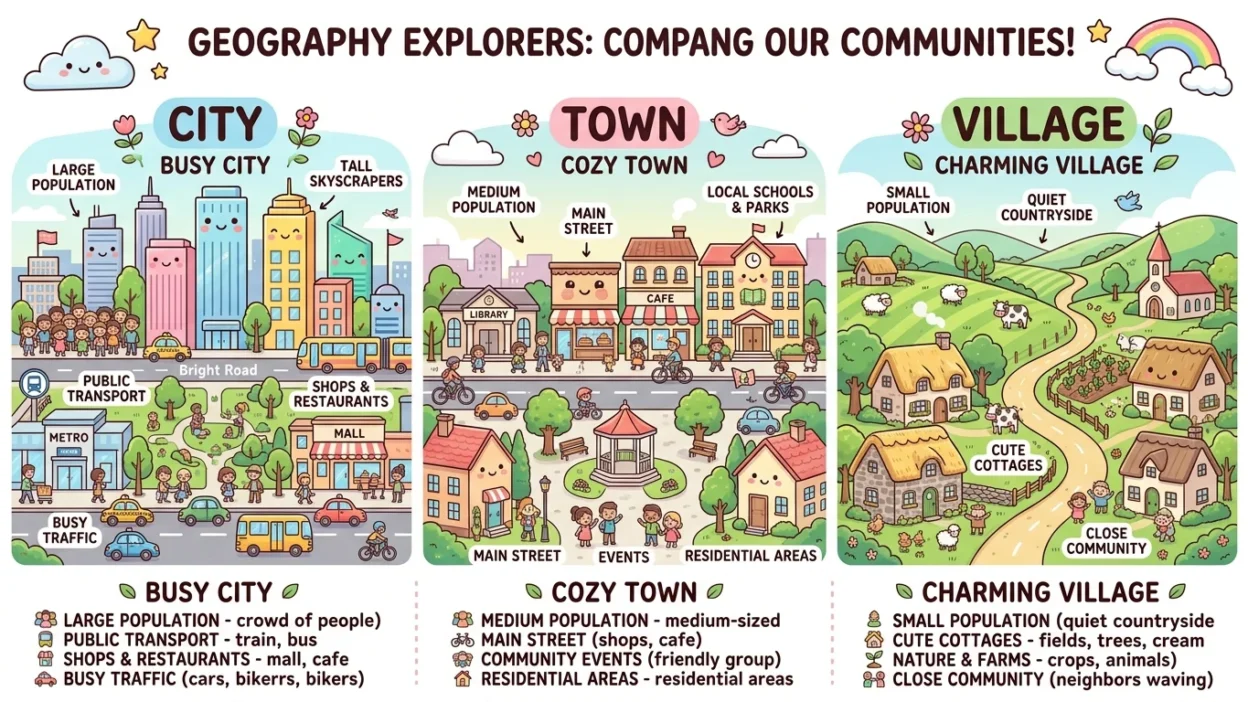
The difference between a city, town, and village often depends on population size, but city vs town vs village also involves legal status, infrastructure, and governance factors.
From my experience reviewing geography and civic topics, several factors including legal status, administrative infrastructure, and local headcount are equally important. A city typically holds a charter or cathedral, with populations exceeding 100,000 and supported by complex governance structures.
A town generally falls within a range between 1,000 and 100,000 residents. These communities often provide basic municipal services and maintain organized leadership. While towns may vary greatly in character and development, they usually offer more public facilities and planning than smaller settlements.
In comparison, villages have fewer people and operate with minimal formal administration. A village may rely on simpler systems and a close-knit community structure. Understanding these distinctions makes it easier to compare cities, towns, and villages accurately across different regions of the world.
Quick Answer
- A city is usually the largest type of settlement and often has a legal city status, larger population, and complex administration.
- A town is generally smaller than a city but larger than a village, with organized local services and governance.
- A village is typically a smaller community with fewer residents and a simpler administrative structure.
The exact definitions can vary by country, but population size alone does not always determine the classification.
Why Do People Confuse Cities, Towns, and Villages?
One reason for the confusion is that different countries use different rules. A place considered a town in one country might qualify as a city in another.
Many people assume that population is the only factor. While population is important, governments may also consider legal status, municipal authority, economic activity, infrastructure, historical significance, and administrative functions.
For example, some cities have fewer residents than large towns but still hold official city status because of legal or historical reasons.
What Is a City?
A city is generally the largest and most developed type of settlement within a region. Cities usually serve as economic, cultural, administrative, or political centers.
Many cities contain:
- Large populations
- Extensive transportation systems
- Major businesses
- Universities
- Hospitals
- Government offices
- Advanced infrastructure
In some countries, city status is granted through legal recognition rather than population size alone.
Examples of Cities
- New York City
- London
- Tokyo
- Paris
Cities often act as regional hubs that attract residents, businesses, and visitors.
What Is a Town?
A town typically falls between a city and a village in terms of size and development.
Towns usually provide:
- Municipal services
- Schools
- Local government
- Retail businesses
- Community facilities
- Public transportation options
While towns may not have the extensive infrastructure of major cities, they often function as important local centers for nearby communities.
Characteristics of Towns
- Medium-sized population
- Organized governance
- Public facilities
- Commercial activity
- Residential neighborhoods
Many people prefer living in towns because they often balance convenience with a slower pace of life.
What Is a Village?
A village is generally the smallest recognized settlement type.
Villages usually feature:
- Smaller populations
- Close-knit communities
- Limited administrative structures
- Fewer public services
- Rural surroundings
Villages often focus on community relationships and local traditions.
Characteristics of Villages
- Small population
- Simple administration
- Limited infrastructure
- Strong community identity
- Rural environment
In many parts of the world, villages remain an essential part of cultural and agricultural life.
City vs Town vs Village Comparison Table
| Feature | City | Town | Village |
|---|---|---|---|
| Population | Usually largest | Medium-sized | Usually smallest |
| Governance | Complex administration | Local government | Minimal administration |
| Infrastructure | Extensive | Moderate | Basic |
| Services | Wide range | Standard municipal services | Limited services |
| Economy | Diverse and large-scale | Regional commerce | Local activities |
| Development | Highly developed | Moderately developed | Less developed |
| Community Size | Large | Medium | Small |
Population Differences
Although there is no universal rule, many countries use general population guidelines.
Cities
- Often exceed 100,000 residents
- May contain millions of people
Towns
- Often range from 1,000 to 100,000 residents
Villages
- Frequently contain fewer than 1,000 residents
However, legal classification often matters more than population numbers alone.
Common Mistakes People Make
When discussing city vs town vs village, several misconceptions appear repeatedly.
Mistake 1: Assuming Population Is the Only Factor
Population matters, but legal status and administrative authority are equally important.
Mistake 2: Believing Every Large Settlement Is a City
Some large towns have populations bigger than official cities.
Mistake 3: Assuming Villages Have No Government
Many villages have local councils or administrative bodies, even if they are smaller and less complex.
Mistake 4: Applying One Country’s Rules Everywhere
Classification systems differ significantly around the world.
Real-World Examples
Imagine three communities.
A densely populated metropolitan area with skyscrapers, airports, and major government offices would typically be considered a city.
A moderately populated community with schools, local businesses, and municipal services would often be classified as a town.
A smaller rural settlement with a close-knit population and limited infrastructure would generally be considered a village.
These examples illustrate why size, governance, and infrastructure all matter.
American vs British English Differences
The terms city, town, and village exist in both American and British English, but the classification systems differ.
In the United States
City status is usually determined by state law. Different states have different legal definitions for cities and towns.
In the United Kingdom
Historically, city status was often linked to the presence of a cathedral. Today, official city status is granted by the Crown and does not depend solely on population size.
Because of these differences, a settlement classified as a city in one country may not qualify as a city elsewhere.
Why Understanding the Difference Matters
Knowing the difference between cities, towns, and villages can be useful in many situations.
- Geography studies
- Travel planning
- Government administration
- Real estate research
- Historical analysis
- Academic writing
Accurate terminology helps communicate information more clearly and avoids misunderstandings.
FAQs
What is the main difference between a city, town, and village?
The main difference involves legal status, population size, governance, infrastructure, and available services rather than population alone.
Is a city always larger than a town?
Not necessarily. Some towns may have larger populations than official cities, depending on local laws and classifications.
How many people does a village usually have?
Many villages have fewer than 1,000 residents, although definitions vary by country.
Can a town become a city?
Yes. In some countries, a town can receive official city status through legal or governmental processes.
What makes a place a city?
Factors may include legal designation, governance structure, population size, economic importance, and infrastructure.
Are villages always rural?
Most villages are rural, but some may exist near urban areas while still maintaining village status.
Which is bigger, a town or a village?
A town is generally larger than a village in terms of population, infrastructure, and services.
Why do different countries define cities differently?
Historical traditions, legal systems, and government structures influence how settlements are classified.
Final Thoughts
Understanding city vs town vs village goes beyond simply counting residents. While population plays an important role, legal status, governance, infrastructure, and administrative responsibilities often determine how a settlement is classified. This is why places with similar populations can sometimes carry different labels.
From studying geographic classifications and municipal systems, one thing becomes clear: there is no universal definition that applies everywhere. What qualifies as a city in one country may be considered a town in another.
By focusing on legal recognition, community structure, and available services rather than population alone, it becomes much easier to understand the differences and use each term accurately.

Narelle Merindah is a passionate author committed to delivering thoughtful, engaging, and well-structured content. With a keen eye for detail and a love for storytelling, Narelle creates informative articles that resonate with readers. Her dedication to clarity, creativity, and authenticity ensures meaningful and impactful writing.