Many people become worried about making a spelling mistake after they have typed a word, then press delete to try another way.
From my experience reviewing grammar questions, ingrained or engrained often creates uncertainty because the spellings look very similar in modern writing today. Taking a closer look at the difference can help you feel more confident when writing.
When comparing these terms, many writers wonder which form is correct. The confusion is understandable because both words appear in dictionaries and published writing. However, ingrained is the more common choice in modern English, while engrained is less frequently used.
If you are unsure which version to choose, it is likely best to check the context and audience. Understanding how these words are used makes it easier to avoid errors, select the form that fits naturally, and improve the clarity of your writing.
Quick Answer
- Ingrained is the preferred and far more common spelling in modern English.
- Engrained is also a recognized word but is much less frequently used.
- In most situations, writers should choose ingrained.
Quick Examples
- Good habits become ingrained over time.
- The belief was deeply ingrained in the culture.
- Traditional patterns were originally described as engrained in older usage.
For modern writing, ingrained is almost always the safest choice.
Why Do People Confuse Ingrained and Engrained?
The confusion comes from the fact that both spellings exist and share a similar meaning.
Many English learners assume that one must be incorrect because dictionaries and style guides often emphasize ingrained. However, engrained has historical roots and appeared more frequently in older English.
Today, the overwhelming majority of published writing uses ingrained, which is why it is considered the standard form.
What Does Ingrained Mean?
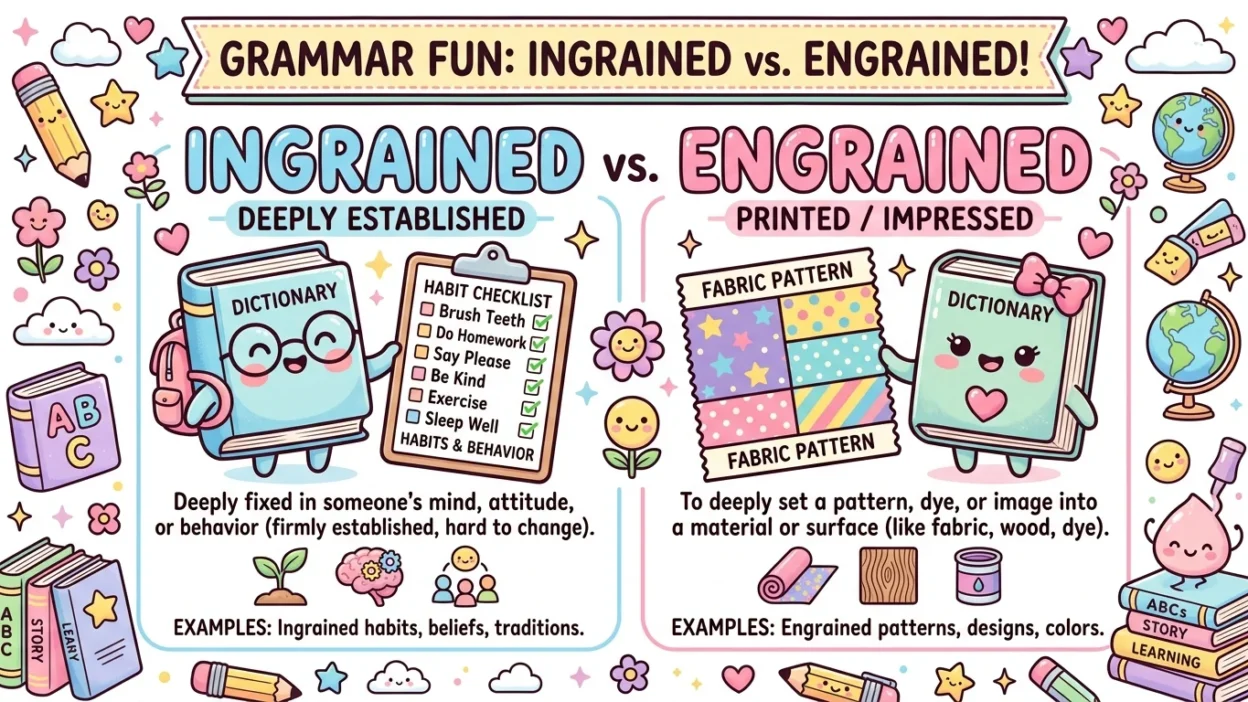
Ingrained describes something that is firmly established, deeply rooted, or difficult to change.
It often refers to:
- Habits
- Beliefs
- Attitudes
- Behaviors
- Traditions
- Cultural practices
When something becomes ingrained, it is so deeply embedded that it feels natural or automatic.
Examples of Ingrained
- Respect for others was ingrained from childhood.
- The routine became ingrained after years of practice.
- Certain traditions remain ingrained in the community.
- Strong work ethics are often ingrained through experience.
Synonyms of Ingrained
- Deep-rooted
- Established
- Embedded
- Fixed
- Instilled
- Entrenched
These words share the idea of something becoming a permanent part of a person’s thinking or behavior.
What Does Engrained Mean?
Engrained traditionally referred to something dyed into fibers before being woven into fabric.
Over time, the word developed figurative meanings similar to ingrained.
However, modern dictionaries and style guides generally favor ingrained, and most contemporary writers rarely use engrained outside of historical or specialized contexts.
Examples of Engrained
- The color was engrained into the fabric.
- Some older texts use engrained where modern writers would choose ingrained.
- The pattern appeared engrained within the material.
Although these examples are technically correct, most modern readers expect to see ingrained instead.
Ingrained vs Engrained Comparison Table
| Feature | Ingrained | Engrained |
|---|---|---|
| Modern Usage | Very common | Rare |
| Dictionary Recognition | Yes | Yes |
| Preferred Spelling | Yes | No |
| Historical Usage | Common | Common |
| Everyday Writing | Recommended | Usually avoided |
| Meaning | Deeply established | Similar meaning, historically linked to dyeing |
Why Is Ingrained More Common?
Language changes over time.
While both spellings survived for centuries, ingrained gradually became dominant in newspapers, books, academic writing, and online content.
Several factors contributed to this shift:
- Simpler and more familiar spelling
- Greater adoption in modern publishing
- Consistent use in style guides
- Preference among professional editors
As a result, most readers now recognize ingrained immediately, while engrained may appear unusual.
Common Mistakes Writers Make
When deciding between ingrained and engrained, several mistakes appear frequently.
Mistake 1: Assuming Engrained Is Wrong
❌ Engrained is not a real word.
✅ Engrained is a legitimate word but is much less common today.
Mistake 2: Using Engrained in Modern Formal Writing
❌ The company’s engrained culture promotes teamwork.
✅ The company’s ingrained culture promotes teamwork.
In most professional contexts, ingrained is preferred.
Mistake 3: Thinking They Have Completely Different Meanings
❌ Ingrained and engrained mean unrelated things.
✅ Their meanings overlap significantly, but ingrained is the standard modern spelling.
How to Remember the Correct Choice
A simple memory trick can help.
Think about the word in.
When an idea, habit, or belief is deeply “in” your mind, it becomes ingrained.
Examples:
- Ingrained habit
- Ingrained belief
- Ingrained behavior
- Ingrained tradition
Because these are the expressions people see most often, the spelling becomes easier to remember.
Ingrained in Everyday English
You will frequently encounter ingrained in discussions involving:
- Personal habits
- Cultural traditions
- Social behavior
- Education
- Workplace values
- Family customs
For example:
- An ingrained routine
- An ingrained fear
- An ingrained assumption
- An ingrained mindset
The word is particularly useful when describing patterns that develop over a long period.
American vs British English Differences
Unlike some spelling variations, there is very little difference between American English and British English regarding these words.
American English
American publications overwhelmingly prefer ingrained.
British English
British publications also strongly favor ingrained.
Although engrained can still be found occasionally in historical writing or specialized discussions, neither variety of English treats it as the preferred form.
Therefore, regardless of whether you write for an American or British audience, ingrained is usually the best choice.
When Should You Use Ingrained?
Choose ingrained when discussing:
- Habits
- Beliefs
- Traditions
- Behaviors
- Values
- Cultural practices
Examples:
- Ingrained prejudice
- Ingrained routine
- Ingrained custom
- Ingrained habit
When Might You Use Engrained?
Choose engrained only when:
- Referring to historical texts
- Discussing textile dyeing processes
- Preserving original wording from older sources
For most modern writing projects, ingrained remains the recommended option.
FAQs
Is ingrained or engrained correct?
Both words are technically correct, but ingrained is the preferred spelling in modern English.
Which spelling is more common?
Ingrained is significantly more common in books, newspapers, websites, and professional writing.
Is engrained outdated?
Not completely, but it is much less common today and often appears in historical or specialized contexts.
Do ingrained and engrained mean the same thing?
Their meanings largely overlap, although engrained originally had stronger connections to textile dyeing.
Should I use ingrained in academic writing?
Yes. Ingrained is generally the preferred choice in academic, professional, and formal writing.
Is there an American vs British English difference?
No major difference exists. Both American and British English strongly favor ingrained.
Can engrained still be found in dictionaries?
Yes. Most major dictionaries still recognize engrained as a valid word.
How can I remember which spelling to use?
Remember that ideas, habits, and beliefs become deeply “in” your mind, making ingrained the easier choice.
Final Thoughts
The debate over ingrained or engrained is less about right versus wrong and more about modern usage.
Both spellings exist, both appear in dictionaries, and both have historical legitimacy. However, ingrained has become the standard choice for contemporary English and is the form most readers expect to see.
From years of reading grammar resources, editing content, and reviewing style guides, one pattern consistently stands out: professional writers almost always choose ingrained.
Unless you are quoting historical material or discussing textile terminology, using ingrained will usually make your writing clearer, more natural, and more recognizable to your audience.

Narelle Merindah is a passionate author committed to delivering thoughtful, engaging, and well-structured content. With a keen eye for detail and a love for storytelling, Narelle creates informative articles that resonate with readers. Her dedication to clarity, creativity, and authenticity ensures meaningful and impactful writing.