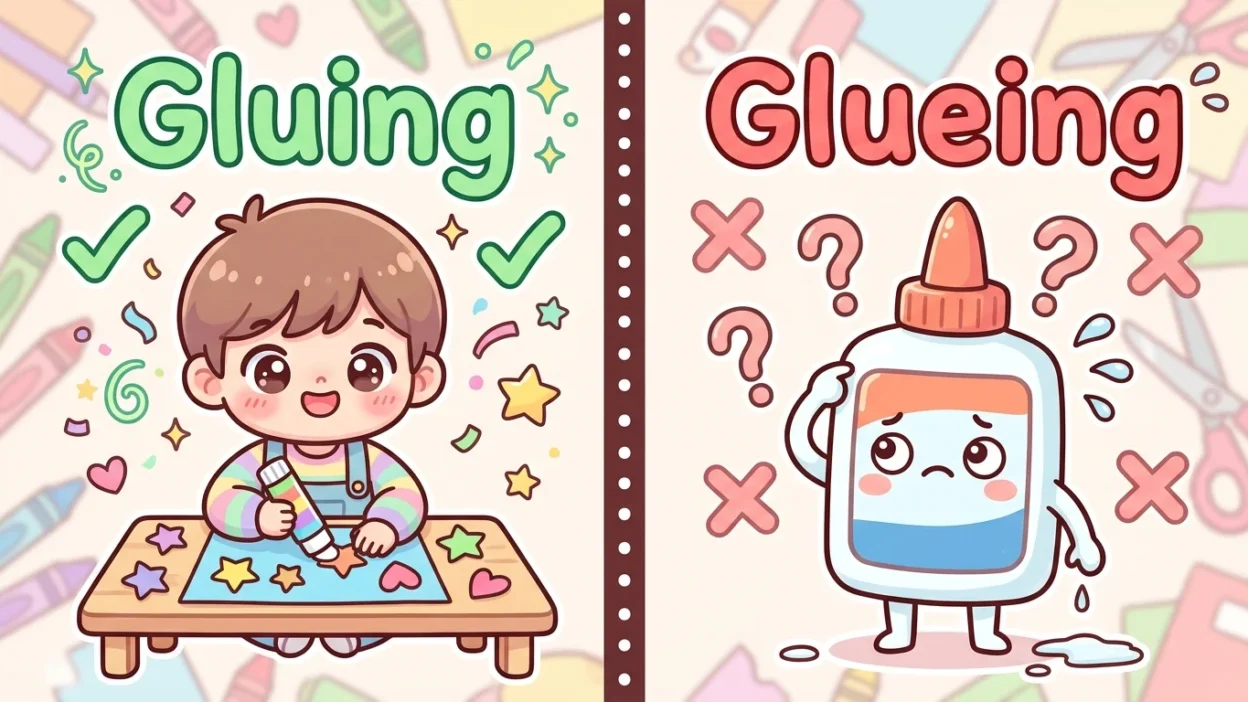
Many English learners wonder whether gluing or glueing is the correct spelling. Since the word “glue” ends with an “e,” adding “-ing” can create confusion.
Fortunately, the answer is straightforward. While both spellings have appeared in English, one is overwhelmingly preferred in modern usage. So, if you want natural and professional English, it’s important to know which form to choose.
Quick Answer
✨ Here’s the simple rule:
✅ Gluing = preferred and standard spelling
⚠️ Glueing = accepted but much less common
🌟 Easy way to remember:
- Modern English prefers gluing.
- Most dictionaries list gluing as the primary spelling.
Examples:
- She is gluing the pieces together. ✔
- She is glueing the pieces together. ✔ (less common)
👉 Therefore, gluing is usually the best choice.
What Does Gluing Mean?
First of all, gluing is the present participle and gerund form of the verb “glue.”
Therefore, it describes the action of joining things together with glue.
Examples
- He is gluing the broken vase.
- We spent the afternoon gluing decorations.
- She enjoys gluing photos into scrapbooks.
👉 As a result, gluing is the spelling you’ll see most often in books, websites, and professional writing.
What About Glueing?
On the other hand, glueing is an alternative spelling that some dictionaries still recognize.
However, modern English strongly favors gluing. Consequently, glueing appears far less often in contemporary writing.
Examples
- She was glueing the model together.
- They spent hours glueing paper shapes.
👉 Although these sentences are understandable, most editors would prefer gluing.
Gluing vs Glueing: Key Differences
| Word | Correct? | Modern Usage |
|---|---|---|
| Gluing | ✅ Yes | Standard and preferred |
| Glueing | ✅ Yes | Rare and less preferred |
Why Is Gluing More Common?
English often drops the final silent “e” before adding “-ing.”
Similar Examples
- Make → making
- Bake → baking
- Write → writing
- Glue → gluing
👉 Therefore, gluing follows the pattern that most English speakers expect.
Common Mistakes to Avoid
Many learners assume glueing must be correct because the original word ends with “e.”
❌ Incorrect Assumption
- The “e” must always stay.
✅ Better Understanding
- English usually drops the silent “e” before adding “-ing.”
Examples
- Bake → baking
- Drive → driving
- Glue → gluing
👉 Consequently, gluing looks more natural to modern readers.
Easy Trick to Remember
Whenever you feel unsure, remember:
🖍️ Glue + ing = gluing
Think:
- Make → making
- Write → writing
- Glue → gluing
Because of this simple pattern, you’ll remember the preferred spelling easily.
American vs British English
Interestingly, both American and British English generally prefer gluing.
Although glueing occasionally appears in both varieties, gluing remains the standard spelling worldwide.
Therefore, regional differences do not significantly affect this choice.
Real-Life Examples
Using Gluing
- The children are gluing paper stars together.
- He spent an hour gluing the frame.
- She is gluing photos into an album.
Using Glueing
- Some older texts use glueing.
- Certain dictionaries still recognize glueing.
👉 Nevertheless, gluing remains the spelling most readers expect.
Why This Difference Matters
Although both spellings can be considered correct, choosing the preferred form improves readability.
When you use gluing:
- Your writing looks modern.
- Readers recognize the spelling instantly.
- Your content feels more professional.
- You follow current usage standards.
Therefore, gluing is usually the best option.
FAQs
Which is correct, gluing or glueing?
Both are accepted, but gluing is the standard and preferred spelling.
Gluing appears far more often in modern English.
Is glueing wrong?
Not completely. However, it is much less common than gluing.
Why do we write gluing instead of glueing?
English usually drops a silent “e” before adding “-ing.”
Which spelling do dictionaries prefer?
Most modern dictionaries list gluing as the primary spelling.
Do British and American English use different spellings?
No. Both generally prefer gluing.
Which spelling should I use in professional writing?
Use gluing because it is the modern standard.
Final Thoughts
Now you know that both gluing and glueing can be found in English, but gluing is the standard spelling that most writers, editors, and dictionaries prefer.
Because English commonly drops a silent “e” before adding “-ing,” gluing follows the pattern readers expect.
Therefore, if you want clear, modern, and professional English, choose gluing. While glueing isn’t necessarily wrong, it looks unusual and may distract some readers.

Narelle Merindah is a passionate author committed to delivering thoughtful, engaging, and well-structured content. With a keen eye for detail and a love for storytelling, Narelle creates informative articles that resonate with readers. Her dedication to clarity, creativity, and authenticity ensures meaningful and impactful writing.