
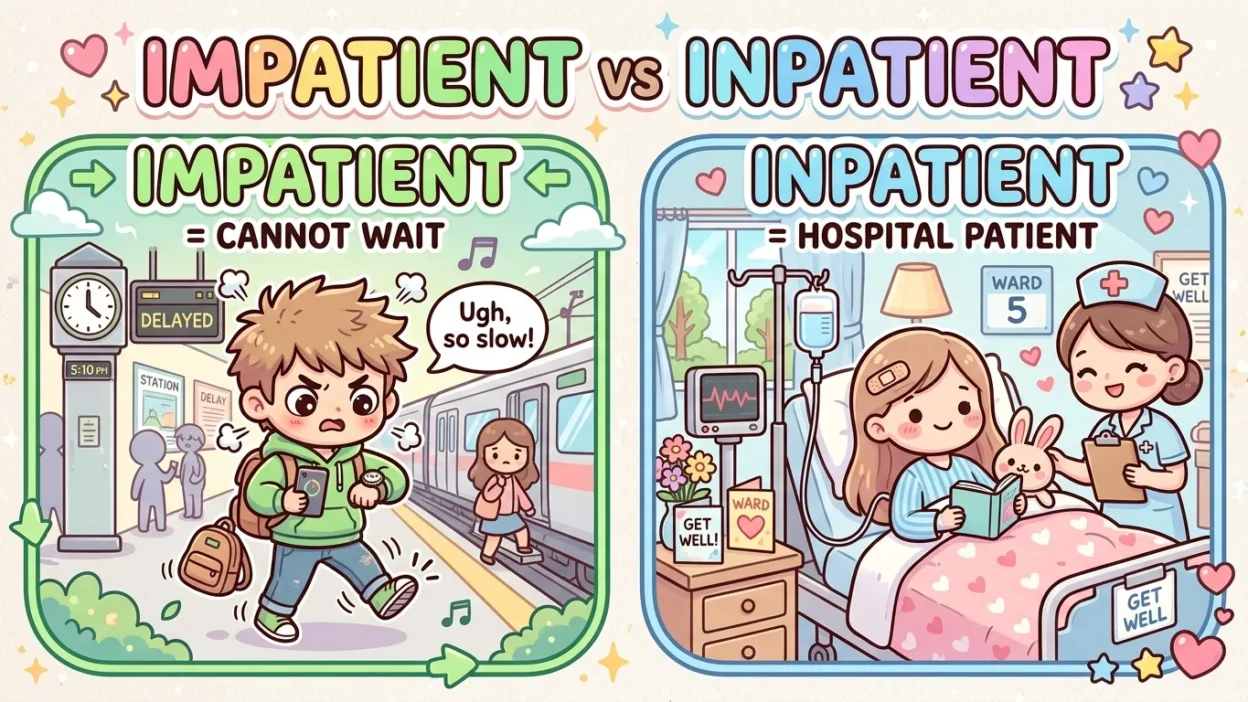
Impatient vs inpatient can confuse English learners because the two words look and sound very similar. However, they have completely different meanings and uses. Therefore, knowing the small difference between them can help you avoid common spelling and grammar mistakes.
Impatient describes someone who does not want to wait or who becomes annoyed by delays. On the other hand, inpatient refers to a person who stays in a hospital or healthcare facility while receiving treatment. Consequently, the correct word depends entirely on the context.
Moreover, the easiest way to remember the difference is to connect impatient with waiting and inpatient with healthcare. Once you understand this distinction, you can use both words confidently in everyday, academic, professional, and medical English.
Quick Answer
Impatient means unable or unwilling to wait calmly, while inpatient refers to a person who stays in a hospital or healthcare facility for treatment. Therefore, use impatient for feelings or behavior related to waiting and inpatient for medical care involving a stay at a healthcare facility.
Why Do People Confuse Impatient and Inpatient?
People often confuse impatient and inpatient because both words contain patient. Furthermore, the spelling differs by only one letter, which makes the distinction easy to miss.
However, the meanings are completely different.
- Impatient = unable or unwilling to wait.
- Inpatient = a patient staying in a healthcare facility.
In addition, the prefix im- in impatient creates the idea of a lack of patience. Meanwhile, inpatient connects with the idea of being in a hospital or healthcare facility.
Therefore, remembering the context can make the difference much easier.
Impatient: Meaning and Definition
Impatient is an adjective that describes someone who does not want to wait or who becomes annoyed because something takes too long.
For example:
She became impatient after waiting for an hour.
Here, impatient describes her frustration with the delay.
Similarly:
He is impatient to start his new job.
In this sentence, impatient means eager and unable to wait for something to happen.
Simple Meaning of Impatient
Impatient = unable or unwilling to wait calmly.
You can use impatient when talking about:
- waiting
- delays
- frustration
- eagerness
- slow progress
- someone’s attitude
Inpatient: Meaning and Definition
Inpatient is mainly a noun that refers to a person who stays in a hospital or healthcare facility while receiving treatment.
For example:
The hospital admitted a new inpatient yesterday.
Here, inpatient identifies a person receiving treatment while staying at the facility.
Additionally, inpatient can work as an adjective when it describes medical care, treatment, services, or facilities.
For example:
The doctor recommended inpatient treatment.
Therefore, inpatient mainly belongs to medical and healthcare contexts.
Simple Meaning of Inpatient
Inpatient = a person who stays in a healthcare facility for treatment.
The related opposite term is outpatient, which generally describes someone who receives medical treatment without staying in the facility as an admitted patient.
Impatient vs Inpatient: Comparison Table
| Feature | Impatient | Inpatient |
|---|---|---|
| Meaning | Unable or unwilling to wait calmly | A patient staying in a healthcare facility |
| Main use | Feelings, behavior, waiting | Medical treatment and healthcare |
| Part of speech | Adjective | Noun and adjective |
| Example | She became impatient. | He is an inpatient. |
| Related word | Patience | Outpatient |
Therefore, impatient relates to a person’s attitude toward waiting, whereas inpatient relates to medical care.
When to Use Impatient
Use impatient when someone feels frustrated, restless, or eager because they must wait.
For example:
The children became impatient while waiting for dinner.
Similarly:
I am impatient to hear the results.
You can also use impatient with when someone becomes frustrated with another person, process, or situation.
For example:
The teacher became impatient with the repeated questions.
Moreover, you can use impatient to when someone strongly wants something to happen.
She was impatient to begin the project.
You can also use impatient for in certain contexts.
He was impatient for the results.
When to Use Inpatient
Use inpatient when discussing someone who stays in a hospital or healthcare facility for treatment.
For example:
The doctor recommended inpatient care.
Here, the patient needs treatment while staying at the facility.
Similarly:
The hospital provides inpatient services.
You can also use inpatient as a noun.
The nurse checked on the inpatient.
Therefore, whenever your sentence focuses on hospital admission or medical care that requires a stay, inpatient usually fits the context.
Impatient vs Inpatient Examples
Examples With Impatient
- I became impatient after waiting for thirty minutes.
- She was impatient because the bus was late.
- The children grew impatient during the long wait.
- He is impatient to see the results.
- Please do not become impatient with me.
- The customer sounded impatient on the phone.
- She became impatient during the meeting.
- He was impatient for the announcement.
- The students were impatient to leave.
- I felt impatient because the service was slow.
Examples With Inpatient
- The hospital admitted a new inpatient.
- She requires inpatient treatment.
- The doctor recommended inpatient care.
- The facility provides inpatient services.
- The nurse checked on the inpatient.
- The hospital has several inpatient units.
- He received inpatient rehabilitation.
- The program offers specialized inpatient care.
Common Mistakes With Impatient and Inpatient
Because these words look so similar, writers sometimes use the wrong form.
Mistake 1: Using Inpatient for Waiting
Incorrect:
She became inpatient because the food was late.
Correct:
She became impatient because the food was late.
The sentence describes frustration caused by waiting. Therefore, impatient is correct.
Mistake 2: Using Impatient for Medical Treatment
Incorrect:
The doctor recommended impatient treatment.
Correct:
The doctor recommended inpatient treatment.
Here, the sentence describes medical treatment that requires a patient to stay at a healthcare facility. Therefore, inpatient is correct.
Mistake 3: Thinking Inpatient Means “Not Patient”
Inpatient does not mean someone who lacks patience.
Instead:
- Impatient = not patient or unable to wait calmly.
- Inpatient = a patient receiving treatment while staying in a healthcare facility.
Therefore, never use inpatient simply because you want to describe someone who cannot wait.
Memory Trick for Impatient vs Inpatient
Here is an easy way to remember the difference.
Impatient = I Can’t Wait
Think:
IMpatient → I can’t wait!
For example:
She is impatient to hear the news.
Inpatient = In a Hospital
Think:
INpatient → IN a healthcare facility.
For example:
He is receiving inpatient treatment.
Therefore, remember:
Impatient = waiting
Inpatient = healthcare
American vs British English
Both impatient and inpatient appear in American and British English.
Moreover, their basic meanings remain the same in both varieties.
- Impatient describes someone who does not want to wait.
- Inpatient describes someone receiving treatment while staying in a healthcare facility.
However, specific healthcare terminology can vary between healthcare systems. Nevertheless, the basic distinction between these two words remains consistent.
Similar Words
Understanding related words can make this distinction even easier.
Patient
Patient can describe someone receiving medical care.
The doctor examined the patient.
However, patient can also describe someone who can wait calmly.
You need to be patient.
Outpatient
Outpatient describes someone who receives medical treatment without staying in the healthcare facility as an admitted patient.
She received outpatient treatment.
Impatience
Impatience is the noun form related to impatient.
His impatience was obvious.
Patiently
Patiently is an adverb.
She waited patiently for her turn.
Final Verdict
Both impatient and inpatient are correct words. However, they have completely different meanings.
Use impatient when you are talking about someone who cannot wait calmly or who feels frustrated by a delay. In contrast, use inpatient when you are talking about a person who stays in a hospital or healthcare facility for treatment.
Therefore, the simplest distinction is:
Impatient = cannot wait.
Inpatient = stays in a healthcare facility.
Remember This
Impatient → I can’t wait.
Inpatient → In a healthcare facility.
Consequently, if your sentence involves waiting, frustration, or eagerness, choose impatient. If it involves hospital care, admission, or staying in a healthcare facility, choose inpatient.
FAQs
Is impatient the same as inpatient?
No. Impatient describes someone who cannot wait calmly or becomes frustrated by delays. Inpatient refers to a person who stays in a healthcare facility while receiving treatment.
What is the difference between an impatient person and an inpatient?
An impatient person struggles with waiting or becomes frustrated by delays. In contrast, an inpatient stays in a hospital or healthcare facility for treatment.
Is inpatient a medical term?
Yes. Inpatient commonly appears in healthcare terminology. It describes patients who stay in a healthcare facility for treatment and can also describe related care, services, and facilities.
What is the opposite of inpatient?
Outpatient generally refers to someone who receives medical treatment without staying in the healthcare facility as an admitted patient.
Can impatient mean eager?
Yes. Impatient can describe someone who strongly wants something to happen soon.
For example:
She was impatient to begin the project.
How can I remember impatient vs inpatient?
Remember impatient = cannot wait and inpatient = in a healthcare facility. This simple connection can help you choose the correct word.
Is inpatient one word?
Yes. Inpatient is normally written as one word. Likewise, outpatient is also written as one word.
Conclusion
Ultimately, impatient vs inpatient becomes easy once you focus on context. Impatient describes a person’s lack of patience, frustration, or eagerness, while inpatient refers to a patient who stays in a healthcare facility for treatment.
Moreover, the easiest memory trick is simple: impatient means “I can’t wait,” while inpatient means “in a healthcare facility.” Therefore, whenever you see these similar-looking words, think about whether the sentence discusses waiting or medical care.