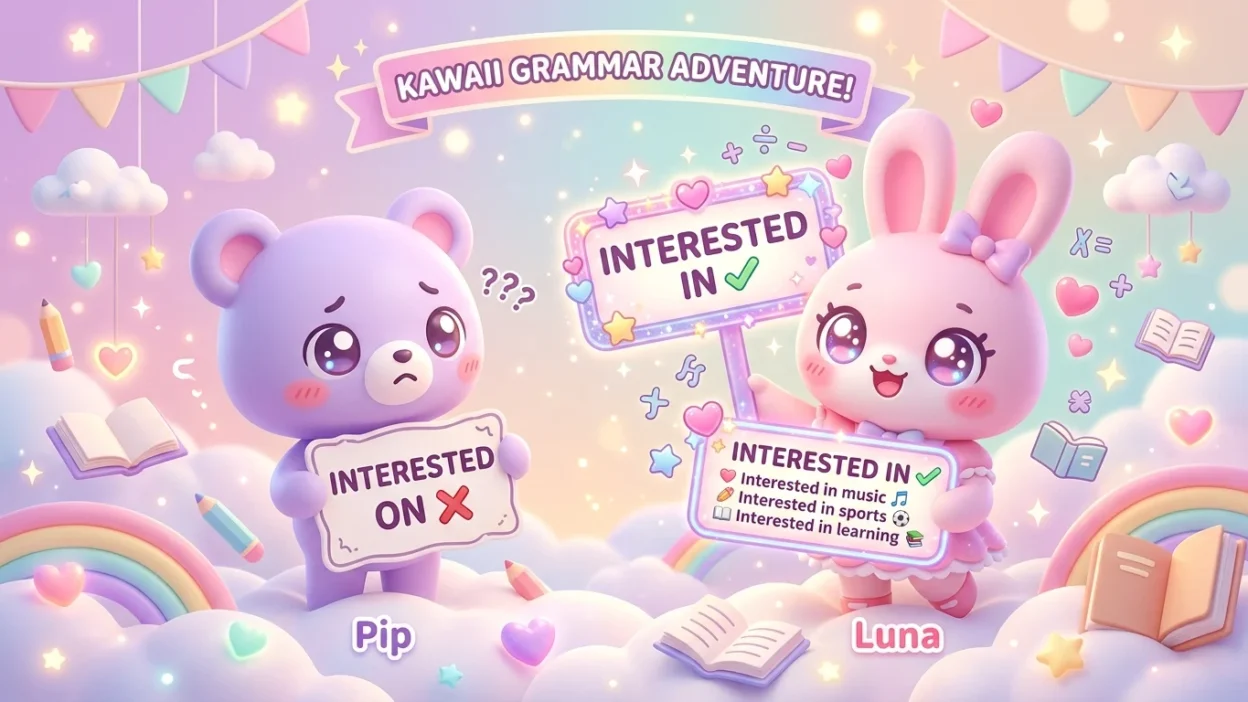
The correct phrase is “interested in.” Therefore, “interested on” is generally incorrect in standard English.
For example, you should say “I am interested in photography”, not “I am interested on photography.” Moreover, interested in works with hobbies, subjects, activities, people, careers, topics, and many other things.
Quick Answer
Interested in is the standard and correct expression. Therefore, use in when describing something that attracts your attention or curiosity. For example, “She is interested in music.” Interested on is not normally correct in standard English.
Why People Confuse It
The confusion happens because English prepositions do not always follow a predictable pattern. Therefore, learners may wonder whether in or on should follow interested.
However, the standard collocation is fixed:
interested in
Examples:
- interested in sports
- interested in history
- interested in art
- interested in science
- interested in learning English
Interested In: Meaning and Definition
Interested in means having curiosity, attention, enthusiasm, or concern about something.
For example:
- I am interested in photography.
- She is interested in medicine.
- He is interested in learning Spanish.
- They are interested in the new project.
Moreover, the phrase can describe interest in a person:
- She is interested in him.
- He is interested in her.
Interested On: Meaning and Usage
Interested on is generally incorrect when you mean that someone has an interest in something.
Therefore:
❌ I am interested on photography.
✔ I am interested in photography.
❌ She is interested on fashion.
✔ She is interested in fashion.
The preposition on can appear near the word interested in a sentence for another grammatical reason, but it does not normally form the expression interested on.
Interested In vs Interested On: Comparison Table
| Phrase | Correct? | Example |
|---|---|---|
| Interested in | ✔ Correct | I am interested in history. |
| Interested on | ❌ Usually incorrect | I am interested on history. |
| Interested in learning | ✔ Correct | She is interested in learning English. |
| Interested in someone | ✔ Correct | He is interested in her. |
When to Use Each
Use “Interested In”
Use interested in when talking about a subject, activity, person, idea, career, hobby, or topic.
For example:
- I am interested in business.
- She is interested in painting.
- He is interested in football.
- We are interested in your proposal.
- They are interested in the course.
Furthermore, use interested in + -ing when followed by an activity.
- I am interested in learning French.
- She is interested in studying medicine.
- He is interested in working abroad.
Examples
- I am interested in photography.
- She is interested in fashion.
- He is interested in history.
- They are interested in science.
- We are interested in your idea.
- I am interested in learning English.
- She is interested in becoming a teacher.
- He is interested in playing cricket.
- Are you interested in joining us?
- My brother is interested in technology.
- She is interested in studying abroad.
- They are interested in buying a new house.
Common Mistakes
Mistake 1: Using “Interested On”
❌ I am interested on music.
✔ I am interested in music.
Mistake 2: Forgetting “In” Before an -ing Form
❌ She is interested learning English.
✔ She is interested in learning English.
Mistake 3: Using “Interested At”
❌ He is interested at sports.
✔ He is interested in sports.
The standard preposition is in.
Mistake 4: Confusing “Interested In” With “Interesting”
Interested describes how a person feels.
Interesting describes something that creates interest.
For example:
- I am interested in history.
- History is interesting.
Memory Trick
Remember this simple combination:
Interested + IN
Think:
I am interested IN it.
Examples:
- interested in music
- interested in sports
- interested in reading
- interested in you
Therefore, whenever you use interested, in should be your first choice.
American vs British English
Both American English and British English use interested in.
American English:
I am interested in learning French.
British English:
I am interested in learning French.
Therefore, there is no meaningful difference between the two varieties here.
Similar Expressions
Interested In vs Curious About
Interested in describes attention or enthusiasm.
Curious about emphasizes a desire to know more.
- I am interested in psychology.
- I am curious about how the brain works.
Interested In vs Keen On
Keen on is also possible, especially in British English.
- She is interested in photography.
- She is keen on photography.
However, keen on can also mean enthusiastic about or fond of something.
Interested In vs Fascinated By
Fascinated by expresses a stronger level of interest.
- I am interested in astronomy.
- I am fascinated by astronomy.
FAQs
1. Is it interested in or interested on?
The correct phrase is interested in.
2. Is “I am interested in you” correct?
Yes. I am interested in you is grammatically correct. Depending on the context, it can express personal, romantic, or general interest.
3. Is “interested in learning” correct?
Yes. Interested in + -ing is a standard grammatical structure.
4. Can I say “interested on”?
Generally, no. Use interested in when describing someone’s interest in a subject, person, activity, or idea.
5. Is it interested in or interested about?
Interested in is the standard expression. For example, “She is interested in art.”
6. What comes after “interested in”?
A noun, pronoun, or -ing form can follow it.
- interested in music
- interested in it
- interested in learning
7. Is “interested on this topic” correct?
No. The natural sentence is “interested in this topic.”
Conclusion
The correct expression is interested in, not interested on. Therefore, use in when discussing someone’s curiosity, enthusiasm, attention, or attraction toward a subject, person, activity, or idea.
Moreover, remember the useful pattern interested in + noun and interested in + -ing. For example, “I am interested in photography” and “I am interested in learning English.” Once you memorize interested in, this common preposition mistake becomes much easier to avoid.