If you have ever written to fast or too fast and wondered which form belongs in your sentence, the answer usually depends on what you want to say. Although to and too sound exactly alike in standard pronunciation, they perform different grammatical jobs. Therefore, choosing the wrong one can completely change your sentence.
In most situations where you mean faster than necessary, acceptable, safe, or desirable, too fast is correct. For example, “You are driving too fast” means the person’s speed exceeds a safe or appropriate level. Meanwhile, to fast can also appear correctly, but only when to introduces the verb fast, meaning to abstain from food or sometimes drink for a period.
Therefore, “The car is moving too fast” and “She decided to fast” can both be correct. The meaning determines whether you need to or too.
Quick Answer: To Fast or Too Fast?
Use too fast when you mean excessively fast or faster than necessary, safe, or desirable. For example, “He drives too fast” is correct. However, to fast can also be grammatical when fast acts as a verb meaning to abstain from food, as in “They decided to fast.”
Why Do People Confuse To Fast and Too Fast?
People commonly confuse to fast and too fast because to and too are homophones. In other words, they sound alike even though their meanings and grammatical functions differ.
Moreover, both forms can appear naturally in English sentences. Therefore, a spelling checker may not always recognize the wrong choice based on spelling alone.
For example:
“She was driving to fast.”
Here, to is incorrect because the writer means that her speed was excessive.
The correct sentence is:
“She was driving too fast.”
However, consider this sentence:
“She decided to fast before the medical test.”
Here, to fast is correct because to introduces the verb fast.
Consequently, you cannot choose between these forms based only on pronunciation. Instead, you need to consider the meaning of fast in the sentence.
What Does Too Fast Mean?
Too fast means excessively fast, faster than necessary, or faster than an acceptable, safe, comfortable, or desirable speed.
Here, too functions as an adverb meaning excessively or more than desirable.
Meanwhile, fast describes speed.
For example:
- You are driving too fast.
- The music is playing too fast.
- He speaks too fast for me to understand him.
- The machine is running too fast.
- Everything happened too fast.
- She walked too fast for the children.
- The internet connection dropped because the process moved too fast.
In each case, too adds the idea of excess.
Therefore:
too fast = excessively fast
You can often test the phrase by replacing too with excessively.
For example:
“You are driving too fast.”
means approximately:
“You are driving excessively fast.”
Therefore, too fast clearly fits the sentence.
What Does To Fast Mean?
To fast can also be correct, but it has a completely different grammatical structure.
Here, to functions as part of the infinitive to fast.
The verb fast means to intentionally avoid eating, or sometimes drinking, for a particular period, often for religious, medical, personal, or other reasons.
For example:
- She decided to fast.
- Some people choose to fast for religious reasons.
- He plans to fast tomorrow.
- They agreed to fast for a specific period.
- The instructions told him to fast before the procedure.
Therefore, to fast does not normally describe speed.
Instead:
to + fast = infinitive verb
Compare:
“She drives too fast.”
Here, fast relates to speed.
“She decided to fast.”
Here, fast describes abstaining from food.
The meanings are completely different.
To Fast vs Too Fast: Comparison Table
| Feature | To Fast | Too Fast |
|---|---|---|
| Basic meaning | To abstain from food for a period | Excessively fast |
| Role of to/too | Infinitive marker | Adverb meaning excessively |
| Role of fast | Verb | Adjective or adverb depending on context |
| Related to speed? | No | Yes |
| Example | She decided to fast. | She drives too fast. |
| Common in everyday writing | Less common | Very common |
| Can be grammatically correct? | Yes | Yes |
| Correct for excessive speed | No | Yes |
Therefore, both forms can be grammatical, but they express entirely different ideas.
When Should You Use Too Fast?
Use too fast whenever something happens at an excessive or undesirable speed.
For example:
“The driver was going too fast.”
Here, the driver’s speed exceeded an appropriate or safe level.
Similarly:
“You’re talking too fast.”
This sentence means the person’s speaking speed makes listening or understanding difficult.
You can also use too fast for events or situations that progress more quickly than someone wants.
For example:
“Our relationship is moving too fast.”
Here, the phrase does not describe physical speed. Instead, it means the relationship is developing more quickly than the speaker feels comfortable with.
Therefore, too fast works in both literal and figurative situations.
When Should You Use To Fast?
Use to fast when fast functions as a verb.
For example:
“She wants to fast tomorrow.”
Here, to introduces the infinitive verb fast.
Likewise:
“They decided to fast for a day.”
Again, fast describes intentionally abstaining from food for a period.
Other examples include:
- He plans to fast.
- She chose to fast.
- They wanted to fast.
- Some people prefer to fast at certain times.
- He continued to fast according to his schedule.
Therefore, if you can replace fast with another verb such as eat, wait, or exercise and the grammatical structure still works, to may be correct.
For example:
“She decided to fast.”
“She decided to wait.”
Both use the structure to + verb.
To Fast or Too Fast: 18 Practical Examples
These examples show the difference clearly.
Examples With Too Fast
- You are driving too fast.
- He speaks too fast for me to understand him.
- The motorcycle was traveling too fast around the corner.
- Please slow down because you are walking too fast.
- Everything happened too fast for me to react.
- She thinks the relationship is moving too fast.
- The teacher explained the lesson too fast.
- The machine is operating too fast.
- He ate too fast and barely tasted his meal.
- The children grew up too fast.
- The presentation moved too fast for the audience.
- Don’t scroll too fast, or you might miss something important.
- My computer seems to be processing the animation too fast.
- The runner started too fast and became tired later.
Examples With To Fast
- She decided to fast for a specific period.
- He plans to fast tomorrow.
- Some people choose to fast for religious reasons.
- The instructions required him to fast beforehand.
Therefore, when fast describes speed, you will usually need too fast if you mean excessive speed. When fast functions as a verb, to fast can be perfectly correct.
Common Mistakes With To Fast and Too Fast
Several mistakes commonly appear because writers focus on sound rather than meaning.
Mistake 1: Writing “To Fast” for Excessive Speed
Incorrect:
“She drives to fast.”
Correct:
“She drives too fast.”
Here, the writer means excessively fast, so too needs two o’s.
Mistake 2: Writing “Too Fast” Before the Verb Fast
Incorrect:
“He decided too fast for a day.”
Correct:
“He decided to fast for a day.”
Here, fast functions as a verb. Therefore, you need the infinitive marker to.
Mistake 3: Thinking Too Always Means “Also”
Too can mean also:
“I want to come too.”
However, it can also mean excessively:
“You are walking too fast.”
Therefore, context determines the meaning.
Mistake 4: Assuming “To Fast” Is Always Wrong
Although to fast is incorrect when you mean excessive speed, it can be completely correct when fast functions as a verb.
For example:
“They decided to fast.”
Therefore, do not label the phrase universally incorrect.
Mistake 5: Confusing Fast With Quickly
Both fast and quickly can describe speed in many contexts.
For example:
“He runs fast.”
“He runs quickly.”
However, when you mean excessive speed, too fast often sounds especially natural:
“He runs too fast for me to keep up.”
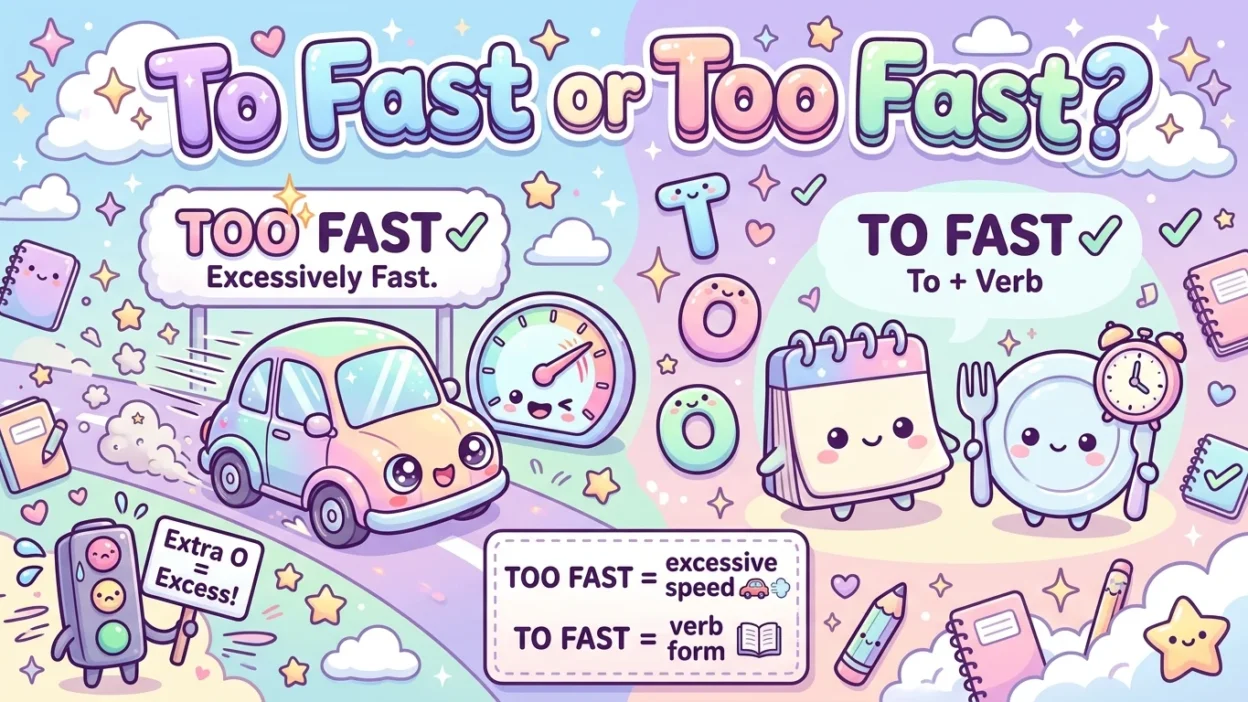
A Simple Memory Trick
Here is an easy way to remember the difference:
TOO = EXTRA O = EXCESS
The word too has an extra o, so think of that extra letter as representing too much of something.
Therefore:
too fast = more speed than wanted
For example:
“He drives too fast.”
His speed exceeds the desired level.
Meanwhile:
to fast = to + verb
For example:
“He decided to fast.”
So remember:
Extra O = excessive speed → TOO FAST
This simple connection can help you choose the correct form immediately.
To Fast vs Too Fast in Driving
Driving provides one of the most common contexts for this spelling question.
Correct:
“You are driving too fast.”
Incorrect:
“You are driving to fast.”
Why?
Because you mean the driver’s speed is excessive.
Similarly:
- The car was moving too fast.
- He took the corner too fast.
- She was traveling too fast for the conditions.
- Don’t drive too fast in bad weather.
Therefore, whenever you describe excessive driving speed, use too fast.
Too Fast vs Very Fast
Although too fast and very fast both emphasize speed, they do not mean exactly the same thing.
Very fast simply describes a high speed.
For example:
“That car is very fast.”
The sentence does not necessarily suggest a problem.
However, too fast suggests that the speed exceeds a desirable or acceptable level.
For example:
“That car is going too fast.”
Now, the speaker suggests that the speed creates a problem or exceeds a limit.
Therefore:
very fast = high speed
too fast = excessive speed
This distinction can significantly change your meaning.
Too Fast vs So Fast
So fast emphasizes a high degree of speed, while too fast generally indicates excess.
For example:
“She runs so fast!”
Here, the speaker simply emphasizes her speed, perhaps with admiration or surprise.
However:
“She runs too fast for me to keep up.”
Here, her speed creates a practical problem.
Therefore, so fast emphasizes intensity, while too fast often suggests that something exceeds a suitable level.
Too Fast vs Too Quickly
Both too fast and too quickly can describe excessive speed, and they sometimes overlap.
For example:
“He spoke too fast.”
“He spoke too quickly.”
Both sentences can sound natural.
However, fast commonly describes speed directly, while quickly often focuses on how rapidly an action occurs.
For instance:
“She made the decision too quickly.”
This wording usually sounds more natural than:
“She made the decision too fast.”
Therefore, context determines which expression sounds best.
American vs British English
Both American and British English use too fast when something happens at an excessive speed.
For example, speakers in both varieties can say:
“You’re driving too fast.”
Likewise, both varieties use to fast when fast functions as a verb:
“He decided to fast.”
Therefore, this distinction does not depend on whether you follow American or British spelling conventions.
In both varieties:
too fast = excessively fast
to fast = infinitive form of the verb fast
Consequently, the same basic grammar rule works for both audiences.
Similar To vs Too Expressions
Understanding other to/too combinations can help reinforce the rule.
- too slow — excessively slow
- too quickly — excessively quickly
- too loud — excessively loud
- too quiet — excessively quiet
- too early — earlier than desired
- too late — later than desired
- too much — an excessive amount
- too many — an excessive number
- too far — farther than desired
- too close — closer than desired
In each expression, too communicates the idea of excess.
Therefore, if you mean “more than necessary or desirable,” too will often be the correct choice.
Frequently Asked Questions
Is it to fast or too fast?
If you mean excessively fast, write too fast. For example, “You’re driving too fast” is correct. However, to fast can also be grammatical when fast functions as a verb, as in “She decided to fast.”
Is “you are going to fast” correct?
If you mean that someone is moving at an excessive speed, write “You are going too fast.” However, “You are going to fast” could theoretically contain to fast as a verb phrase in a different sentence structure, although that wording would require appropriate context.
Is “driving to fast” correct?
No, not when you mean excessive speed. Write “driving too fast.” Here, too means “excessively,” so the extra o matters.
What does too fast mean?
Too fast means faster than necessary, desirable, safe, comfortable, or appropriate. For example, “He speaks too fast” means his speaking speed exceeds a comfortable or understandable level.
Can “to fast” ever be correct?
Yes. To fast is correct when fast functions as a verb meaning to abstain from food, or sometimes drink, for a period. For example, “She decided to fast” uses the phrase correctly.
Is it “growing to fast” or “growing too fast”?
Write “growing too fast” when you mean that growth happens more rapidly than expected or desired. Here, too expresses excess.
Is it “moving to fast” or “moving too fast”?
Write “moving too fast” when you mean excessive speed. For example, “The project is moving too fast” means its progress feels more rapid than desired.
Why does too fast have two O’s?
Too has two o’s because it is a separate word from to. In too fast, it means “excessively.” A useful memory trick is extra O = excess.
Final Verdict: To Fast or Too Fast?
In most searches for to fast or too fast, the intended phrase is too fast. Use it whenever you mean that someone or something moves, develops, speaks, grows, changes, or happens at an excessive speed.
However, to fast is not automatically incorrect. It works when fast functions as a verb meaning to abstain from food for a period. Therefore, “You are driving too fast” and “She decided to fast” are both correct, but they communicate completely different ideas.
Remember This
Remember the extra O rule:
TOO = EXTRA O = EXCESS
Therefore:
too fast = excessively fast
“You’re talking too fast.”
Meanwhile:
to fast = to + verb
“She decided to fast.”
So, if you are talking about excessive speed, choose TOO FAST.
If you are talking about the action of fasting, TO FAST can be correct.
Conclusion
Ultimately, choosing between to fast and too fast becomes easy once you identify the meaning of fast. When you describe excessive speed, too fast is correct because too means “excessively” or “more than desirable.” Therefore, sentences such as “You’re driving too fast” and “Everything happened too fast” require two o’s.
However, when fast functions as a verb meaning to abstain from food for a period, to fast is correct. Consequently, remember the simple trick extra O = excess. If the sentence means “excessively fast,” choose too fast every time.