
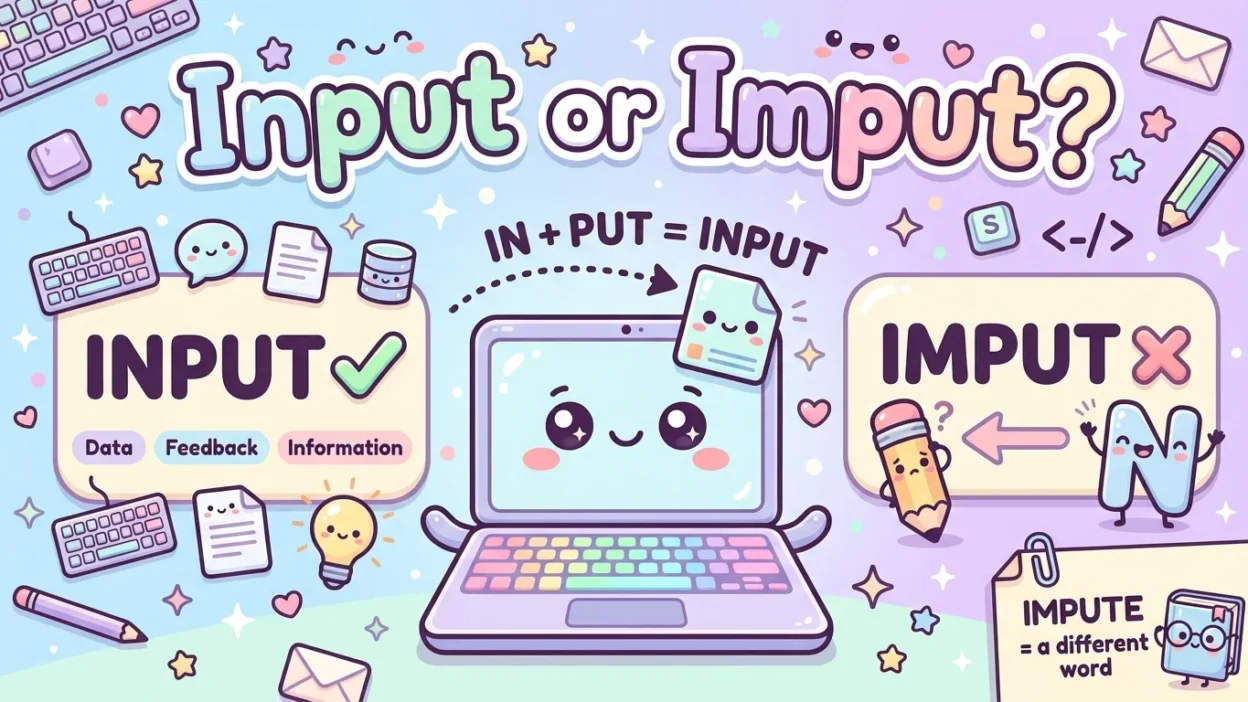
If you have ever typed input or imput and wondered which spelling belongs in your sentence, you are certainly dealing with an easy spelling mix-up. Although these two forms look almost identical, standard English does not use them interchangeably. Therefore, knowing the correct spelling can help you avoid a noticeable mistake in academic, professional, technical, and everyday writing.
In most situations, input is the correct word. It can refer to information, ideas, advice, data, or something entered into a computer or system. Moreover, input can function as both a noun and a verb. Imput, on the other hand, usually appears as a misspelling of input. However, English does have the separate verb impute, which means to attribute or assign something, such as responsibility, blame, or a value, to someone or something.
Therefore, if you mean information, feedback, or entered data, choose input.
Quick Answer: Input or Imput?
Input is the correct standard spelling when you mean information, feedback, data, or something entered into a system. For example, “Thank you for your input” and “Please input your password” are correct. Imput is generally a misspelling of input. However, do not confuse it with the separate word impute.
Why Do People Confuse Input and Imput?
People often confuse input and imput because the words look extremely similar. In fact, only one letter separates them: input contains n, while imput contains m.
Additionally, pronunciation can contribute to the confusion. When people speak quickly, the n sound in input may not always stand out clearly. Consequently, some writers spell the word according to what they think they hear.
Moreover, English contains many words beginning with im-, such as impossible, improper, imperfect, and immature. Therefore, imput may look believable at first glance.
Another source of confusion comes from impute, which is a genuine English word. However, impute carries a different meaning and includes a final e.
Therefore, remember the basic distinction:
Input = information, feedback, data, or the act of entering something.
Imput = usually a misspelling when you mean input.
Impute = attribute or assign something to someone or something.
What Does Input Mean?
Input is the standard English word. Depending on the sentence, it can function as either a noun or a verb.
As a noun, input can mean information, advice, ideas, feedback, resources, or data that someone provides.
For example:
- Thank you for your input.
- We need your input before making a decision.
- The manager asked employees for their input.
- Your input helped us improve the project.
- The computer processes the input quickly.
As a verb, input means to enter information or data into a computer, system, device, or process.
For example:
- Please input your password.
- You must input the correct information.
- She input the figures into the system.
- Employees input customer details every morning.
- The program allows users to input their own values.
Therefore, input works in many contexts, including technology, business, education, communication, mathematics, and everyday conversation.
What Does Imput Mean?
If you mean information, feedback, data, or the act of entering information, imput is generally an incorrect spelling.
For example:
❌ Thank you for your imput.
✅ Thank you for your input.
Similarly:
❌ Please imput your password.
✅ Please input your password.
The confusion usually occurs because writers replace the n in input with an m.
However, you may occasionally encounter imput in unusual contexts, names, abbreviations, historical material, or specialized terminology. Those exceptional appearances do not make it the standard spelling of input.
Therefore, in normal English writing, choose input when you mean data, feedback, information, or entering something into a system.
Input vs Imput: Comparison Table
| Feature | Input | Imput |
|---|---|---|
| Standard spelling | Yes | Generally no, for the intended meaning |
| Can mean feedback | Yes | No |
| Can mean data | Yes | No |
| Can mean information entered | Yes | No |
| Can function as a noun | Yes | Not as a standard alternative to input |
| Can function as a verb | Yes | Not as a standard alternative to input |
| Example | Thank you for your input. | Thank you for your imput. ❌ |
| Best choice | Input | Avoid when you mean input |
Therefore, the choice is straightforward: use input, not imput, when referring to information, feedback, data, or entering information.
When Should You Use Input?
Use input when you refer to information, ideas, opinions, feedback, data, or something that enters a process or system.
For example, you can ask someone for their input when you want their opinion:
“I would appreciate your input on this proposal.”
Likewise, you can use input when discussing technology:
“The computer received the wrong input.”
Furthermore, you can use it as a verb when someone enters information:
“Please input your account number.”
Therefore, input appears naturally in several major contexts.
Input for Advice or Feedback
You can use input to describe someone’s ideas, opinions, or suggestions.
For example:
“Before we finalize the design, we need the client’s input.”
Input for Computer Data
In computing, input refers to data or instructions supplied to a computer or program.
For example:
“The application checks the user’s input before processing it.”
Input as a Verb
You can also use input to describe entering data.
For example:
“Please input the correct date.”
Consequently, input works as both a noun and a verb.
When Should You Use Imput?
When you mean input, you generally should not use imput.
For example:
❌ I need your imput on this project.
✅ I need your input on this project.
Similarly:
❌ Please imput your email address.
✅ Please input your email address.
Therefore, if you find yourself writing imput, first check whether you actually mean input or impute.
In most everyday, professional, and technological contexts involving data or feedback, input will be the word you need.
Input or Imput: 18 Practical Examples
The following examples make the correct spelling easier to recognize.
Correct Examples With Input
- Thank you for your input on the project.
- We value your input and appreciate your suggestions.
- The manager asked the team for input before making the final decision.
- Please input your username and password.
- The program cannot process incorrect input.
- Your input could help us improve the service.
- Students provided valuable input during the discussion.
- Please input the correct figures into the spreadsheet.
- The designer requested the client’s input before making changes.
- The computer receives input from several devices.
- We need additional input from the marketing department.
- Users can input their preferred settings manually.
- Her input played an important role in the final decision.
- The system validates each input before saving the information.
- Could you provide some input on my presentation?
- Employees must input their working hours accurately.
- The committee welcomed input from community members.
- Please check your input before submitting the form.
In every example, input provides the correct standard spelling.
Incorrect Examples With Imput
Here are several common spelling mistakes:
❌ Thanks for your imput.
✅ Thanks for your input.
❌ We need your imput before proceeding.
✅ We need your input before proceeding.
❌ Please imput the required information.
✅ Please input the required information.
❌ The computer received invalid imput.
✅ The computer received invalid input.
❌ Your imput was extremely helpful.
✅ Your input was extremely helpful.
Therefore, whenever imput carries the intended meaning of information, data, feedback, or entering something, replace it with input.
Input vs Impute: What Is the Difference?
Although imput is generally a misspelling when someone intends input, impute is a genuine English word.
Input means to provide or enter information, or it refers to the information, feedback, or data itself.
Impute, however, means to attribute, assign, or ascribe something to someone or something.
For example:
“Do not impute dishonest motives to her without evidence.”
Here, impute means to attribute dishonest motives to someone.
Another example:
“The law may impute responsibility under certain circumstances.”
Therefore:
Input → information, feedback, data, or entering data
Impute → attribute or assign something
These words have different meanings, so you should not use them interchangeably.
Input vs Imput vs Impute
Understanding all three forms makes the distinction even clearer.
| Word | Meaning | Standard? | Example |
|---|---|---|---|
| Input | Information, feedback, data, or entering information | Yes | We need your input. |
| Imput | Usually a misspelling of input | No, for this meaning | We need your imput. ❌ |
| Impute | Attribute or assign something | Yes | Do not impute blame unfairly. |
Therefore, check the meaning before choosing the spelling.
If you mean information or feedback, write input.
If you mean enter data, write input.
If you mean attribute something, write impute.
Common Mistakes With Input and Imput
Although the spelling difference involves only one letter, several common mistakes appear frequently.
Mistake 1: Writing Imput Instead of Input
This mistake appears when someone replaces the n with an m.
Incorrect:
“Thank you for your imput.”
Correct:
“Thank you for your input.”
Therefore, always remember that input contains the word in at the beginning.
Mistake 2: Confusing Input With Impute
Because impute resembles input, some writers assume the words share the same meaning.
However, they do not.
Input relates to information or entering information, while impute means to attribute something.
Mistake 3: Assuming Input Only Relates to Computers
Although technology frequently uses the word, input also means advice, ideas, opinions, or contributions.
For example:
“I appreciate your input.”
Here, nobody necessarily enters data into a computer. Instead, input means advice or feedback.
Mistake 4: Avoiding Input as a Verb
Some writers know input as a noun but hesitate to use it as a verb.
However, English commonly uses input as a verb, particularly in computing and data-related contexts.
For example:
“Please input the customer information.”
Mistake 5: Writing In Put
When you mean information, feedback, or entered data, do not normally split input into two words.
Incorrect:
“Thank you for your in put.”
Correct:
“Thank you for your input.”
Therefore, remember that input forms one word.
A Simple Memory Trick
Here is an easy way to remember the spelling:
IN + PUT = INPUT
Think about putting information in.
You put information in a system.
Therefore:
IN + PUT → INPUT
For example, when you enter your password, you put information in the computer. Consequently, you input your password.
The same spelling also works when input means advice or feedback.
So, whenever you hesitate between input and imput, remember:
Put it IN = INPUT.
That simple connection can help you avoid the spelling mistake.
American vs British English
Both American and British English use input as the standard spelling when referring to data, information, feedback, advice, or the act of entering information.
Therefore, you do not need to change the spelling according to whether you write for an American or British audience.
For example, both varieties can use:
“Thank you for your input.”
Similarly, both can use:
“Please input the required information.”
Meanwhile, imput does not become the standard spelling simply because you switch between American and British English.
Therefore, whether you follow American or British conventions, choose input for the meanings discussed here.
Input as a Noun vs Input as a Verb
One reason input appears so frequently involves its flexibility.
As a noun, it can refer to information, advice, feedback, or data:
“Your input helped us make a better decision.”
As a verb, it describes entering information:
“Please input your details.”
Therefore, the same spelling works in both grammatical roles.
However, the sentence structure helps reveal its function.
In:
“We appreciate your input,”
input functions as a noun.
Meanwhile, in:
“Please input the numbers,”
input functions as a verb.
Input vs Output
Input and output often appear together, especially in computing, mathematics, electronics, economics, and business.
Input refers to what goes into a system.
Meanwhile, output refers to what comes out of the system.
For example:
“The program processes the input and produces an output.”
Imagine a calculator. You enter numbers as the input, and the calculator gives you a result as the output.
Therefore, remembering the relationship between input and output can also reinforce the correct spelling.
Input vs Feedback
Although input and feedback can overlap, they do not always mean exactly the same thing.
Input can refer broadly to ideas, information, suggestions, or contributions that help a process or decision.
Meanwhile, feedback usually refers to reactions, evaluations, comments, or suggestions about something that already exists or has already happened.
For example:
“We need your input before designing the new website.”
Here, the person contributes ideas before the design process finishes.
However:
“We need your feedback on the new website.”
Here, the person may review an existing design and comment on it.
Therefore, context determines which word communicates your meaning more precisely.
Similar Words to Input
Several words can carry meanings related to input, depending on context:
- Feedback — comments or reactions
- Advice — guidance about what someone should do
- Suggestion — an idea or recommendation
- Contribution — something provided toward a larger effort
- Information — facts or details
- Data — information collected for analysis or processing
- Entry — information entered into a system or record
- Opinion — a personal view or judgment
- Recommendation — a suggested course of action
- Response — an answer or reaction
However, these words are not always interchangeable. Therefore, choose the one that best matches your intended meaning.
Frequently Asked Questions
Is it input or imput?
Input is the correct standard spelling when you mean information, feedback, data, or entering information into a system. Imput is generally a misspelling in these contexts.
Is imput a correct word?
If you intend the common word meaning data, information, feedback, or entering information, write input, not imput. You may encounter the letter sequence imput in unusual or specialized contexts, but it does not serve as the standard alternative spelling of input.
Is input one word?
Yes. Input forms one word when you use it as a noun or verb. For example, “I appreciate your input” and “Please input your details” both use the correct one-word spelling.
What does input mean?
As a noun, input can mean information, ideas, feedback, advice, or data. As a verb, it means to enter information into a computer, system, or process.
Can input be a verb?
Yes. You can use input as a verb, particularly when discussing computers, databases, forms, and information systems. For example, “Please input your account number.”
What is the difference between input and impute?
Input refers to information, feedback, data, or entering information. In contrast, impute means to attribute or assign something, such as responsibility, blame, or a particular quality.
Is “thank you for your input” correct?
Yes. “Thank you for your input” is grammatically correct and natural. Here, input means someone’s advice, ideas, feedback, or contribution.
Is input spelled differently in British English?
No. Both British and American English use input for information, feedback, data, and the action of entering information. Therefore, imput does not represent a standard British alternative.
Final Verdict: Input or Imput?
Ultimately, input is the spelling you need when referring to information, data, feedback, advice, or the act of entering information into a system. Therefore, sentences such as “Thank you for your input” and “Please input your password” use the correct spelling.
Meanwhile, imput is generally a spelling error when a writer intends input. However, remember that impute exists as a separate standard word meaning “to attribute or assign.” Consequently, checking both spelling and meaning will help you choose the correct form every time.
Remember This
The easiest memory trick is:
IN + PUT = INPUT
You put information in, so you input it.
Therefore:
Input = correct for information, feedback, data, and entering information.
Imput = generally incorrect when you mean input.
Impute = a different word meaning to attribute or assign something.
So, when you want to thank someone for their ideas, write:
“Thank you for your input.”
And when you enter information into a computer, write:
“Please input your details.”
Conclusion
Although input and imput differ by only one letter, standard English clearly favors input when you mean information, feedback, data, advice, or the act of entering information. Moreover, input works as both a noun and a verb, which explains why you encounter it frequently in business, education, technology, and everyday communication.
Therefore, remember the simple formula IN + PUT = INPUT. Meanwhile, keep impute separate because it carries a different meaning. Once you connect input with the idea of putting information in, choosing the correct spelling becomes much easier.

Lutana Maroochy is a creative author recognized for delivering engaging and well-researched content. With a passion for clear communication and storytelling, Lutana focuses on producing informative, reader-centered articles across various subjects. Dedicated to quality and originality, Lutana consistently connects with audiences through thoughtful insights and compelling narratives.