
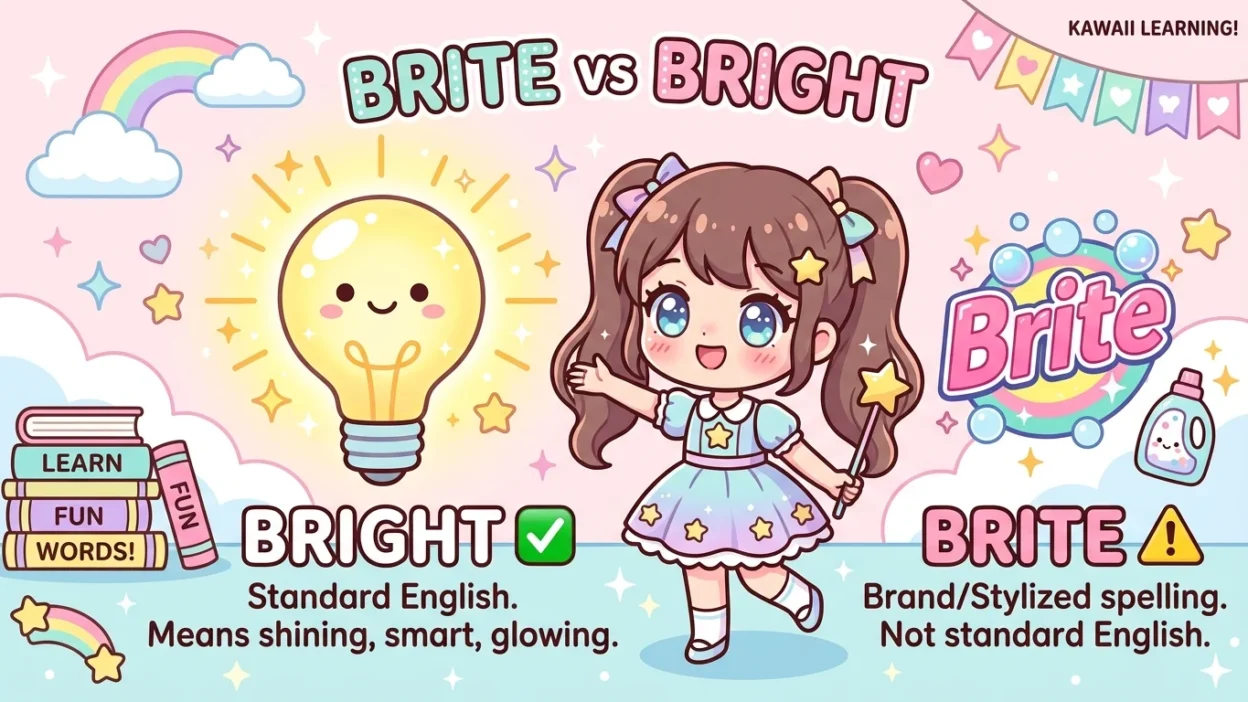
When you want to describe something that gives off plenty of light, looks vivid, or shows strong intelligence, you may wonder whether “brite” or “bright” works correctly. Although both spellings can appear in English, they do not have the same standard status or everyday use.
Generally, bright represents the standard English spelling. Therefore, you should use bright in ordinary writing, professional communication, academic work, and most everyday situations. In contrast, brite usually appears as a stylized or brand-related spelling rather than as the standard form of the adjective.
Moreover, people sometimes write brite because English pronunciation makes the word sound like “brite.” However, spelling does not always follow pronunciation. Consequently, remembering the standard spelling can help you avoid this common mistake.
Quick Answer
Bright is the standard English spelling. It can describe something full of light, vivid in color, intelligent, or promising. Brite does not normally work as the standard spelling of the adjective, although companies, brands, products, and names may use Brite as a stylized spelling.
Why People Confuse “Brite” and “Bright”
People often confuse these words because brite and bright sound the same when pronounced.
However, standard English spelling uses bright, including the silent-looking gh combination.
For example:
- The room is bright. ✅
- She has a bright smile. ✅
- He is a bright student. ✅
Therefore, although brite may look like a logical spelling based on pronunciation, standard writing generally requires bright.
Bright: Meaning and Use
Bright works as an adjective with several related meanings. Therefore, context determines exactly what it describes.
Bright Means Full of Light
First, bright can describe something that produces or reflects a lot of light.
- The sun is bright.
- Turn off the bright light.
- The room looks bright today.
- She wore a bright lamp for her desk.
Bright Means Vivid in Color
Additionally, bright can describe strong or vivid colors.
- She wore a bright yellow dress.
- The walls have a bright blue color.
- I like bright colors.
- He bought a bright red backpack.
Bright Means Intelligent
Furthermore, bright can describe someone who learns quickly or shows intelligence.
- She is a bright student.
- He has a bright mind.
- The child seems very bright.
- She is one of the brightest students in her class.
Bright Means Promising
Moreover, bright can describe a positive or promising future.
- He has a bright future.
- The company has bright prospects.
- She sees a bright future ahead.
Bright Means Cheerful
In addition, bright can describe a cheerful expression or mood.
- She gave me a bright smile.
- His bright personality attracted everyone.
- The children looked bright and cheerful.
Brite: Meaning and Use
Brite does not normally function as the standard spelling of the adjective bright.
However, you may see Brite in names, trademarks, product names, company names, and stylized branding.
Therefore, if a specific brand or organization chooses Brite, you should preserve its spelling when referring to that proper name.
For example, a fictional company could choose the name Brite Solutions, even though standard English still spells the adjective bright.
Consequently:
Standard adjective: bright ✅
Stylized name or brand: Brite may appear as a proper name.
Comparison Table
| Word | Standard English? | Main Use | Example |
|---|---|---|---|
| Bright | Yes | Light, color, intelligence, optimism | The room is bright. |
| Brite | Usually no | Brand or stylized spelling | The company uses Brite in its name. |
| Brightly | Yes | Adverb | The stars shone brightly. |
| Brightness | Yes | Noun | The brightness hurt my eyes. |
When to Use “Bright”
Use “Bright” for Light
Use bright when something gives off or reflects strong light.
- The flashlight is bright.
- The sun looks bright.
- This room has bright lighting.
Use “Bright” for Colors
Similarly, use bright for vivid colors.
- She chose a bright pink shirt.
- The artist used bright colors.
- The flowers have bright petals.
Use “Bright” for Intelligence
Use bright when you describe someone as intelligent.
- He is a bright student.
- She is very bright.
- The teacher recognized his bright mind.
Use “Bright” for Positive Futures
Likewise, use bright when you describe something as promising.
- She has a bright future.
- The project has bright prospects.
- The young athlete has a bright career ahead.
When to Use “Brite”
Use “Brite” in an Official Name
If a company, product, organization, or brand officially spells its name Brite, keep that spelling.
For example:
- Brite Solutions
- Brite Learning
- Brite Energy
However, do not automatically replace bright with brite in ordinary sentences.
Use “Brite” Only When the Name Requires It
If you quote or mention an official name, follow the organization’s chosen spelling.
Therefore, the distinction remains simple:
Brite as a name → potentially correct
Brite as the ordinary adjective → generally incorrect
Brite vs Bright Examples
- The room is bright.
- The sunlight looks bright this morning.
- She wore a bright yellow dress.
- He bought a bright red car.
- The students decorated the classroom with bright colors.
- She is a bright student.
- He has a bright future.
- Her bright smile made everyone happy.
- The stars looked bright in the night sky.
- Turn down the bright light.
- The flowers have bright colors.
- The screen looks too bright.
- She has a bright personality.
- The young athlete has a bright career ahead.
- The company chose bright colors for its logo.
- “Brite” may appear in a company’s official name.
- The brand spells its name Brite.
- In ordinary English, write bright, not brite.
Common Mistakes
Mistake 1: Writing “Brite” in Normal Sentences
Incorrect: The room is brite.
Correct: The room is bright.
Therefore, always choose bright when you need the ordinary adjective.
Mistake 2: Assuming Pronunciation Determines Spelling
Because bright sounds similar to “brite,” some writers remove the letters they do not hear.
However, English spelling often preserves letters that pronunciation does not clearly reveal.
Consequently, remember the standard written form: bright.
Mistake 3: Using “Brite” for Intelligence
Incorrect: She is a brite student.
Correct: She is a bright student.
Mistake 4: Using “Brite” for Colors
Incorrect: He chose a brite blue shirt.
Correct: He chose a bright blue shirt.
Mistake 5: Changing a Brand’s Official Spelling
If a brand officially uses Brite, do not automatically change it to Bright.
For example, if a company calls itself Brite, its name remains Brite.
Memory Trick
Use this simple trick:
Bright has “GH.”
Think of the phrase:
Bright = Light
Both ideas connect with seeing and visibility.
Therefore, when you mean light, vivid color, intelligence, or optimism, remember bright.
Bright = standard
Brite = usually a stylized name
American vs British English
Both American and British English use bright as the standard spelling.
Therefore:
- American English: bright
- British English: bright
Neither variety normally changes bright to brite in standard writing.
However, both varieties can use Brite when a company, product, or organization intentionally chooses that spelling as its name.
Similar Words
Bright vs Brilliant
Both words can describe strong light or intelligence. However, brilliant often carries stronger emphasis.
- She has a bright mind.
- She has a brilliant mind.
Bright vs Shiny
Bright can describe strong light or vivid appearance, while shiny specifically describes a surface that reflects light.
- The room is bright.
- The car has a shiny surface.
Bright vs Light
Light can describe the amount of illumination or a pale color. Meanwhile, bright often emphasizes strong illumination or vividness.
- The room has plenty of light.
- The room looks bright.
Final Verdict
Bright is the correct standard spelling for the ordinary English adjective. Therefore, use bright when you describe light, vivid colors, intelligence, cheerfulness, or a promising future.
In contrast, brite usually appears as a stylized spelling in brand names, product names, or other official names. Consequently, do not use brite as a replacement for bright in ordinary writing.
Remember This
Bright ✅ = standard English spelling
Brite ⚠️ = usually a brand or stylized spelling
So, write:
“The room is bright.” ✅
Not:
“The room is brite.” ❌
FAQs
Is “brite” a correct spelling?
Generally, no. Bright represents the standard spelling of the adjective. However, Brite can appear as a stylized spelling in brand names, product names, and company names.
Is it “bright” or “brite”?
Use bright in standard English. Therefore, write “a bright light,” “a bright color,” or “a bright student.”
Why do people spell bright as “brite”?
People sometimes use brite because it reflects the pronunciation of bright. Additionally, businesses may choose Brite as a shorter or more distinctive brand spelling.
Is “brite” a word in English?
You may encounter brite in specialized names, branding, or informal contexts. Nevertheless, bright remains the standard spelling for the common adjective.
Can I use “Brite” in a company name?
Yes. A company can choose Brite as its official name. However, that branding choice does not change the standard spelling bright in ordinary English.
What does “bright” mean?
Bright can describe strong light, vivid colors, intelligence, cheerfulness, or something promising. Therefore, its exact meaning depends on the sentence.
Is “bright” the same in American and British English?
Yes. Both American and British English use bright as the standard spelling.
Conclusion
Overall, bright clearly wins when you need the standard English spelling. Whether you describe a strong light, vivid color, intelligent person, cheerful personality, or promising future, bright provides the correct form.
Therefore, remember that brite mainly appears as a stylized spelling, especially in names and branding. Whenever you write a normal English sentence, choose bright. That simple rule will keep your spelling accurate and professional.

Narelle Merindah is a passionate author committed to delivering thoughtful, engaging, and well-structured content. With a keen eye for detail and a love for storytelling, Narelle creates informative articles that resonate with readers. Her dedication to clarity, creativity, and authenticity ensures meaningful and impactful writing.