
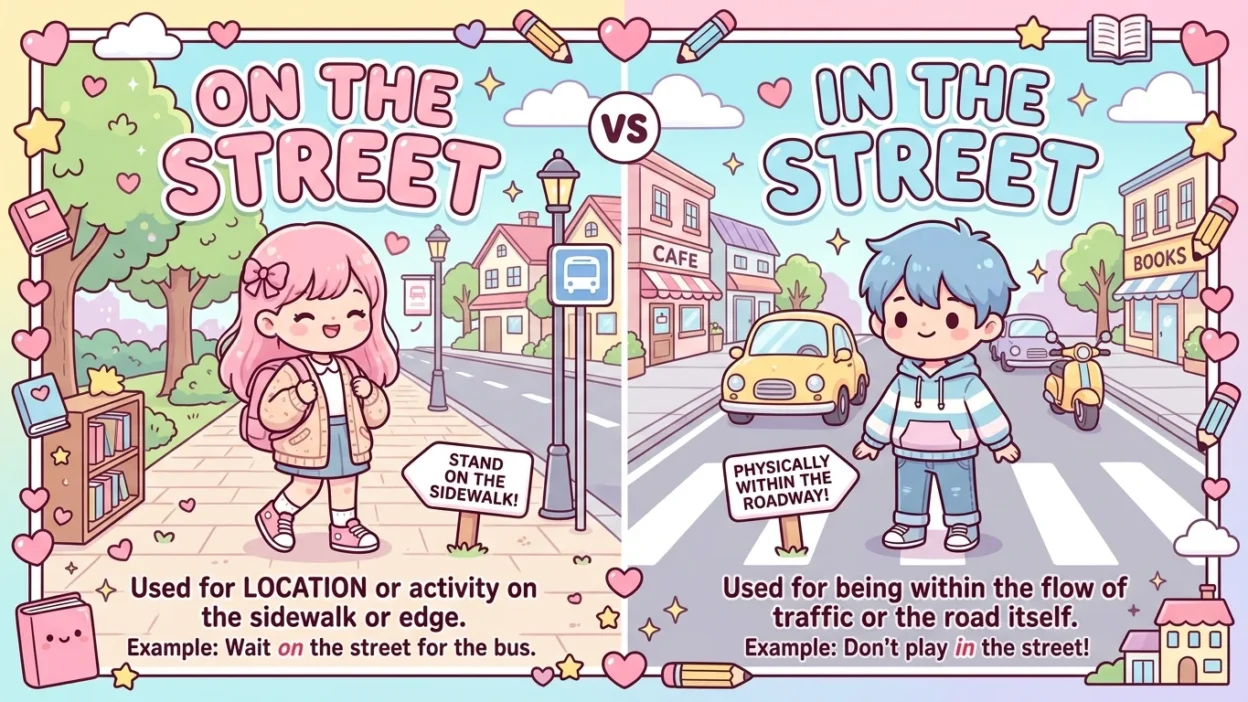
“In the street” and “on the street” are both grammatically correct, but they can communicate slightly different ideas depending on the context. Therefore, choosing between them depends on whether you mean a position within the street area or a location along a particular street.
More specifically, on the street often refers to someone’s location along a street, especially when you talk about addresses, shops, buildings, or general whereabouts. Meanwhile, in the street often emphasizes being physically within the street itself, particularly in the roadway or among the traffic. However, regional differences also influence which expression sounds more natural.
For example, you can say “There is a café on the street” when you mean the café sits along that street. On the other hand, “The children are playing in the street” emphasizes that the children are physically in the roadway or street area. Consequently, both expressions work, but context determines the better choice.
Quick Answer
“On the street” usually describes a location along a street, while “in the street” emphasizes being physically within the street area or roadway. Therefore, use on for general street location and in when you mean inside the street space.
Why People Confuse Them
People often confuse these expressions because both in and on can describe location.
However, English uses these prepositions differently depending on the relationship between the person or object and the street.
For example:
- She lives on this street. ✅
- The children are playing in the street. ✅
The first sentence describes a location along the street.
The second sentence emphasizes physical presence within the street itself.
Therefore, the easiest distinction is:
on the street = located along the street
in the street = physically within the street
“On the Street” — Meaning and Usage
On the street commonly describes someone’s or something’s location along a street.
For example:
I live on Green Street.
Here, the speaker’s home has a location along Green Street.
Similarly:
There is a pharmacy on the street.
This sentence describes the pharmacy as being located along the street.
You can also use on the street when talking about someone’s whereabouts:
I saw him on the street yesterday.
Here, the phrase simply indicates that you saw him outside along the street.
Common Examples
- I live on this street.
- The restaurant is on the street.
- There is a bank on Main Street.
- She works on the street nearby.
- We met on the street.
Therefore, on the street works especially well when you focus on a street as a location or route.
“In the Street” — Meaning and Usage
In the street usually emphasizes physical presence within the street area.
For example:
The children are playing in the street.
Here, the children are physically in the roadway or street space.
Similarly:
There is a large hole in the street.
The hole exists within the surface or structure of the street.
You can also use in the street when something occupies the roadway:
A car stopped in the street.
The car physically sits in the street rather than simply being located somewhere along it.
Common Examples
- The children are playing in the street.
- A car stopped in the street.
- There is a hole in the street.
- Someone left a box in the street.
- The workers found damage in the street.
Therefore, in the street often creates a stronger sense of physical position within the street.
In the Street vs On the Street: Comparison Table
| Expression | Main Meaning | Example |
|---|---|---|
| On the street | Along or located at a street | She lives on Oak Street. |
| On the street | Outside or along a street | I saw him on the street. |
| In the street | Physically within the street | The children are playing in the street. |
| In the street | Within the roadway/surface | There is a hole in the street. |
Consequently, both expressions are correct, but they emphasize different relationships with the street.
When to Use “On the Street”
Use on the street when you mean that someone or something exists along a street.
For example:
My office is on King Street.
The office has a location along King Street.
You can also use it when describing businesses:
There are several cafés on this street.
Additionally, on the street often works when talking about someone’s general location:
I met an old friend on the street.
Therefore, choose on when you think of the street as a location or route.
When to Use “In the Street”
Use in the street when you want to emphasize physical position within the street area.
For example:
The children were playing in the street.
Here, the children physically occupied the street.
Similarly:
A truck is blocking the street.
You can also say:
A truck is stopped in the street.
This emphasizes the truck’s physical position within the roadway.
Therefore, use in when the street itself acts more like a physical space or container.
18 Examples of Correct Usage
- I live on this street.
- There is a supermarket on the street.
- She works on Main Street.
- We met on the street yesterday.
- The café is on the next street.
- There are several houses on this street.
- I saw your brother on the street.
- The hotel is on a busy street.
- The children are playing in the street.
- A car stopped in the street.
- There is a large hole in the street.
- Someone left a bicycle in the street.
- The workers found damage in the street.
- A dog was sitting in the street.
- The ball rolled into the street.
- The protesters gathered in the street.
- Water was flowing through the street.
- A fallen tree was lying in the street.
As you can see, on usually emphasizes location along the street, while in emphasizes physical presence within it.
“In the Street” vs “On the Street” in American and British English
Both American and British English use in the street and on the street.
However, usage can vary slightly depending on the context and region.
For example, on the street commonly describes someone’s location or address in both varieties:
She lives on Park Street.
Meanwhile, in the street commonly describes something physically occupying the roadway:
The children are playing in the street.
Therefore, the basic distinction remains useful in both American and British English.
Common Mistakes
Mistake 1: Using “In” for an Address
A common mistake is:
I live in Green Street. ❌
In standard English, say:
I live on Green Street. ✅
When you give a street name as an address, on normally works.
Mistake 2: Using “On” for Physical Position
For example:
The children are playing on the street.
This sentence can occur, particularly in some varieties of English, but “in the street” more clearly emphasizes that the children are physically in the roadway or street area.
Mistake 3: Thinking One Preposition Always Works
Neither in nor on works in every street-related sentence.
Instead, consider the meaning.
Ask yourself:
Am I describing a location along the street?
Use on.
Am I describing physical presence within the street?
Use in.
Memory Trick
Remember:
ON = location along the street
IN = physically inside the street area
For example:
I live on King Street.
The children are playing in the street.
You can visualize the difference like this:
On the street → along the street
In the street → inside the street space
Therefore, this simple image can help you choose the right preposition quickly.
Similar Expressions
On Main Street
Use on with a specific street name.
The shop is on Main Street.
In the Road
Use in the road when something physically occupies the roadway.
There is a bicycle in the road.
On the Road
On the road can mean traveling, being away from home, or physically located on a road.
We are on the road.
In the City
Use in for being within a city.
She lives in London.
On the Avenue
Like on the street, use on when describing a location along an avenue.
The hotel is on Fifth Avenue.
Therefore, English prepositions depend heavily on the relationship between the object and the location.
Final Verdict
Both “in the street” and “on the street” are correct. However, they usually emphasize different meanings.
Use on the street for a location along a street, especially with addresses, businesses, buildings, and general whereabouts.
Use in the street when you want to emphasize physical presence within the street or roadway.
Therefore:
I live on this street. ✅
The children are playing in the street. ✅
Remember This
ON the street = along the street
IN the street = physically within the street
So, if you are giving an address, say:
I live on Park Street.
If you are describing something physically occupying the roadway, say:
The car is in the street.
Once you understand this difference, choosing between in and on becomes much easier.
FAQs
Is “in the street” correct?
Yes. “In the street” is correct when you mean that someone or something is physically within the street area, especially the roadway.
Is “on the street” correct?
Yes. “On the street” is correct and commonly describes a location along a street or someone’s general whereabouts.
Should I say “I live in the street” or “I live on the street”?
Use “I live on the street.” When you mention a street as an address or location, on normally works in standard English.
Should I say “children are playing in the street” or “on the street”?
“The children are playing in the street” more clearly emphasizes that the children are physically within the street area or roadway. However, regional usage can vary.
Is “on the street” used for addresses?
Yes. For example, you can say “She lives on Park Street” or “The shop is on Main Street.”
What is the easiest way to remember in the street and on the street?
Remember “on = along” and “in = within.” Therefore, on the street describes a location along a street, while in the street emphasizes physical presence within it.
Do American and British English use these expressions differently?
Both varieties use in the street and on the street. The basic distinction remains similar, although particular contexts and regional speech can influence which expression sounds more natural.
Conclusion
Overall, “in the street” and “on the street” are both correct, but they usually highlight different ideas. On the street commonly describes a location along a street, especially when you mention an address, building, business, or someone’s whereabouts. Meanwhile, in the street emphasizes physical presence within the street area or roadway.
Therefore, remember the simple rule “on = along” and “in = within.” For example, say “I live on Green Street” but “The children are playing in the street.” Once you connect each preposition with its basic spatial meaning, the difference becomes much easier to understand.

Narelle Merindah is a passionate author committed to delivering thoughtful, engaging, and well-structured content. With a keen eye for detail and a love for storytelling, Narelle creates informative articles that resonate with readers. Her dedication to clarity, creativity, and authenticity ensures meaningful and impactful writing.