
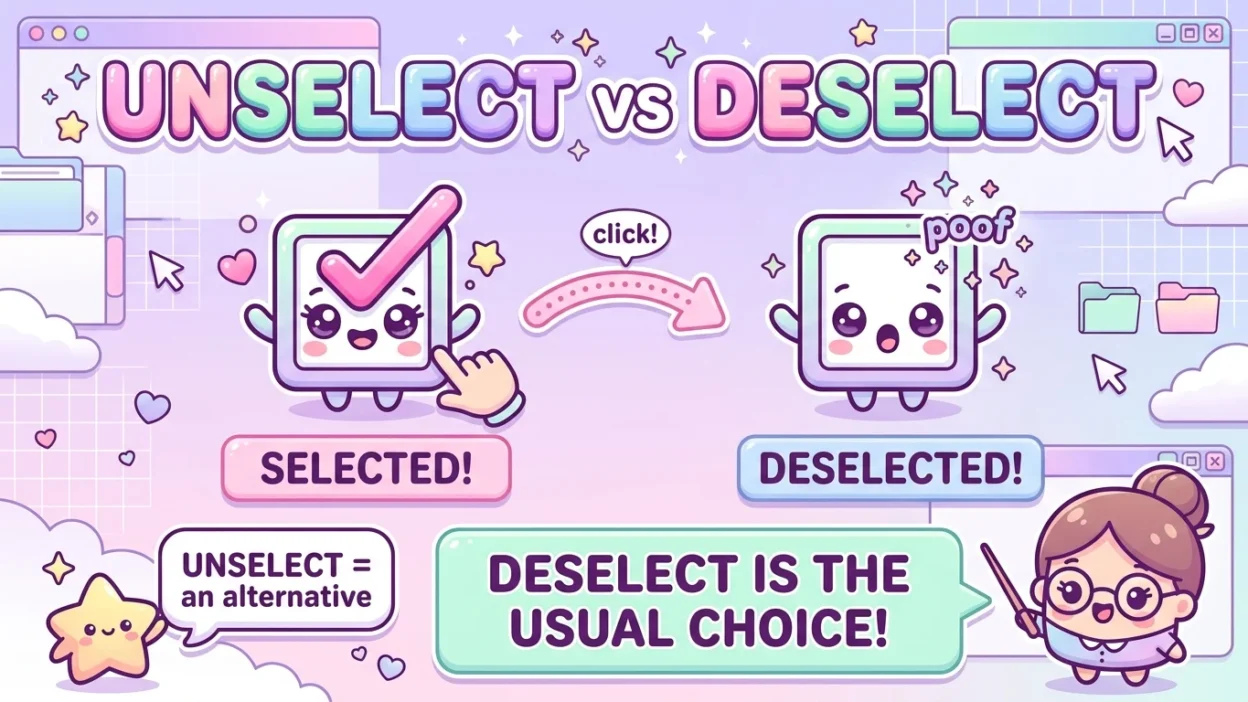
Have you ever wondered whether you should write unselect or deselect when you want to remove a selection? Although both words can communicate a similar idea, they do not appear equally often in standard English. Therefore, choosing the right word can make your writing sound clearer, more natural, and more professional.
In everyday conversations, software instructions, online forms, and user interface messages, people often use these terms to describe reversing a previous selection. However, deselect generally serves as the more widely accepted and natural choice, especially when someone clicks an option to remove its selected status. Meanwhile, unselect also appears in technical contexts and informal usage, although some readers may find it less familiar.
Fortunately, you can remember the difference with a simple rule: use deselect when you want to remove a selection, and use unselect only when your context or software terminology specifically favors it.
Quick Answer: Unselect vs Deselect
Deselect is generally the preferred word when you want to remove a selection, especially in software, forms, menus, and instructions. For example, “Deselect the checkbox” sounds natural and clear. Unselect can also mean to remove a selection, but it appears less commonly in standard usage. Therefore, choose deselect when you want the safest, clearest option.
Why Do People Confuse Unselect and Deselect?
People confuse these words because both can describe reversing an action that selected something. Moreover, both contain a prefix that suggests undoing or reversing an action.
However, their usage differs in familiarity and convention. English speakers commonly use deselect in technology, design, and everyday instructions. For example, a website might tell you to deselect an option when you no longer want it.
On the other hand, unselect follows a familiar English pattern: adding un- to suggest the opposite of an action. Consequently, readers can usually understand what it means, even if they encounter it less frequently.
Additionally, software developers sometimes choose terminology based on a platform’s documentation or established interface language. Therefore, a particular application might use unselect, even though deselect remains the more broadly recognizable choice.
What Does Deselect Mean?
Deselect is a verb that means to remove something from a selected state or reverse a previous selection.
For example, imagine that you select a checkbox on a website. If you click it again to remove the check mark, you deselect that checkbox.
Similarly, you can deselect text, an image, a file, a menu option, or an item in a digital interface. In these situations, the word describes an action that reverses selection rather than deleting the item itself.
Examples:
- Please deselect the options you no longer want.
- Click the image again to deselect it.
- I accidentally selected the wrong file, so I deselected it.
- You can deselect this checkbox at any time.
- The application lets users deselect multiple items.
Moreover, deselect works well in professional instructions because readers commonly recognize it in software and digital environments.
What Does Unselect Mean?
Unselect is a verb that can mean to remove something from a selected state. Although people use it in technical writing, software interfaces, and informal communication, it generally appears less often than deselect.
The word follows a recognizable pattern because the prefix un- often expresses reversal or removal. For instance, unlock means to reverse a locked state, while untie means to reverse the action of tying.
Nevertheless, English does not use un- and de- interchangeably in every situation. Therefore, even when unselect makes sense, deselect often sounds more conventional.
Examples:
- The application allows users to unselect an option.
- Try to unselect the item before choosing another one.
- I need to unselect these files from the list.
- The system lets you unselect an unwanted preference.
- You can unselect the option if you change your mind.
These sentences communicate the intended meaning, but many editors would prefer deselect in polished instructions.
Unselect vs Deselect: Comparison Table
| Feature | Deselect | Unselect |
|---|---|---|
| Meaning | Remove a selection | Remove a selection |
| Part of speech | Verb | Verb |
| Standard usage | Widely established | Less common |
| Software instructions | Generally preferred | Sometimes used |
| Professional writing | Usually the safer choice | Depends on context |
| Example | Deselect the checkbox. | Unselect the checkbox. |
| Best general recommendation | Use this by default | Use when context supports it |
As the table shows, both words can express the same basic action. However, deselect generally offers the clearest and most conventional choice for broad audiences.
When Should You Use Deselect?
Use deselect when you want to describe removing an existing selection. Furthermore, choose it when writing instructions for websites, mobile apps, computer programs, forms, and other digital tools.
Here are the most common situations.
1. When discussing checkboxes
For example, “Deselect the checkbox if you do not want email notifications.”
2. When working with files
For example, “Deselect the files you do not want to upload.”
3. When editing images or text
For example, “Click outside the highlighted area to deselect the text.”
4. When writing software instructions
For example, “Deselect the option before continuing to the next screen.”
5. When explaining user interface actions
For example, “The button allows you to deselect all selected items.”
In each situation, deselect sounds natural, communicates the action clearly, and suits professional writing.
When Should You Use Unselect?
Use unselect when a particular application, technical specification, or established team vocabulary already uses that term. Additionally, you can use it in informal communication when your audience understands what you mean.
For example, a developer might maintain the word unselect throughout a codebase because the existing documentation uses it. In that case, consistency may matter more than changing the terminology.
However, if you are writing a new help article, user guide, email, or general instruction, consider choosing deselect instead. This approach helps you avoid unfamiliar wording and keeps your message consistent with common interface language.
Examples:
- The legacy application uses an unselect command.
- The internal guide tells users to unselect unwanted entries.
- Our team uses “unselect” in its existing documentation.
- The developer named the function
unselectItem().
Notice that the final example shows a programming identifier. Developers can choose function names according to their project’s conventions; that choice does not automatically make the term preferable in general prose.
Deselect vs Unselect: 18 Practical Examples
The following examples show how both words work in context. Although the meaning remains similar, deselect usually sounds more natural in standard instructions.
Examples Using Deselect
- Please deselect the checkbox if you do not agree with the optional setting.
- You can deselect any item before submitting your order.
- I accidentally selected the wrong image, so I had to deselect it.
- Deselect the files you do not want to include in the upload.
- The application lets users deselect multiple entries at once.
- Click anywhere outside the highlighted text to deselect it.
- Please deselect the unwanted options before saving your preferences.
- The designer clicked the background to deselect the selected object.
- You must deselect the first option before choosing the alternative.
- The website allows customers to deselect optional extras during checkout.
Examples Using Unselect
- The older software guide tells users to unselect the checkbox.
- Our internal documentation uses the term unselect for this action.
- You can unselect the item if you change your mind.
- The application includes an option to unselect unwanted entries.
- The developer created an
unselectItem()function for the project. - Please unselect the files that you do not want to transfer.
- Some users say unselect when they mean to remove a selection.
- The team kept the word unselect to match the existing interface.
These examples demonstrate that both forms can communicate the intended action. Nevertheless, for most readers, deselect remains the more familiar option.
Common Mistakes When Using Unselect and Deselect
Although the distinction seems simple, several mistakes can make your instructions confusing.
Mistake 1: Assuming unselect is always incorrect
Unselect exists and appears in real usage. Therefore, calling it universally incorrect would overstate the difference. However, deselect generally offers the more conventional choice.
Mistake 2: Using both words inconsistently
For example, an instruction might say, “Deselect the first checkbox, then unselect the second one.” Unless the software distinguishes these actions, the change in wording can confuse readers.
Instead, write, “Deselect the first and second checkboxes.”
Mistake 3: Confusing deselect with delete
These words describe different actions. When you deselect a file, you remove its selected status. When you delete a file, you remove the file itself from its current location or system.
Mistake 4: Assuming deselect always means cancel
Although deselection can reverse a selection, it does not necessarily cancel an entire task or transaction. For example, deselecting a product option does not automatically cancel an order.
Mistake 5: Ignoring established software terminology
If a particular product consistently uses unselect, changing its wording without a reason might create inconsistency. Therefore, follow the product’s established terminology when editing existing interface text.
A Simple Memory Trick
Remember this simple rule:
Deselect = remove a selection.
Think of de- as a signal that you are reversing an existing action. This memory trick can help you recall the word when you write software instructions or explain digital tasks.
For example, when you select a checkbox and then remove the check mark, you deselect the checkbox.
Meanwhile, you can remember unselect as an alternative that some people and applications use for the same action. However, when you are unsure which word to choose, deselect usually provides the safer option.
American vs British English
Both American English and British English use deselect. The word appears in computing, digital interfaces, and general instructions on both sides of the Atlantic.
Similarly, people in both varieties may use unselect, particularly in technical or informal contexts. However, neither variety requires you to choose unselect over deselect.
Therefore, you can generally use the same rule in American and British writing: prefer deselect for clarity and conventional usage, while respecting established terminology in a particular product or organization.
Similar Words: Select, Deselect, Unselect, and Delete
These terms may appear together in software instructions, but they describe different actions.
- Select: Choose an item or mark it for an action.
- Deselect: Remove an item from the selected state.
- Unselect: An alternative term for removing a selection, although it appears less commonly.
- Delete: Remove an item or its content.
- Clear selection: Remove the current selection, often from several items at once.
- Uncheck: Remove the check mark from a checkbox.
For example, you might select three files, deselect one file, and then delete the two remaining selected files. Consequently, understanding these distinctions helps you follow instructions accurately.
Frequently Asked Questions
Is unselect a real word?
Yes, unselect appears in English usage and can mean to remove something from a selected state. However, it occurs less commonly than deselect, so many writers prefer deselect in standard instructions and professional communication.
Is deselect grammatically correct?
Yes, deselect is a standard verb. You can use it when you want someone to remove a selection, such as a checkbox, image, file, or menu option.
Should I write unselect or deselect a checkbox?
In most situations, write “deselect a checkbox.” This wording sounds natural and fits common software instructions. However, if a specific application consistently uses unselect, follow its established terminology for consistency.
What is the opposite of select?
The usual opposite of select in software contexts is deselect. For example, you select an item to mark it and deselect it to remove that selected status.
Does deselect mean delete?
No, deselect does not normally mean delete. When you deselect an item, you remove its selected status without necessarily removing the item itself. By contrast, deleting an item removes it from its current location or system.
Can I use unselect in professional writing?
Yes, you can use unselect when a technical context, product convention, or established terminology supports it. Nevertheless, deselect usually works better in new documentation, formal instructions, and writing for a broad audience.
Is deselect used in both American and British English?
Yes, both American and British English use deselect. Therefore, you can confidently use it in instructions and professional writing for readers in either variety.
Final Verdict: Unselect or Deselect?
Ultimately, deselect is the better general choice when you want to describe removing an existing selection. It appears widely in software instructions, digital interfaces, and professional writing. Moreover, most readers can understand it immediately.
Although unselect can communicate the same meaning, it appears less commonly and may sound less conventional in some contexts. Therefore, use deselect when writing new instructions, editing help articles, or explaining how a digital tool works. If an established application already uses unselect, however, maintain consistency unless you have a clear reason to change it.