If you have ever wondered whether to say when I can or when can I, the answer depends on how the words function in your sentence. Interestingly, both forms are grammatically correct, but you cannot always use them interchangeably. Therefore, understanding basic English word order will help you choose the right phrase naturally.
Generally, when can I introduces a direct question. For example, “When can I call you?” directly asks someone about a suitable time. In contrast, when I can usually appears inside a statement, an indirect question, or a longer clause. For example, “I’ll call you when I can” means you will call whenever you have the opportunity.
Consequently, the easiest distinction involves sentence structure: use when can I for most direct questions, while use when I can when when introduces a clause rather than a direct question.
Quick Answer: When I Can or When Can I?
Both when I can and when can I are correct, but their grammar differs. Use when can I in a direct question, such as “When can I visit?” However, use when I can in statements, clauses, and indirect questions, such as “I’ll visit when I can.”
Why Do People Confuse When I Can and When Can I?
People confuse when I can and when can I because both contain exactly the same three words. However, changing their order changes their grammatical function.
English direct questions often require subject-auxiliary inversion. In simple terms, the auxiliary or modal verb moves before the subject.
For example:
I can call you.
When you turn this statement into a direct question with when, the order changes:
When can I call you?
However, an embedded clause normally keeps statement word order:
I’ll call you when I can.
Similarly, an indirect question keeps the subject before the modal verb:
I wonder when I can call you.
Therefore, the key difference comes from direct-question word order versus clause word order.
What Does When Can I Mean?
When can I usually begins a direct question about time, opportunity, or permission.
For example:
When can I call you?
Here, the speaker directly asks which time would work.
Similarly:
When can I start?
The speaker directly asks when they may or will have the opportunity to begin.
Other examples include:
- When can I visit you?
- When can I collect my order?
- When can I apply?
- When can I see the results?
- When can I come back?
Because these sentences directly ask questions, English places can before I.
Therefore, the usual pattern is:
When + can + subject + main verb?
For example:
When + can + I + leave?
What Does When I Can Mean?
When I can usually appears as part of a statement, subordinate clause, or indirect question.
For example:
I’ll help you when I can.
Here, the speaker does not ask a question. Instead, when I can means approximately when I am able to or when I have the opportunity.
Similarly:
I exercise when I can.
This sentence means the speaker exercises whenever time or circumstances allow it.
You can also use when I can in an indirect question:
I don’t know when I can visit.
Here, the speaker expresses uncertainty about the time of the visit but does not directly ask someone a question.
Therefore, the normal pattern is:
when + subject + can + main verb
For example:
when + I + can + visit
When I Can vs When Can I: Comparison Table
| Feature | When I Can | When Can I |
|---|---|---|
| Grammatically correct? | Yes | Yes |
| Typical use | Clause or indirect question | Direct question |
| Word order | Subject + can | Can + subject |
| Usually needs a question mark? | Not by itself | Yes, as a direct question |
| Example | I’ll go when I can. | When can I go? |
| Another example | I wonder when I can start. | When can I start? |
| Basic meaning | When I am able to | Asking at what time I can |
| Main grammar rule | Statement/clause order | Question order |
Therefore, neither expression is universally better. Instead, your sentence structure determines which one you need.
When Should You Use When Can I?
Use when can I when you directly ask someone about a time, opportunity, or permission.
For example:
When can I come over?
This sentence directly asks another person to provide a suitable time.
Likewise:
When can I expect an answer?
Here, the speaker asks when an answer will become available.
You can use this structure in many everyday situations:
- When can I call you?
- When can I see you?
- When can I start working?
- When can I make an appointment?
- When can I collect the package?
- When can I submit my application?
Therefore, if your sentence directly asks “At what time?”, when can I will often provide the correct structure.
When Should You Use When I Can?
Use when I can when the phrase forms part of a statement or another clause.
For example:
I’ll visit you when I can.
Here, the phrase means when I am able to visit you.
Similarly:
I answer emails when I can.
The speaker answers emails whenever circumstances allow.
Additionally, use when I can inside indirect questions:
I’m not sure when I can return.
Notice that the sentence contains uncertainty about when, but it does not use direct-question word order.
Therefore, avoid:
❌ I’m not sure when can I return.
Instead, write:
✅ I’m not sure when I can return.
Direct Questions: Why “When Can I” Is Correct
English often changes word order when forming direct questions with modal verbs such as can, could, should, would, will, and may.
Consider this statement:
I can leave at five.
Now turn it into a direct question:
When can I leave?
The modal verb can moves before the subject I.
Therefore:
Statement: I can leave.
Direct question: When can I leave?
The same pattern appears in other questions:
When should I leave?
When could I call?
When will I know?
When may I return?
Consequently, when can I follows normal English direct-question structure.
Indirect Questions: Why “When I Can” Is Correct
Indirect questions do not normally use the inverted word order found in direct questions.
For example:
Direct: When can I leave?
However:
Indirect: Do you know when I can leave?
Not:
❌ Do you know when can I leave?
Similarly:
Direct: When can I start?
Indirect: I wonder when I can start.
The clause after expressions such as I wonder, I don’t know, can you tell me, and do you know normally uses statement word order.
Therefore:
when + I + can
rather than:
when + can + I
This distinction represents one of the most important rules to remember.
When I Can or When Can I: 18 Examples
Here are 18 practical examples showing both structures.
Examples With When Can I
- When can I call you?
- When can I visit your office?
- When can I start the new job?
- When can I collect my package?
- When can I see you again?
- When can I expect a response?
- When can I submit the application?
- When can I book another appointment?
- When can I come back?
Examples With When I Can
- I’ll call you when I can.
- I visit my family when I can.
- I’ll finish the remaining work when I can.
- I exercise when I can.
- I’ll send you an update when I can.
- I don’t know when I can return.
- I wonder when I can start.
- Please tell me when I can collect the documents.
- I’m trying to find out when I can apply again.
Therefore, when can I usually asks the question directly, while when I can fits naturally inside a larger sentence or clause.
Common Mistakes With When I Can and When Can I
Although both forms are correct, writers often choose the wrong word order.
Mistake 1: Using Question Order in an Indirect Question
Incorrect:
❌ Do you know when can I start?
Correct:
✅ Do you know when I can start?
Because when I can start forms an embedded question, use normal subject-before-modal word order.
Mistake 2: Using Statement Order for a Direct Question
Incorrect in standard direct-question structure:
❌ When I can start?
Correct:
✅ When can I start?
Because the sentence directly asks a question, place can before I.
Mistake 3: Assuming When I Can Is Always a Question
Consider:
I’ll come when I can.
Here, when I can does not ask anything. Instead, it means when I am able to come.
Mistake 4: Assuming When Can I Always Needs a Time Like 5:00
A question beginning with when can I can ask about more than a precise clock time.
For example:
When can I apply again?
The answer could be:
“Next month.”
Therefore, when can refer to a date, period, opportunity, or appropriate moment.
Mistake 5: Writing “I Don’t Know When Can I”
Avoid:
❌ I don’t know when can I go.
Instead, write:
✅ I don’t know when I can go.
The phrase after I don’t know functions as an embedded question, so it keeps statement-style word order.
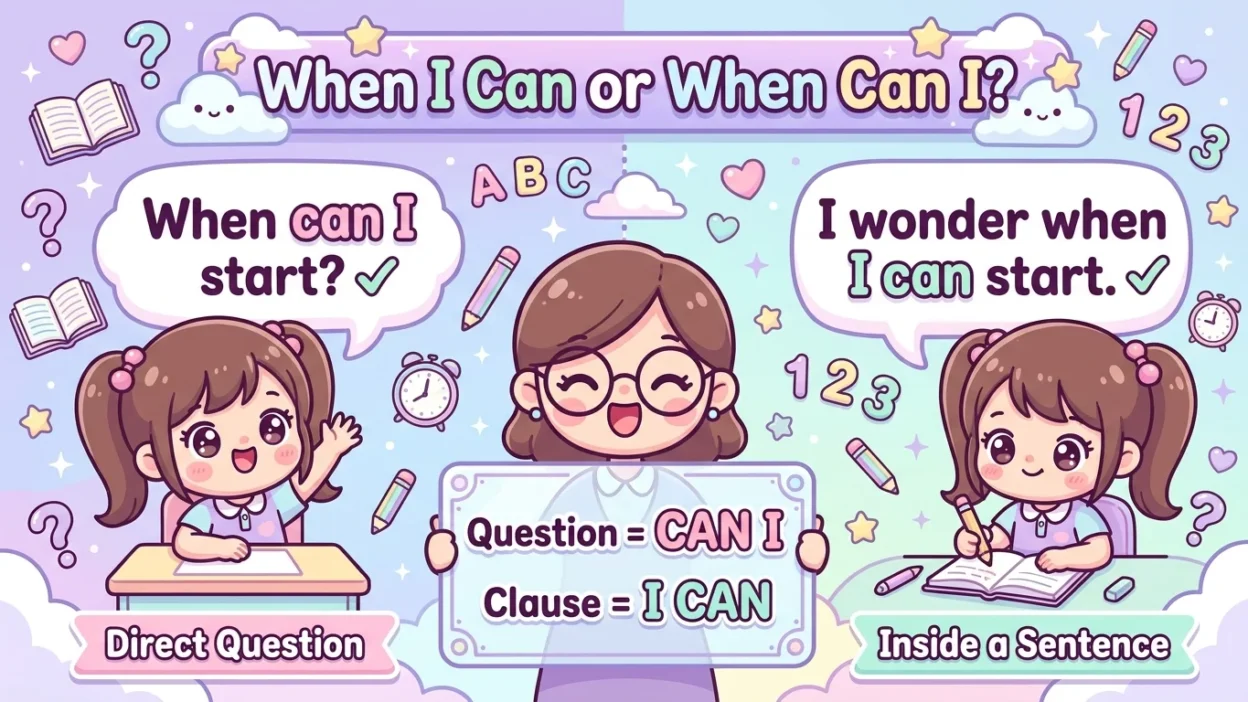
A Simple Memory Trick
Use this easy rule:
DIRECT QUESTION = CAN I
INSIDE A SENTENCE = I CAN
For example:
When can I leave? → direct question
I don’t know when I can leave. → inside a sentence
You can also remember:
Question? Flip it.
A normal statement says:
I can go.
A direct question flips I can to:
Can I go?
Add when:
When can I go?
However, when the question becomes embedded inside another sentence, return to:
when I can go
This simple pattern solves most cases.
When Can I vs When Could I
Both forms can introduce direct questions, but could sometimes sounds more tentative or polite.
For example:
When can I call you?
This question directly asks about an available time.
Meanwhile:
When could I call you?
Depending on context, this version may sound slightly more tentative.
However, both follow the same question structure:
When + modal + subject + verb
Therefore:
When can I call?
When could I call?
Both follow correct direct-question word order.
When Can I vs When May I
When can I commonly asks about possibility, opportunity, or permission in everyday English.
For example:
When can I enter the room?
Meanwhile, when may I can sound more formal when asking permission:
When may I enter the room?
However, everyday speakers frequently use can when requesting permission.
Therefore, the choice often depends on tone and context rather than a simple correct-versus-incorrect distinction.
When I Can vs Whenever I Can
These expressions can sometimes communicate similar ideas.
For example:
I help when I can.
This means the speaker helps when circumstances allow.
Similarly:
I help whenever I can.
The second sentence more strongly suggests every opportunity that becomes available.
Therefore, whenever I can often emphasizes repeated opportunities more clearly.
For example:
“I visit my grandparents whenever I can.”
The speaker visits them at every suitable opportunity.
When I Can vs As Soon As I Can
These phrases do not mean exactly the same thing.
When I can means when circumstances allow.
For example:
“I’ll reply when I can.”
However, as soon as I can emphasizes doing something at the earliest available opportunity.
For example:
“I’ll reply as soon as I can.”
Therefore, the second sentence usually communicates greater urgency.
American vs British English
Both American and British English follow the same basic distinction between when I can and when can I.
A direct question can use:
When can I start?
Meanwhile, an embedded question can use:
Could you tell me when I can start?
Likewise, a statement can use:
I’ll start when I can.
Therefore, you do not need to change the basic word order according to whether you write for an American or British audience.
Similar Question Patterns
The same grammar appears with many other modal and auxiliary verbs:
- When should I leave? → I don’t know when I should leave.
- When will I know? → Tell me when I will know.
- When could I visit? → I wonder when I could visit.
- When may I start? → Please tell me when I may start.
- Where can I park? → Do you know where I can park?
- How can I help? → Tell me how I can help.
- What should I do? → I don’t know what I should do.
Therefore, learning the difference between when can I and when I can can improve your understanding of many English question structures.
Frequently Asked Questions
Is it when I can or when can I?
Both are correct. Use when can I for a direct question, such as “When can I call?” Use when I can inside a statement or embedded question, such as “I don’t know when I can call.”
Is “when can I call you?” correct?
Yes. “When can I call you?” is a correct direct question. Because can functions as a modal verb, it comes before the subject I in this question structure.
Is “when I can call you?” correct?
Usually, not as a standalone standard direct question. Instead, write “When can I call you?” However, when I can call you works inside a larger sentence, such as “Please tell me when I can call you.”
Is “I don’t know when can I go” correct?
No. In standard English, write “I don’t know when I can go.” Because when I can go functions as an embedded question, use subject-before-modal word order.
Is “I will do it when I can” correct?
Yes. “I will do it when I can” is natural and grammatically correct. Here, when I can means when I am able to do it or when circumstances allow.
Should I say “Do you know when can I come?” or “Do you know when I can come?”
Say “Do you know when I can come?” The sentence contains an indirect or embedded question, so I comes before can.
What does “when I can” mean?
When I can generally means when I am able to, when I have the opportunity, or when circumstances allow. For example, “I exercise when I can” means the speaker exercises whenever an opportunity becomes available.
What does “when can I” mean?
When can I usually begins a direct question asking about a suitable time, opportunity, or permission. For example, “When can I visit?” asks when visiting will be possible or appropriate.
Final Verdict: When I Can or When Can I?
Both when I can and when can I are grammatically correct. However, their word order serves different sentence structures. Use when can I when asking a direct question, such as “When can I leave?”
Meanwhile, use when I can inside statements, subordinate clauses, and indirect questions. For example, “I’ll leave when I can” and “I don’t know when I can leave” both use the correct order. Therefore, remember that the difference depends on grammar rather than one phrase being universally right and the other wrong.
Remember This
Use this simple formula:
Direct question → WHEN CAN I?
Inside a sentence → WHEN I CAN
For example:
When can I call you? ✓
I don’t know when I can call you. ✓
Therefore, when you ask the question directly, put can before I. However, when the phrase sits inside a statement or embedded question, put I before can.
Conclusion
Ultimately, choosing between when I can and when can I becomes simple once you identify whether you are asking a direct question. If you directly ask about a time or opportunity, use when can I, as in “When can I start?”
However, if the words appear inside a statement, subordinate clause, or indirect question, use when I can, as in “I don’t know when I can start.” Therefore, remember the quick rule: direct question = can I; inside a sentence = I can.

Lutana Maroochy is a creative author recognized for delivering engaging and well-researched content. With a passion for clear communication and storytelling, Lutana focuses on producing informative, reader-centered articles across various subjects. Dedicated to quality and originality, Lutana consistently connects with audiences through thoughtful insights and compelling narratives.