When you use relative clauses in English, you may wonder whether “by which” or “in which” fits your sentence. Although both expressions contain which, they perform different grammatical jobs. Therefore, you need to understand the relationship between the verb, noun, and preposition before choosing one.
Generally, by which indicates a method, means, process, or deadline-related idea. In contrast, in which usually indicates that something happens inside a place, situation, period, system, or context. Consequently, the surrounding meaning determines which phrase works correctly.
Moreover, these expressions often appear in formal writing because they connect a noun with additional information. However, everyday English may use simpler alternatives such as “that,” “where,” “when,” “how,” or “through which.” Nevertheless, learning the distinction helps you write clearer and more precise sentences.
Quick Answer
“By which” usually expresses the method, means, or way something happens, while “in which” usually describes the place, situation, period, or context where something happens. Therefore, use by which for “through what method?” and in which for “inside what situation, place, or period?”
Why People Confuse “By Which” and “In Which”
People often confuse these phrases because both structures can introduce relative clauses.
For example:
- This is the method by which we solved the problem.
- This is the room in which we solved the problem.
Both sentences contain which, but the prepositions create different meanings.
In the first sentence, by explains the method. In the second, in identifies the location.
Therefore, always look at the relationship between the noun and the information that follows it.
By Which: Meaning and Use
By which generally means “through which,” “by means of which,” or “using which.”
Therefore, use it when you want to explain the method, process, mechanism, or means that produces an outcome.
For example:
- This is the method by which we solved the problem.
- She explained the process by which the machine operates.
- They developed a system by which customers can track orders.
- We need to understand the mechanism by which the device works.
“By Which” for Methods
Use by which when you describe how something happens.
- This is the process by which the company selects employees.
- The teacher explained the method by which students calculate the answer.
- Scientists studied the process by which plants grow.
Therefore, if you can replace by which with “through which” or “by means of which,” the phrase probably fits.
“By Which” for Systems or Processes
Similarly, by which works well when you describe a system or process.
- They created a system by which users can submit applications.
- The company introduced a procedure by which customers receive refunds.
- Researchers discovered a mechanism by which cells communicate.
“By Which” for Deadlines
Additionally, by which can introduce a deadline when the meaning involves “by the time when.”
For example:
- We need a date by which everyone must respond.
- She gave me a deadline by which I had to finish the report.
- They established a date by which the project should finish.
Here, by which connects the noun with a required completion time.
In Which: Meaning and Use
In which generally means “inside which,” “during which,” or “within which,” depending on context.
Therefore, use it when something occurs inside a place, situation, period, condition, or system.
For example:
- This is the room in which we met.
- That was the year in which she graduated.
- He described the situation in which the accident occurred.
- We discussed the environment in which children learn.
“In Which” for Places
Use in which when you refer to something located or happening inside a place.
- This is the house in which I grew up.
- She entered the room in which the meeting took place.
- They visited the city in which he lived.
Therefore, in which often replaces “where” in more formal writing.
For example:
The house in which I grew up is beautiful.
More naturally in everyday English:
The house where I grew up is beautiful.
“In Which” for Time Periods
You can also use in which with years, periods, eras, and other time expressions.
- 2020 was the year in which everything changed.
- She remembered the period in which she studied abroad.
- That was the month in which we moved.
Here, in which means something similar to “during which.”
“In Which” for Situations
Furthermore, in which works naturally when you describe a situation or circumstance.
- They found themselves in a situation in which they had no choice.
- He described the circumstances in which the decision occurred.
- We need an environment in which everyone feels comfortable.
Comparison Table
| Phrase | Main Meaning | Common Function | Example |
|---|---|---|---|
| by which | Through which / by means of which | Method or means | The method by which we solved it |
| by which | By the time when | Deadline | The date by which we must finish |
| in which | Inside which | Place | The room in which we met |
| in which | During which | Time period | The year in which she graduated |
| in which | Within which | Situation/context | The situation in which they worked |
When to Use “By Which”
Use “By Which” for Methods
If you want to explain how something happens, use by which.
- This is the process by which we make the product.
- They described the method by which the system works.
Use “By Which” for Means
Likewise, use it when something happens through a particular mechanism or means.
- This is the system by which payments are processed.
- Researchers studied the mechanism by which the disease spreads.
Use “By Which” for Deadlines
If the phrase means “before or no later than a particular time,” use by which.
- Tell me the date by which you need the documents.
- We need a deadline by which everyone must respond.
When to Use “In Which”
Use “In Which” for Places
When something happens inside a location, in which works naturally.
- This is the building in which I work.
- That is the room in which we studied.
Use “In Which” for Time
When something happens during a particular period, use in which.
- That was the year in which I graduated.
- It was a difficult period in which many people struggled.
Use “In Which” for Situations
When something happens within a particular situation or context, in which works well.
- We entered a situation in which nobody knew what to do.
- She created an environment in which students could succeed.
By Which vs In Which Examples
- This is the method by which we solved the problem.
- This is the room in which we solved the problem.
- She explained the process by which the machine works.
- She described the environment in which the machine operates.
- They developed a system by which customers can track orders.
- This is the building in which the company operates.
- We need a deadline by which everyone must respond.
- 2025 was the year in which she graduated.
- Scientists studied the mechanism by which cells communicate.
- They discussed the situation in which the accident occurred.
- This is the process by which we calculate the result.
- This is the laboratory in which researchers conducted the experiment.
- Tell me the date by which you need the report.
- That was the period in which the company expanded.
- They created a system by which users could register online.
- We entered an environment in which everyone felt comfortable.
- The manager established a procedure by which employees could submit complaints.
- She remembered the house in which she grew up.
Common Mistakes
Mistake 1: Using “In Which” for a Method
Incorrect: This is the method in which we solved the problem.
Better: This is the method by which we solved the problem.
Therefore, use by which when you mean the method or means.
Mistake 2: Using “By Which” for a Physical Location
Incorrect: This is the room by which we held the meeting.
Better: This is the room in which we held the meeting.
Here, the meeting happened inside the room, so in which works.
Mistake 3: Confusing “By Which” With “In Which” for Time
If you mean deadline, use by which.
- The date by which I must finish the project.
If you mean during a period, use in which.
- The year in which I started the project.
Mistake 4: Using Formal Language When Simpler English Works
Although in which and by which remain grammatically correct, everyday English often prefers simpler structures.
For example:
The house in which I live.
More naturally:
The house where I live.
Similarly:
The method by which we solved it.
More simply:
The way we solved it.
Memory Trick
Use this easy rule:
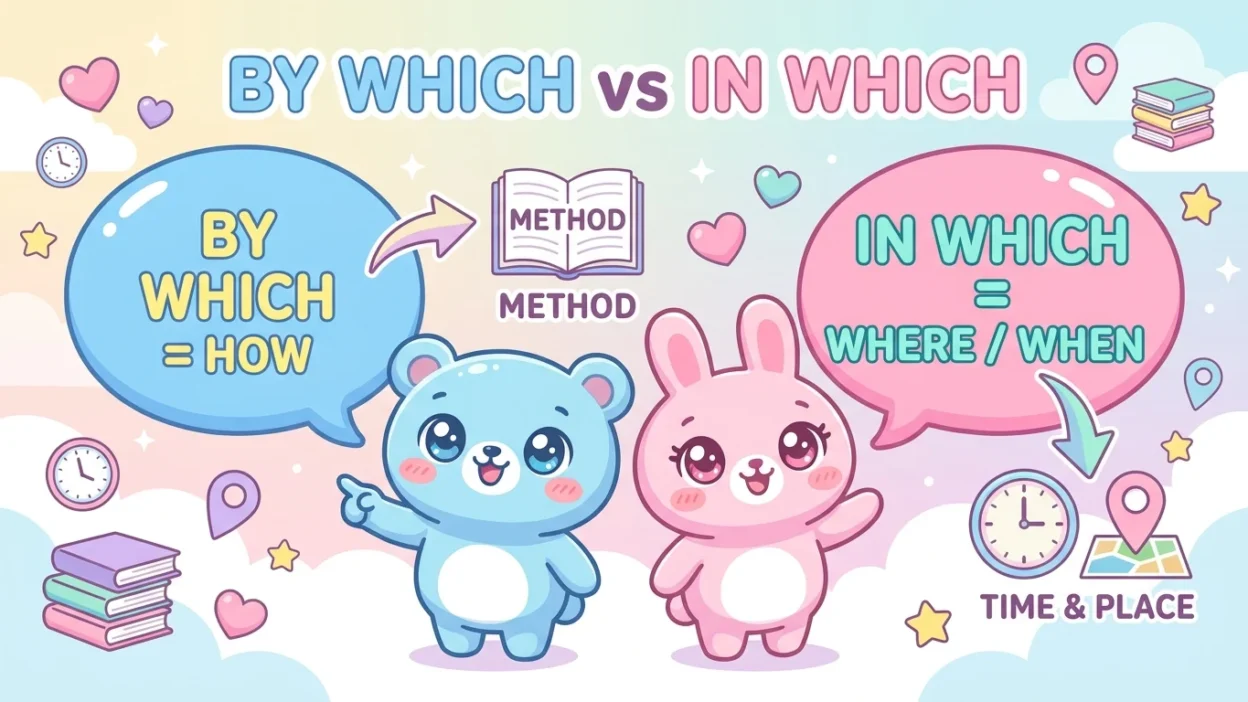
BY = HOW
IN = WHERE / WHEN / WITHIN WHAT
Therefore:
By which → How did it happen?
In which → Where, when, or within what situation did it happen?
For example:
The method by which we solved it → How did we solve it?
The room in which we met → Where did we meet?
The year in which she graduated → When did she graduate?
American vs British English
Both American and British English use by which and in which with the same basic meanings.
Therefore, the distinction does not normally depend on regional English.
However, everyday American and British speakers may prefer simpler alternatives in casual conversation.
For example:
- Formal: The house in which I live.
- Everyday: The house where I live.
Likewise:
- Formal: The method by which we solved it.
- Everyday: The way we solved it.
Similar Expressions
By Which vs Through Which
Both expressions can describe a method or means.
- The process by which the system works.
- The channel through which information travels.
However, through which often emphasizes movement through a medium or channel.
In Which vs Where
Both can describe a place.
- The house in which I live.
- The house where I live.
Therefore, where usually sounds more natural in everyday English.
In Which vs During Which
When in which refers to a time period, during which can often express the same idea.
- The year in which she graduated.
- The year during which she studied abroad.
However, the exact meaning can differ depending on the sentence.
Final Verdict
Both “by which” and “in which” are correct, but they serve different purposes.
Therefore, use by which when you describe a method, means, mechanism, or deadline. In contrast, use in which when you describe a place, time period, situation, or context.
The easiest rule remains:
By which = how
In which = where, when, or within what
Remember This
By which → method, means, mechanism, deadline
In which → place, time, situation, context
So, if you can ask “How?”, choose by which.
If you can ask “Where?”, “When?”, or “Within what situation?”, choose in which.
FAQs
What is the difference between “by which” and “in which”?
By which usually describes a method, means, mechanism, or deadline. Meanwhile, in which usually describes a place, time period, situation, or context.
Is “by which” grammatically correct?
Yes. By which is a correct formal relative structure. For example, “This is the method by which we solved the problem” uses the phrase correctly.
Is “in which” grammatically correct?
Yes. In which is also grammatically correct. For example, “This is the room in which we met” correctly identifies the location.
Can “by which” mean “how”?
Yes. In many formal sentences, by which means something similar to “by what method” or “how.” For example, “The process by which it works” explains how the process works.
Can “in which” mean “where”?
Yes. When you refer to a place, in which can often replace where. For example, “The house in which I live” means “The house where I live.”
Can “in which” refer to time?
Yes. In which can refer to a period during which something happens. For example, “That was the year in which she graduated.”
Which is more formal: “by which” or “in which”?
Neither phrase automatically ranks as more formal than the other. Both can appear in formal writing, and the correct choice depends on the relationship between the noun and the relative clause.
Conclusion
Overall, by which and in which both play useful roles in English, but they express different relationships. By which generally explains a method, means, mechanism, or deadline, whereas in which usually identifies a place, period, situation, or context.
Therefore, remember the easiest distinction: by which answers “how?”, while in which answers “where?”, “when?”, or “within what?” Once you recognize that difference, choosing the correct phrase becomes much easier.

Lutana Maroochy is a creative author recognized for delivering engaging and well-researched content. With a passion for clear communication and storytelling, Lutana focuses on producing informative, reader-centered articles across various subjects. Dedicated to quality and originality, Lutana consistently connects with audiences through thoughtful insights and compelling narratives.