
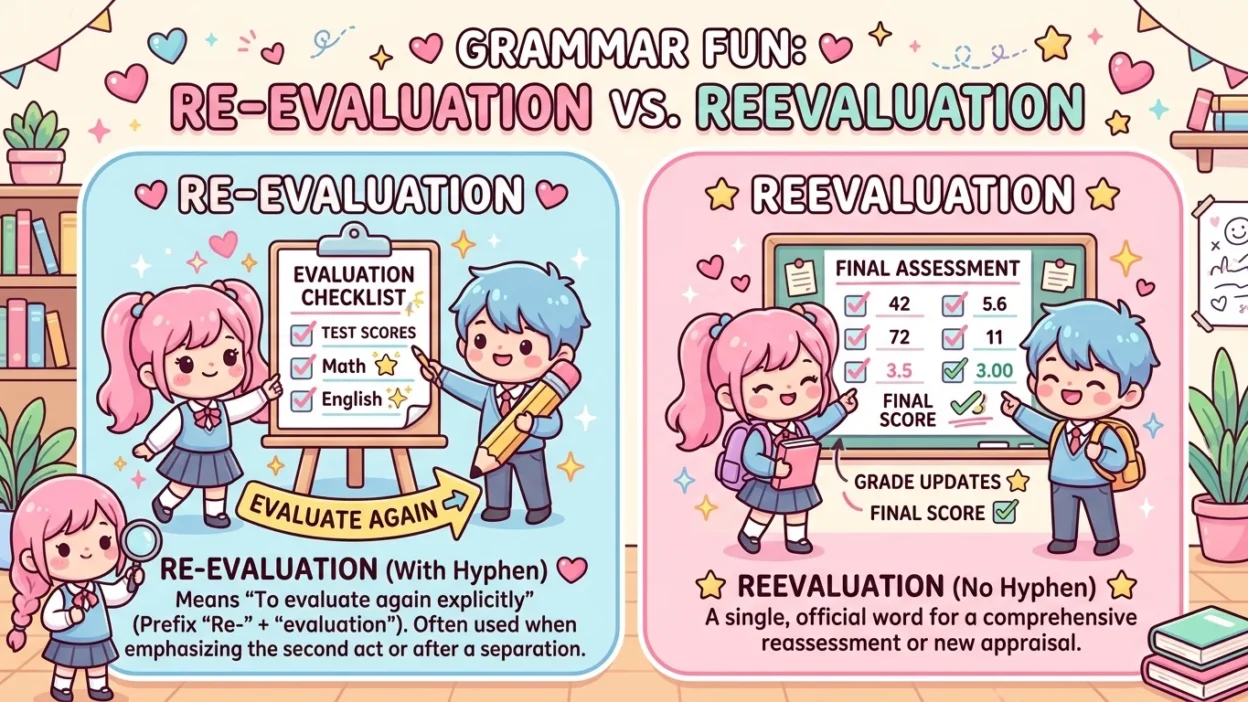
Reevaluation and re-evaluation have the same meaning, pronunciation, and grammatical function. The main difference involves spelling style: one form uses a hyphen, while the other does not. Therefore, English learners and writers often wonder which version they should use.
More specifically, reevaluation follows the increasingly common modern spelling pattern in which the prefix re- joins directly to the main word. Meanwhile, re-evaluation uses a hyphen to make the two parts visually clearer. Both forms appear in English, although current usage generally favors the closed form reevaluation.
The word comes from reevaluate, which means to evaluate, assess, or consider something again. Consequently, reevaluation means the process of evaluating something again. For example, a company might conduct a reevaluation of its strategy, or a teacher might request a reevaluation of a student’s work.
Quick Answer
Reevaluation is the preferred modern spelling in most standard English writing. Re-evaluation also appears and remains understandable and acceptable in many contexts. Therefore, if you want one spelling for general modern usage, choose reevaluation.
Why People Confuse Them
People confuse these forms because the prefix re- can sometimes create spelling questions when it joins another word beginning with a vowel.
Here, the base word is:
evaluation
Adding re- creates:
re + evaluation = reevaluation
Because the two vowels meet, some writers add a hyphen:
re-evaluation
However, English spelling does not always require a hyphen when re- combines with another word.
Therefore, both forms can appear, but modern English often prefers the closed form.
Reevaluation: Meaning and Definition
Reevaluation is a noun.
It means the act or process of evaluating something again.
For example:
- The company conducted a reevaluation of its goals.
- The doctor requested a reevaluation of the treatment plan.
- The teacher completed a reevaluation of the student’s assignment.
The word contains two main parts:
re- = again
evaluation = assessment or judgment
Therefore:
reevaluation = evaluation again
This meaning makes the word relatively easy to understand once you recognize the prefix.
Re-evaluation: Meaning and Definition
Re-evaluation has the same meaning as reevaluation.
The hyphen simply separates re- from evaluation visually.
For example:
The manager requested a re-evaluation of the project.
This means:
The manager requested an evaluation of the project again.
Therefore, the hyphen does not change the meaning.
Reevaluation vs Re-evaluation: Comparison Table
| Form | Meaning | Usage | Example |
|---|---|---|---|
| reevaluation | Evaluation again | Preferred modern spelling | We need a reevaluation of the plan. |
| re-evaluation | Evaluation again | Hyphenated variant | We need a re-evaluation of the plan. |
Consequently, the difference mainly involves spelling style, not meaning.
When to Use Reevaluation
Use reevaluation when you want the modern closed spelling.
For example:
- The project requires a reevaluation.
- We completed a reevaluation of the policy.
- The team requested a reevaluation of the results.
- The situation requires careful reevaluation.
This form works naturally in general writing, professional documents, academic work, and everyday English.
Moreover, using the closed form keeps your spelling consistent with many other words that use re- as a prefix.
When to Use Re-evaluation
You can use re-evaluation when a style guide, organization, publication, or personal writing convention prefers hyphenated compounds.
For example:
The committee requested a re-evaluation of the proposal.
The meaning remains exactly the same as:
The committee requested a reevaluation of the proposal.
Therefore, if you choose the hyphenated spelling, consistency matters more than changing between forms randomly.
18 Examples of Correct Usage
Here are natural examples using reevaluation:
- The company needs a reevaluation of its strategy.
- The teacher requested a reevaluation of the assignment.
- The project requires careful reevaluation.
- We completed a reevaluation of the results.
- The committee ordered a reevaluation of the proposal.
- The new information led to a reevaluation of our plans.
- The team began a reevaluation of its goals.
- The situation requires immediate reevaluation.
- The manager recommended a reevaluation of the budget.
- The policy is currently under reevaluation.
- The evidence prompted a reevaluation of the original decision.
- The organization conducted a complete reevaluation of its procedures.
- The results require further reevaluation.
- The new data caused a reevaluation of the research findings.
- The committee scheduled a reevaluation next month.
- The project underwent a detailed reevaluation.
- The circumstances require us to reevaluate our approach.
- The reevaluation produced several useful recommendations.
You can replace reevaluation with re-evaluation in these sentences without changing the basic meaning.
Common Mistakes
Mistake 1: Assuming Only the Hyphenated Form Works
Some writers believe re-evaluation is the only correct spelling.
However:
reevaluation is also a standard spelling and commonly serves as the preferred modern form.
Mistake 2: Changing the Meaning With the Hyphen
The hyphen does not create a different meaning.
reevaluation = evaluation again
re-evaluation = evaluation again
Therefore, the difference remains orthographic rather than semantic.
Mistake 3: Confusing Reevaluation With Reevaluate
Remember the parts of speech:
- reevaluate = verb
- reevaluation = noun
For example:
We need to reevaluate the plan.
We need a reevaluation of the plan.
Therefore, choose the form that fits the grammatical role in your sentence.
Mistake 4: Using Inconsistent Spelling
Avoid switching randomly between reevaluation and re-evaluation within the same document.
Instead, choose one style and use it consistently.
Memory Trick
Remember:
Re- = again
Evaluation = assessment
Therefore:
Reevaluation = assessment again
You can also remember:
reevaluate → reevaluation
For example:
We should reevaluate the plan.
The reevaluation may take several days.
This connection makes the spelling and meaning easier to remember.
American vs British English
Both American and British English recognize reevaluation and re-evaluation.
However, modern English increasingly favors closed compounds when prefixes such as re- combine clearly with a base word. Therefore, reevaluation provides a strong general-purpose choice.
Nevertheless, particular publishers, organizations, dictionaries, or style guides may retain the hyphenated form.
Consequently, always follow a required house style when one exists.
Similar Words
Several related words follow the same general pattern.
Reevaluate vs Re-evaluate
Both forms mean to evaluate again.
We need to reevaluate the proposal.
We need to re-evaluate the proposal.
Reassessment vs Re-assessment
Reassessment commonly appears as the closed form.
It means another assessment or a fresh assessment.
Reconsider vs Re-consider
Reconsider is normally written without a hyphen.
It means to think about something again.
Reexamine vs Re-examine
Reexamine and re-examine both appear in English, although style preferences can differ.
They mean to examine something again.
Therefore, English prefixes do not always follow one universal hyphen rule.
Final Verdict
Reevaluation and re-evaluation mean exactly the same thing. However, reevaluation generally provides the preferred modern spelling for general English writing.
Meanwhile, re-evaluation remains a recognized variant, particularly where a style guide or publication prefers the hyphen.
Therefore, when you need one default choice, use:
Reevaluation ✅
Remember This
Reevaluation = preferred modern spelling.
Re-evaluation = acceptable hyphenated variant.
Both mean:
evaluation again
The easiest memory trick is:
re- + evaluation → reevaluation
Therefore, unless a specific style guide tells you otherwise, reevaluation is a safe choice.
FAQs
Is “reevaluation” one word?
Yes. Reevaluation is a standard closed spelling of the noun meaning an evaluation conducted again.
Is “re-evaluation” correct?
Yes. Re-evaluation appears as a hyphenated variant and carries the same meaning as reevaluation.
Which is more common, reevaluation or re-evaluation?
Reevaluation generally fits modern closed-compound spelling and provides a strong default choice. However, usage can vary by publication and style guide.
Does the hyphen change the meaning?
No. Reevaluation and re-evaluation have the same basic meaning: evaluating something again.
Is “reevaluate” related to “reevaluation”?
Yes. Reevaluate is the verb, while reevaluation is the noun.
For example, “We need to reevaluate the plan” and “We need a reevaluation of the plan” express related ideas.
Should I use “reevaluation” in academic writing?
Yes. Reevaluation works well in academic writing. However, if your institution or publication follows a particular style guide, follow that guide consistently.
What is the easiest way to remember reevaluation?
Break the word into re- + evaluation. Since re- means “again,” reevaluation means “evaluation again.”
Conclusion
Overall, reevaluation and re-evaluation share the same meaning, so the choice does not change what you want to communicate. However, reevaluation generally works as the preferred modern closed spelling, while re-evaluation remains a common hyphenated variant.
Therefore, if you need a simple default for modern English writing, choose reevaluation. Nevertheless, if a particular style guide, employer, school, or publication prefers re-evaluation, you can use that form consistently. Most importantly, remember that both forms refer to evaluating something again.

Lutana Maroochy is a creative author recognized for delivering engaging and well-researched content. With a passion for clear communication and storytelling, Lutana focuses on producing informative, reader-centered articles across various subjects. Dedicated to quality and originality, Lutana consistently connects with audiences through thoughtful insights and compelling narratives.