
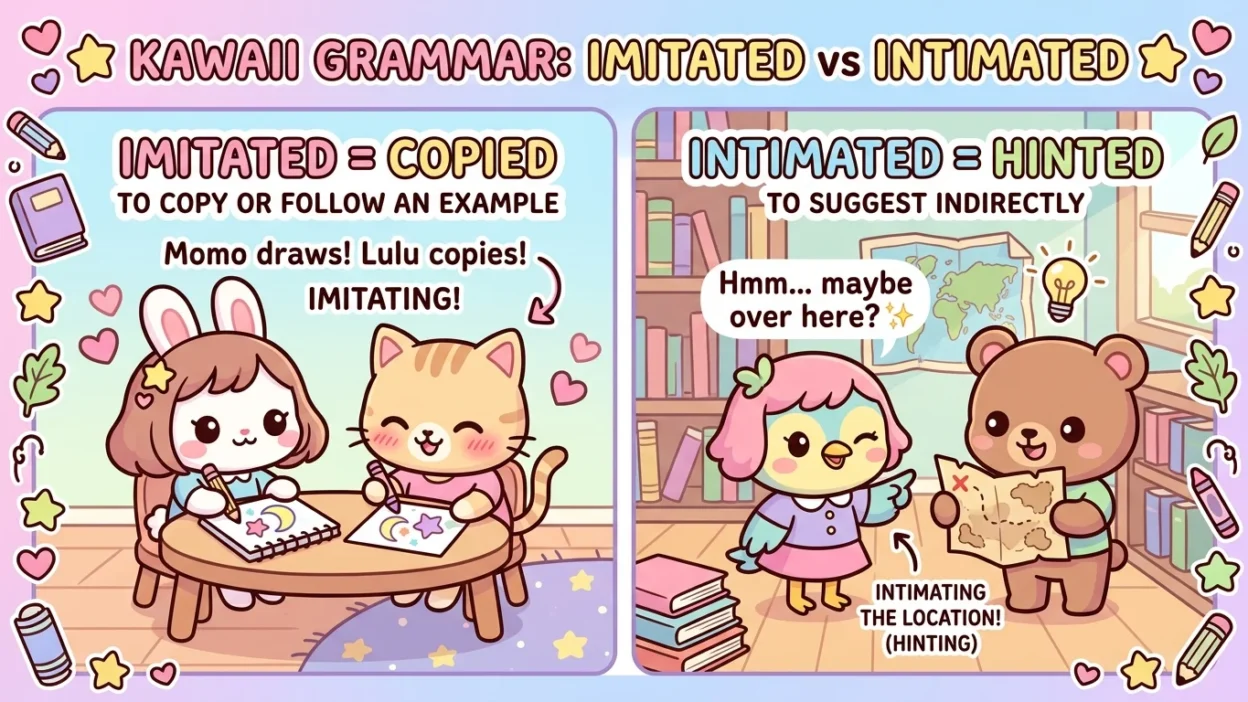
Imitated and intimated look and sound similar, but they have completely different meanings. Because of their similar spelling and pronunciation, English learners often confuse these two words. However, once you understand what each word means, the difference becomes much easier to remember.
More specifically, imitated is the past tense and past participle of imitate, which means to copy someone’s behavior, appearance, style, actions, or technique. Meanwhile, intimated is the past tense and past participle of intimate when used as a verb, meaning to suggest, hint at, or communicate something indirectly.
Therefore, you can say “She imitated her teacher” when she copied her teacher’s behavior. On the other hand, you can say “He intimated that he might resign” when he indirectly suggested that he might resign. Consequently, these words cannot normally replace each other.
Quick Answer
Imitated means copied or reproduced, while intimated means hinted, suggested, or communicated indirectly. Therefore, use imitated when someone copies something and intimated when someone indirectly suggests or reveals an idea.
Why People Confuse Them
People often confuse imitated and intimated because both words contain similar letters and have a similar rhythm when pronounced.
However, their meanings differ completely.
- Imitated = copied
- Intimated = hinted or suggested
For example:
She imitated her friend’s accent. ✅
Here, she copied the accent.
Meanwhile:
He intimated that he knew the answer. ✅
Here, he indirectly suggested that he knew the answer.
Therefore, focusing on the meanings rather than the spelling makes the distinction much easier.
“Imitated” — Meaning and Definition
Imitated comes from the verb imitate.
It means copied, reproduced, or modeled after someone or something.
For example:
The child imitated his father.
This means the child copied his father’s actions, behavior, or mannerisms.
You can imitate:
- a person’s behavior
- someone’s voice
- an accent
- a style
- an action
- a technique
- an appearance
- a sound
For example:
The comedian imitated the actor’s voice.
Here, imitated means copied the actor’s voice.
Common Forms of Imitate
The verb imitate has these common forms:
- imitate
- imitates
- imitated
- imitating
For example:
She imitates her favorite singer.
She imitated her favorite singer.
She is imitating her favorite singer.
Therefore, imitated describes an action that happened in the past or a completed action.
“Intimated” — Meaning and Definition
Intimated comes from the verb intimate.
When intimate functions as a verb, it means to hint at, suggest, or communicate something indirectly.
For example:
She intimated that she wanted to leave.
This means she suggested that she wanted to leave without necessarily saying it directly.
Similarly:
The manager intimated that changes were coming.
The manager indirectly suggested that changes were coming.
Therefore, intimated often appears when someone communicates an idea without stating it directly.
Important Note About “Intimate”
The word intimate has several meanings.
As an adjective, intimate can describe something personal, private, or closely connected.
For example:
They shared an intimate conversation.
As a noun, intimate can refer to a close friend or associate.
However, when intimate works as a verb, it means to suggest or hint at something.
Therefore:
intimated = hinted or suggested
Imitated vs Intimated: Comparison Table
| Word | Base Verb | Meaning | Example |
|---|---|---|---|
| Imitated | Imitate | Copied or reproduced | She imitated her teacher. |
| Intimated | Intimate | Hinted or suggested indirectly | He intimated that he was leaving. |
Consequently, the easiest distinction is:
Imitated = copied
Intimated = hinted
When to Use “Imitated”
Use imitated when someone copies another person or thing.
For example:
The student imitated the teacher’s pronunciation.
Here, the student copied the pronunciation.
You can also use it for artistic or technical copying:
The artist imitated the style of a famous painter.
Similarly:
The young athlete imitated her coach’s technique.
Therefore, whenever the idea involves copying, reproducing, or modeling, use imitated.
When to Use “Intimated”
Use intimated when someone indirectly communicates an idea.
For example:
The manager intimated that the company would make changes.
The manager did not necessarily state the information directly. Instead, the manager hinted at it.
Similarly:
She intimated that she was unhappy with the decision.
The sentence suggests that she communicated her dissatisfaction indirectly.
Therefore, use intimated when the meaning involves hinting, suggesting, or implying.
18 Examples of “Imitated”
- The child imitated his mother.
- She imitated her teacher’s accent.
- The comedian imitated a famous actor.
- The student imitated the pronunciation perfectly.
- He imitated his friend’s mannerisms.
- The artist imitated the original style.
- The puppy imitated the older dog.
- She imitated the dance moves.
- The actor imitated the politician’s voice.
- The young player imitated his coach’s technique.
- He imitated the sound of a bird.
- The children imitated the movements.
- She successfully imitated the singer’s voice.
- The designer imitated the popular style.
- The student imitated the example from the textbook.
- The performer imitated several celebrities.
- He imitated his brother’s gestures.
- The artist carefully imitated the original painting.
In each example, imitated involves some form of copying or reproduction.
18 Examples of “Intimated”
- He intimated that he might resign.
- She intimated that something was wrong.
- The manager intimated that changes were coming.
- He intimated that he disagreed with the decision.
- She intimated that she wanted to leave.
- The report intimated that further action might be necessary.
- He intimated that the meeting would be postponed.
- She intimated that she already knew the answer.
- The director intimated that the project faced difficulties.
- He intimated that he had concerns about the proposal.
- The email intimated that the deadline might change.
- She intimated that she would not attend.
- The statement intimated that further changes were possible.
- He intimated that the situation was becoming serious.
- The manager intimated that layoffs could occur.
- She intimated that she disagreed with the plan.
- He intimated that he knew more than he revealed.
- The speaker intimated that the decision was not final.
In each example, intimated means hinted, suggested, or communicated indirectly.
Common Mistakes
Mistake 1: Using “Imitated” for “Hinted”
Incorrect:
He imitated that he might leave. ❌
Correct:
He intimated that he might leave. ✅
Here, the person is suggesting something indirectly, so intimated fits.
Mistake 2: Using “Intimated” for “Copied”
Incorrect:
She intimated her teacher’s accent. ❌
Correct:
She imitated her teacher’s accent. ✅
Here, she copied the accent, so imitated works.
Mistake 3: Confusing “Imply” With “Imitate”
Imply means to communicate something indirectly.
Imitate means to copy something.
Therefore:
He implied that he was angry. = He hinted that he was angry.
He imitated his brother. = He copied his brother.
Because intimate can mean hint, learners sometimes connect it with imply and confuse it with imitate.
Memory Trick
Use this simple trick:
IMITATED = IMITATED a copy
Think of imitation products: they copy an original.
Meanwhile:
INTIMATED = hinted
You can connect intimated with implied because both can describe indirect communication.
Therefore:
Imitated → copied
Intimated → hinted
This simple pair makes the difference much easier to remember.
American vs British English
Both American and British English use imitated and intimated with the same basic meanings.
In both varieties:
imitated = copied
intimated = hinted or suggested
Therefore, the difference does not come from American versus British English. Instead, it comes from meaning and context.
Similar Words
Imitated vs Copied
These words often have very similar meanings.
She imitated his accent.
She copied his accent.
Both sentences describe reproducing someone’s accent.
Intimated vs Implied
These words can also overlap.
He intimated that he was unhappy.
He implied that he was unhappy.
Both sentences suggest indirect communication.
Intimated vs Suggested
Suggested often sounds more common and natural in everyday English.
He suggested that we leave early.
He intimated that we should leave early.
The second version can sound more formal or literary.
Imitated vs Mimicked
Mimicked means copied someone’s behavior, voice, movement, or sound, often in a noticeable or playful way.
The child mimicked his teacher.
The child imitated his teacher.
Both can work, depending on context.
Final Verdict
Imitated and intimated are both correct words, but they have completely different meanings.
Use imitated when someone copies a person, action, style, sound, or technique. Meanwhile, use intimated when someone hints at or suggests something indirectly.
Therefore, remember:
Imitated = copied
Intimated = hinted
Remember This
She imitated his accent. → She copied it. ✅
He intimated that he was unhappy. → He hinted at it. ✅
So, whenever you mean copy, choose imitated. Whenever you mean hint or suggest indirectly, choose intimated.
FAQs
What is the difference between imitated and intimated?
Imitated means copied or reproduced, while intimated means hinted, suggested, or communicated something indirectly.
Is “imitated” a correct word?
Yes. Imitated is the past tense and past participle of imitate, meaning copied or reproduced something.
Is “intimated” a correct word?
Yes. Intimated is the past tense and past participle of intimate when intimate functions as a verb meaning hinted or suggested.
Does intimated mean implied?
Yes. In many contexts, intimated means suggested or implied something without stating it directly.
Does imitated mean copied?
Yes. Imitated means copied, reproduced, or modeled after someone or something.
What is an easy way to remember the difference?
Remember “imitated = copied” and “intimated = hinted.” If someone copies an action, style, voice, or behavior, use imitated. If someone indirectly suggests something, use intimated.
Is “intimated” common in everyday English?
Intimated is correct, but it often sounds more formal or literary than hinted or suggested. Therefore, everyday speakers may prefer hinted or suggested.
Conclusion
Overall, imitated and intimated may look similar, but their meanings differ clearly. Imitated comes from imitate and describes copying a person, action, style, sound, or technique. Meanwhile, intimated comes from the verb intimate and means hinted, suggested, or communicated something indirectly.
Therefore, the easiest way to remember the difference is to connect each word with one simple meaning: imitated = copied and intimated = hinted. Once you remember this distinction, you can choose the correct word confidently in both everyday and formal English.

Euroa Alinta is a dedicated author known for crafting engaging and insightful content. With a strong passion for storytelling and digital publishing, Euroa specializes in creating informative, reader-friendly articles. Her work reflects creativity, clarity, and authenticity, connecting audiences with meaningful ideas across diverse topics and interests.