
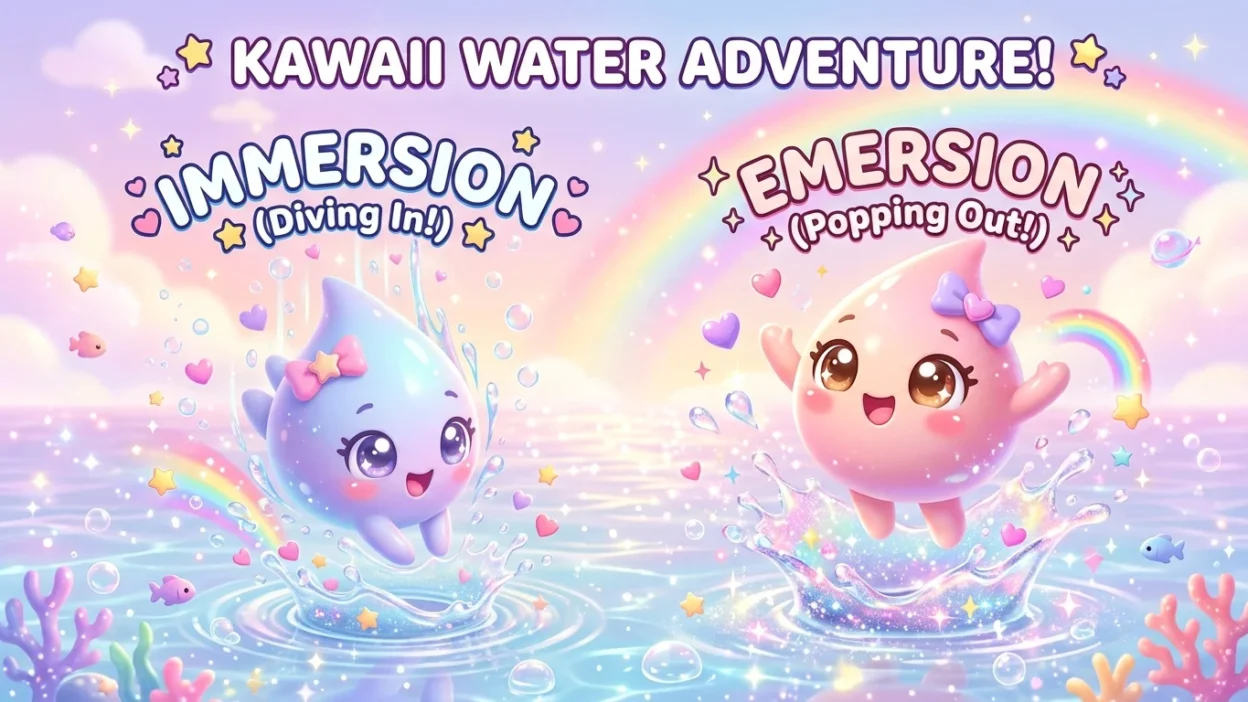
Emersion and immersion may look like opposites—and in many situations, they actually are. The difference comes down to direction: one involves coming out of something, while the other involves going into or being completely surrounded by something.
These words appear in science, education, technology, literature, and everyday discussions. Because immersion is much more common, writers sometimes mistakenly use it when they mean emersion. Understanding the difference can help you choose the right word with confidence.
Quick Answer
Immersion means being placed, involved, or completely surrounded by something, especially a liquid or experience. Emersion means emerging or coming out after being submerged or immersed. Simply remember: immersion = going in; emersion = coming out.
Why People Confuse It
The two words have very similar spellings and both are connected to the idea of being in or around something.
The prefixes provide the biggest clue:
- Im- in immersion suggests movement into or being within.
- E- in emersion suggests movement out of something.
Another reason for confusion is frequency. Immersion is widely used in everyday English, while emersion is relatively uncommon and appears more often in scientific or specialized contexts.
Emersion: Meaning and Definition
Emersion means the act of emerging, rising out of, or coming out from a submerged or immersed state.
It is often used in:
- Biology
- Astronomy
- Environmental science
- Underwater studies
- Technical writing
Examples of Emersion
- The turtle’s emersion from the water was carefully observed.
- Scientists recorded the whale’s emersion at the surface.
- The study examined plant growth after emersion from floodwater.
- The satellite’s emersion from behind the moon was visible through the telescope.
- Researchers measured the effects of repeated emersion and submersion.
Use emersion when the focus is on coming out, emerging, or reappearing.
Immersion: Meaning and Definition
Immersion means the act of putting something into a liquid or becoming deeply involved in an experience, activity, or environment.
It has both literal and figurative meanings.
Literal immersion
- The object was tested through complete immersion in water.
- The device can withstand temporary immersion.
- The diver experienced full immersion in the ocean.
Figurative immersion
- Language immersion can improve communication skills.
- The game creates a strong sense of immersion.
- She achieved deep immersion in the local culture.
- His immersion in the project helped him understand every detail.
Use immersion when something is placed into, surrounded by, or deeply involved in something.
Emersion vs Immersion: Comparison Table
| Feature | Emersion | Immersion |
|---|---|---|
| Main meaning | Coming out or emerging | Going into or being surrounded |
| Direction | Out | In |
| Common use | Science, biology, astronomy | Water, learning, culture, technology |
| Frequency | Less common | Very common |
| Example | The animal’s emersion was recorded. | The diver experienced full immersion. |
When to Use Each
Use emersion when something comes out of a liquid, hidden position, or immersed state.
Choose emersion when discussing:
- Emerging from water
- Reappearing after being hidden
- Scientific observations
- Biological processes
- Astronomical events
Example: Researchers observed the animal’s emersion from the water.
Use immersion when something goes into, is submerged in, or becomes deeply involved with something.
Choose immersion when discussing:
- Being underwater
- Language learning
- Cultural experiences
- Virtual reality
- Games
- Deep involvement
Example: Language immersion helps learners practice naturally.
Examples
Here are 14 examples showing the difference clearly:
- The diver’s immersion in the cold water lasted several minutes.
- Scientists observed the fish during emersion from the water.
- The course offers complete language immersion.
- The researchers studied the plant’s recovery after emersion.
- Virtual reality creates a powerful feeling of immersion.
- The object’s immersion in water was part of the safety test.
- The study measured the effects of emersion after prolonged flooding.
- Her cultural immersion made the trip more meaningful.
- The animal’s emersion was captured on camera.
- The device was designed for temporary immersion in water.
- Literary immersion allows readers to feel deeply connected to a story.
- Scientists recorded the exact time of the object’s emersion.
- Total immersion in a language can accelerate learning.
- The experiment compared repeated immersion with repeated emersion.
Common Mistakes
Mistake 1: Using “emersion” when you mean deep involvement
❌ The game provides complete emersion.
✔ The game provides complete immersion.
A player becomes deeply involved in the game, so immersion is correct.
Mistake 2: Using “immersion” for coming out
❌ The researchers studied the turtle’s immersion from the water.
✔ The researchers studied the turtle’s emersion from the water.
Coming out of the water is emersion.
Mistake 3: Assuming “emersion” is a spelling error
Emersion is a real English word. It is simply much less common than immersion.
Mistake 4: Confusing the direction
This is the easiest mistake to avoid:
- Going in → immersion
- Coming out → emersion
Memory Trick
Think of the first letter:
🌊 Immersion = In
The I can remind you of in.
🌊 Emersion = Exit
The E can remind you of exit or emerge.
An even easier rule:
Immersion = in.
Emersion = emerge out.
American vs British English
Both American English and British English use emersion and immersion with the same core meanings.
There is no major spelling difference between the two varieties.
However, immersion is common in everyday English in both the United States and the United Kingdom. Emersion is much rarer and is more likely to appear in scientific, academic, technical, or specialized writing.
Similar Words
Emerge vs Immerse
- Emerge means to come out or become visible.
- Immerse means to put into or deeply involve in something.
Submersion vs Immersion
Both words can refer to being under a liquid.
- Submersion strongly emphasizes being under the surface.
- Immersion can mean being fully placed in a liquid or deeply involved in an experience.
Emergence vs Emersion
These words are related but not always interchangeable.
- Emergence is the general act of appearing or coming into view.
- Emersion is a more specialized term for coming out of a submerged or hidden state.
Immersion vs Involvement
- Immersion suggests deep, complete involvement.
- Involvement can simply mean taking part.
Emersion vs Exit
Both can involve coming out, but emersion is usually more specialized and often describes emerging from water or another immersed state.
Final Verdict
The difference between emersion vs immersion is mainly about direction.
Use immersion when something goes into a liquid, environment, activity, culture, or experience—or becomes deeply surrounded or involved.
Use emersion when something comes out, emerges, or reappears after being submerged or immersed.
Remember This
🫧 Immersion = IN.
🌸 Emersion = EMERGE OUT.
If something is going in, use immersion. If something is coming out, use emersion.
FAQs
1. Is emersion a real word?
Yes. Emersion is a real English word meaning the act of emerging or coming out from a submerged or immersed state.
2. What is the main difference between emersion and immersion?
Immersion means going into or being completely surrounded by something. Emersion means coming out or emerging from it.
3. Is it “language emersion” or “language immersion”?
The correct phrase is language immersion. It describes learning through deep exposure to and involvement in a language.
4. Can emersion and immersion be opposites?
Yes. In contexts involving entering and leaving a submerged state, they can describe opposite directions.
5. Which word is more common?
Immersion is much more common in general English. Emersion is relatively rare and often used in scientific or technical contexts.
6. What does full immersion mean?
Full immersion means being completely surrounded by or deeply involved in something. It can describe water, language learning, culture, virtual reality, and other experiences.
7. How can I remember the difference quickly?
Remember: I = In = Immersion, while E = Emerge = Emersion.
Conclusion
Although emersion and immersion look and sound similar, they describe movement in opposite directions. Immersion is about going in, being submerged, or becoming deeply involved. Emersion is about coming out, emerging, or reappearing after being submerged or hidden.
When choosing between them, focus on the direction and context. If something enters or becomes deeply surrounded by an experience, use immersion. If it rises, appears, or comes back out, use emersion. Remembering “I = In” and “E = Emerge” makes this commonly confused pair much easier to master.

Lutana Maroochy is a creative author recognized for delivering engaging and well-researched content. With a passion for clear communication and storytelling, Lutana focuses on producing informative, reader-centered articles across various subjects. Dedicated to quality and originality, Lutana consistently connects with audiences through thoughtful insights and compelling narratives.