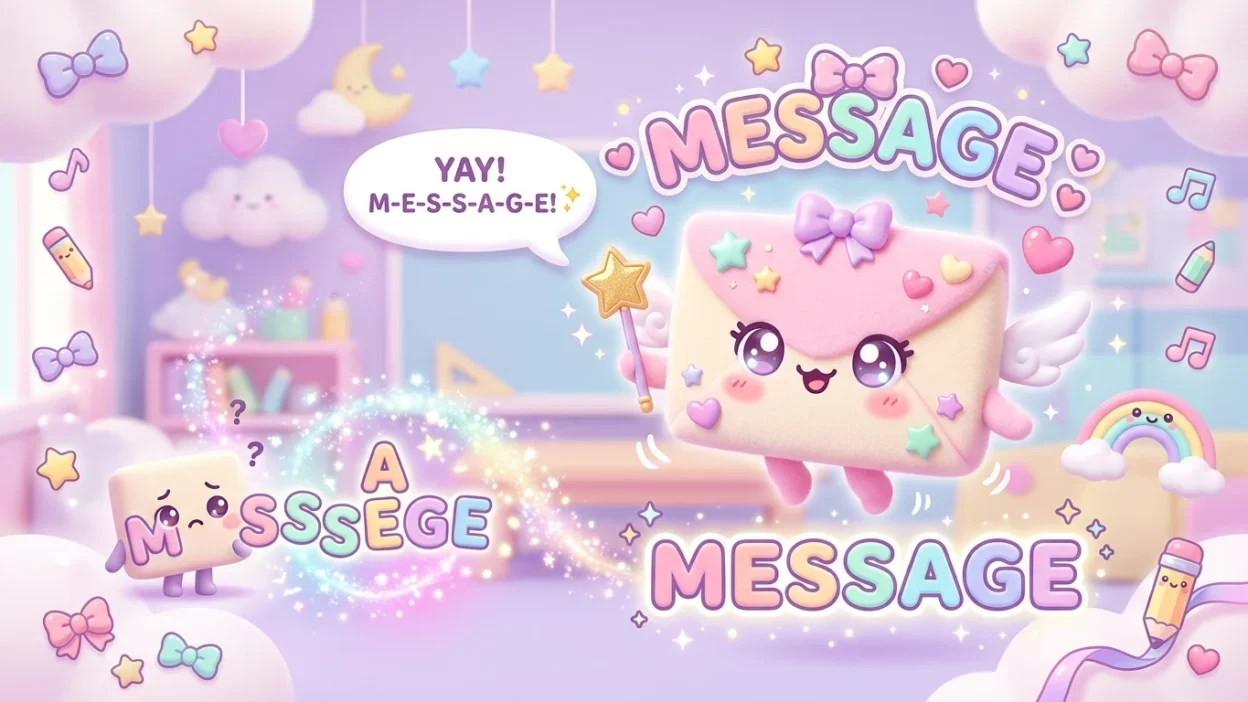
Messege and message are often confused because the words look almost identical. However, only message is the correct standard English spelling. Messege is a misspelling and should not be used in formal or standard writing.
Whether you are sending a text, writing an email, creating social media content, or preparing professional documents, knowing the correct spelling helps your writing look clear and polished. This guide explains the difference between messege vs message, with examples, common mistakes, pronunciation tips, and an easy memory trick.
Quick Answer
Message is the correct spelling. Messege is incorrect in standard English. A message is information, communication, or an idea sent or expressed to someone. Remember: write message with -age at the end, never -ege.
Why People Confuse It
The mistake usually happens because message is pronounced in a way that can make its final letters difficult to remember.
Some writers incorrectly spell it as:
- ❌ messege
- ❌ mesage
- ❌ messsage
The correct spelling is:
- ✔ message
The word has two s letters and ends in -age.
Messege: Meaning and Definition
Messege is not a correct spelling in standard modern English.
It is simply a common misspelling of message.
Incorrect Examples
❌ Please send me a messege.
❌ I received your messege yesterday.
In both sentences, the correct word is message.
✔ Please send me a message.
✔ I received your message yesterday.
Message: Meaning and Definition
A message is a piece of information, communication, request, idea, or statement sent to or expressed for another person.
A message can be:
- A text message
- An email
- A voice message
- A written note
- An announcement
- An underlying idea or meaning
Examples of Message
- I sent you a message this morning.
- Did you receive my message?
- Please leave a message after the beep.
- Her speech delivered an important message.
- The teacher’s message was clear and encouraging.
Messege vs Message: Comparison Table
| Feature | Messege | Message |
|---|---|---|
| Standard English spelling | ❌ Incorrect | ✔ Correct |
| Meaning | No standard meaning | Information or communication |
| Use in formal writing | Never | Yes |
| Example | ❌ Send me a messege. | ✔ Send me a message. |
| Correct ending | ❌ -ege | ✔ -age |
When to Use Each
Use message whenever you mean a communication or piece of information.
For example:
- Send a message
- Read a message
- Delete a message
- Leave a message
- Reply to a message
- Understand the message
Do not use messege in standard English writing because it is a spelling mistake.
Examples
Here are 12 examples using the correct spelling:
- I sent her a message after the meeting.
- Please check your messages.
- He left a message on my phone.
- Did you get my message?
- The email contained an important message.
- She wrote a short message for her friend.
- His speech had a powerful message.
- Please message me when you arrive.
- I forgot to reply to your message.
- The teacher repeated the message several times.
- She sent a birthday message to her brother.
- The advertisement’s main message was easy to understand.
Common Mistakes
Mistake 1: Writing “messege”
❌ I sent you a messege.
✔ I sent you a message.
There is no standard English word messege.
Mistake 2: Using only one “s”
❌ mesage
✔ message
Remember that message contains ss.
Mistake 3: Adding an extra “s”
❌ messsage
✔ message
The correct spelling has exactly two s letters.
Mistake 4: Forgetting the ending
❌ messege
✔ message
The correct word ends in -age, not -ege.
Memory Trick
Here is an easy way to remember the spelling:
💌 MESS + AGE = MESSAGE
Think of the word as:
MESS + AGE
So remember:
Message has double S and ends with AGE.
🌸 MeSSAGE = SS + AGE
This simple pattern can help you avoid writing messege.
American vs British English
Both American English and British English use the same correct spelling:
✔ message
There is no difference between the two varieties.
In both American and British English, messege is considered a misspelling.
The pronunciation may vary slightly between accents, but the spelling remains the same.
Similar Words
Message vs Massage
These words are commonly confused because their spelling is similar.
- Message = communication or information
- Massage = rubbing and pressing the body or muscles
Example:
✔ She sent me a message.
✔ I booked a massage.
Message vs Mess
- Message means communication.
- Mess means something untidy or disorganized.
Although mess appears at the beginning of message, the words have different meanings.
Text vs Message
A text is usually a type of message sent through a phone or messaging service.
- I sent you a text.
- I sent you a message.
Message vs Email
An email is also a type of written electronic communication, but it is usually more formal and structured than a short message.
Message vs Note
A note is usually a short written communication. A message can be spoken, written, digital, or even expressed indirectly.
Final Verdict
The answer is simple: message is correct, while messege is incorrect.
Always use message when referring to information or communication sent from one person to another. Whether it is a text, email, voice recording, note, or important idea, the correct spelling never changes.
Remember This
💌 Message = correct.
❌ Messege = incorrect.
Remember the spelling pattern:
MESS + AGE = MESSAGE
Double S, followed by AGE—and you have the correct spelling.
FAQs
1. Is “messege” a correct English word?
No. Messege is not the standard correct spelling in English. The correct spelling is message.
2. How do you spell message correctly?
The correct spelling is M-E-S-S-A-G-E.
3. Why do people spell “message” as “messege”?
The error often happens because the pronunciation does not make the -age ending obvious to every writer.
4. Is “message” spelled differently in American and British English?
No. Both American and British English spell it message.
5. What is the plural of message?
The plural is messages.
Example: I received several messages today.
6. Can “message” be a verb?
Yes. Message can be a noun or a verb.
- Noun: I received your message.
- Verb: Please message me later.
7. What is the difference between a message and a massage?
A message is communication or information. A massage is a treatment involving rubbing and manipulating muscles or the body.
Conclusion
Messege vs message is not a case of two different words with separate meanings. Only message is correct in standard English. Messege is simply a common spelling mistake.
The easiest way to remember the correct spelling is MESS + AGE = MESSAGE. If you remember the double S and the -age ending, you can confidently spell this common English word correctly in texts, emails, essays, and professional writing.

Lutana Maroochy is a creative author recognized for delivering engaging and well-researched content. With a passion for clear communication and storytelling, Lutana focuses on producing informative, reader-centered articles across various subjects. Dedicated to quality and originality, Lutana consistently connects with audiences through thoughtful insights and compelling narratives.