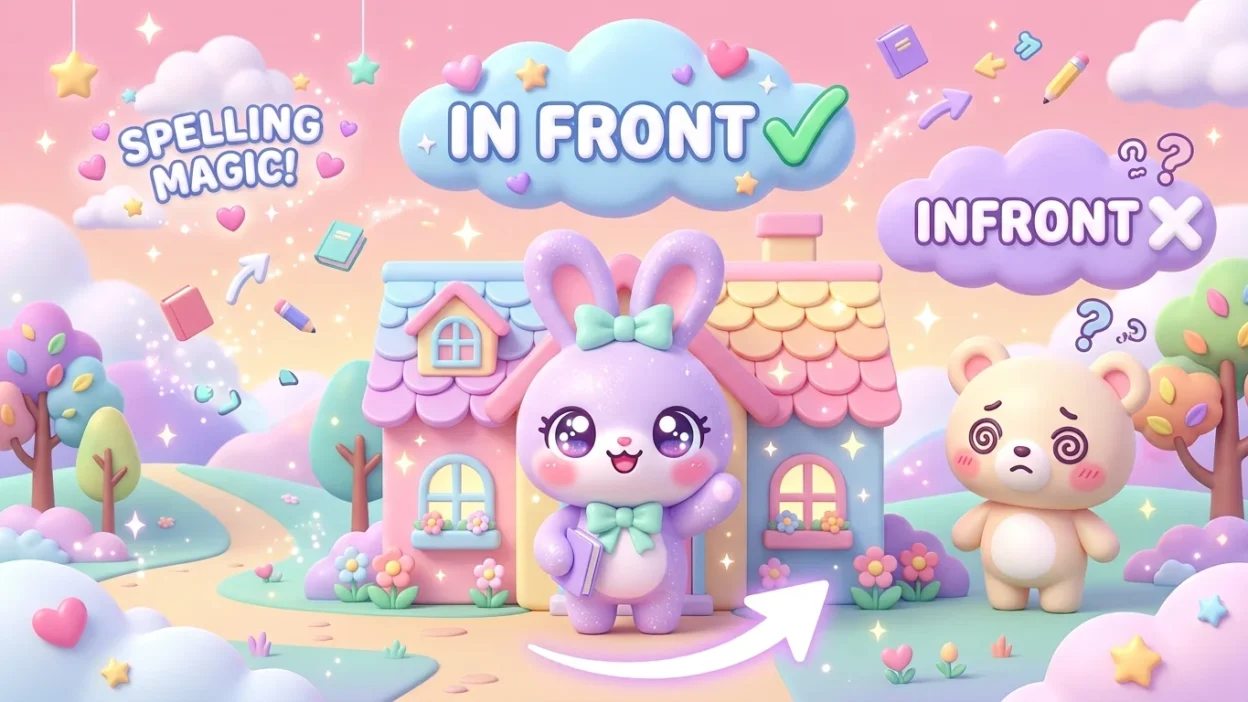
In front and infront look almost the same. However, only one form works in standard English.
In front is the correct spelling. It consists of two separate words. People use it when they describe the position of someone or something relative to another person or object.
Infront is not standard English. Therefore, avoid it in school assignments, emails, professional writing, and everyday communication. The easiest way to remember the spelling involves the phrase itself: something stands in front of something else.
Quick Answer
In front is correct. Infront is incorrect in standard English. Use in front of when you describe position or location. For example, “The car is parked in front of the house.” Always write in front as two words.
Why People Confuse It
English contains many compound words.
For example:
- inside
- outside
- behind
- nearby
- upstairs
This pattern can make infront look reasonable.
However, standard English keeps in front as two words.
The correct form is:
in front
The longer structure is:
in front of
In Front: Meaning and Definition
In front describes a position ahead of someone or something.
Examples:
- The car is in front.
- She stood in front of me.
- The school is in front of the park.
- He parked in front of the building.
The phrase can describe physical location.
It can also describe position within a group or sequence.
- She stood in front of the class.
- He walked in front of us.
- The teacher sat in front of the students.
Infront: Meaning and Definition
Infront does not work as the standard spelling of the phrase.
❌ The car is infront of the house.
✔ The car is in front of the house.
❌ She stood infront of me.
✔ She stood in front of me.
You may see infront in informal online writing. Standard English still uses in front.
In Front vs Infront: Comparison Table
| Form | Correct? | Example |
|---|---|---|
| In front | ✔ Yes | She stood in front of me. |
| Infront | ❌ No | Avoid this spelling. |
| In front of | ✔ Yes | The car is in front of the house. |
When to Use “In Front”
Use in front when you describe a position ahead of someone or something.
In Front of + Person
- She stood in front of me.
- He walked in front of us.
- The child sat in front of his mother.
In Front of + Place
- The car is in front of the house.
- We waited in front of the school.
- They met in front of the restaurant.
In Front of + Object
- The cat sat in front of the television.
- Put the chair in front of the desk.
- The box is in front of the door.
Examples
- She stood in front of the mirror.
- The car stopped in front of our house.
- He sat in front of me.
- We waited in front of the building.
- The teacher stood in front of the students.
- A tree stands in front of the window.
- Please park in front of the gate.
- The dog is sitting in front of the door.
- He walked in front of his friends.
- The bus stopped in front of the school.
- She gave a speech in front of the audience.
- The children gathered in front of the stage.
- I left my shoes in front of the door.
- He stood in front while everyone followed him.
Common Mistakes
Mistake 1: Writing “Infront”
❌ She is standing infront of me.
✔ She is standing in front of me.
Mistake 2: Joining the Words
❌ The shop is infront of the bank.
✔ The shop is in front of the bank.
Keep in and front separate.
Mistake 3: Forgetting “Of”
When you identify what comes after the position, use in front of.
❌ The car is in front the house.
✔ The car is in front of the house.
Mistake 4: Confusing “In Front” With “Before”
In front of usually describes physical position.
Before can describe time or sequence.
- She stood in front of me.
- She arrived before me.
Memory Trick
Think of the phrase as three simple pieces:
IN + FRONT + OF
Do not combine in and front.
Remember:
IN FRONT ✔
INFRONT ❌
A quick sentence can help:
I stand in front of you.
American vs British English
American English uses in front.
British English also uses in front.
The spelling remains the same.
American:
The car is in front of the house.
British:
The car is in front of the house.
Both varieties avoid infront in standard writing.
Similar Words
In Front vs Behind
In front of describes a position ahead.
Behind describes a position at the back.
- The car is in front of the house.
- The garage is behind the house.
In Front vs Ahead
In front of often describes physical position.
Ahead can describe position, direction, progress, or future events.
- She walked in front of me.
- The road continues ahead.
In Front vs Before
Before often relates to time or sequence.
- Finish your homework before dinner.
- He arrived before me.
In front of describes location.
- He stood in front of me.
Final Verdict
In front is correct.
Infront is incorrect in standard English.
Use in front of when you describe the position of one person or thing relative to another.
Correct:
She stood in front of me.
The car is in front of the house.
Incorrect:
She stood infront of me.
Remember: IN FRONT = two words.
Remember This
✔ In front
❌ Infront
✔ In front of the house
✔ In front of me
✔ In front of the school
Keep in and front separate.
FAQs
1. Is it in front or infront?
In front is correct. Infront is not standard English.
2. Is “in front of” three words?
Yes. Write in front of as three separate words.
3. Is “infront of me” correct?
No. Write “in front of me.”
4. Why do people write “infront”?
People often join the words because English has many single-word location terms. Standard English still uses in front as two words.
5. Is “in front” correct in American English?
Yes. American English uses in front.
6. Is “in front” correct in British English?
Yes. British English also uses in front.
7. What is the opposite of “in front of”?
Behind usually provides the opposite meaning.
Conclusion
In front is the correct spelling. English speakers use it to describe a position ahead of someone or something. The phrase commonly appears as in front of.
Infront creates a common spelling mistake. Avoid it in formal and informal standard writing. Remember the simple structure in + front + of. Keep the words separate, and your sentence will look correct.

Euroa Alinta is a dedicated author known for crafting engaging and insightful content. With a strong passion for storytelling and digital publishing, Euroa specializes in creating informative, reader-friendly articles. Her work reflects creativity, clarity, and authenticity, connecting audiences with meaningful ideas across diverse topics and interests.