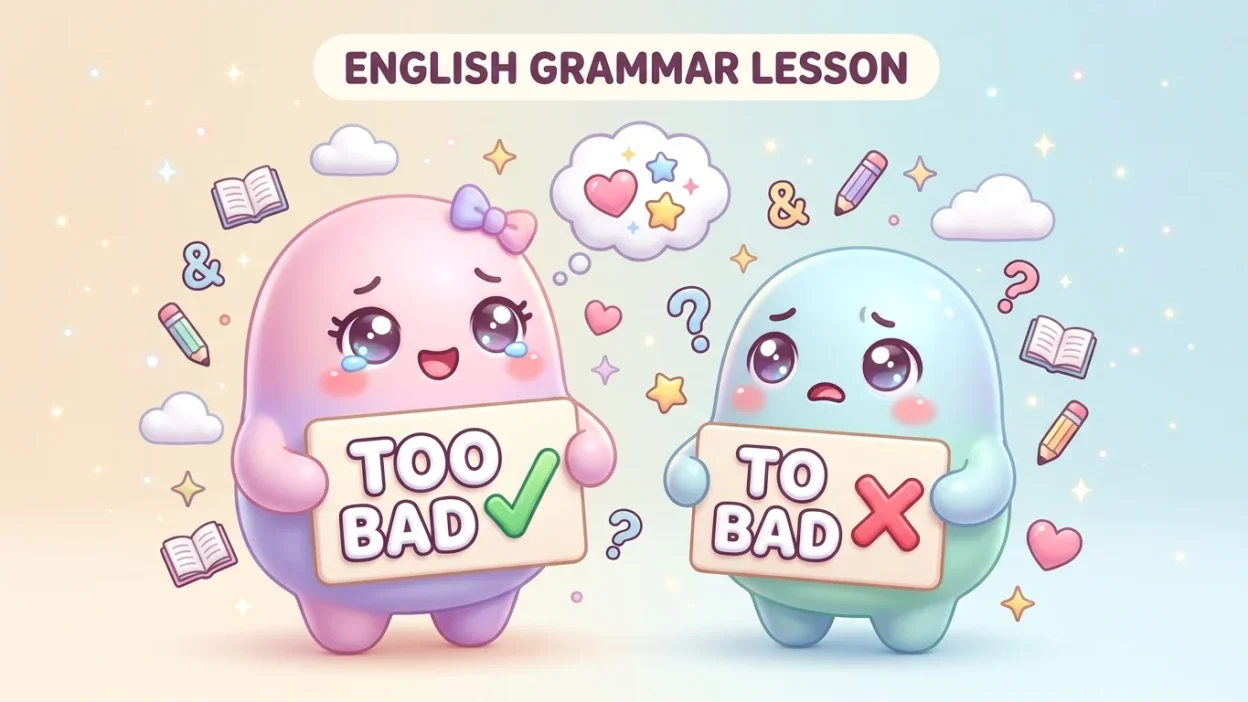
To bad and too bad sound almost identical when people speak quickly. However, they have completely different grammatical roles. Therefore, choosing the right form can make a big difference in your writing.
Too bad is the correct phrase when you want to express disappointment, regret, sympathy, or an unfortunate situation. On the other hand, to normally works as a preposition or as part of an infinitive. Consequently, to bad rarely makes sense as a phrase by itself.
So, if you want to say that something feels unfortunate, disappointing, or regrettable, use too bad.
Quick Answer
Too bad is correct when you express disappointment, regret, or sympathy. To bad usually does not work as a standalone phrase. For example, say “That’s too bad”, not “That’s to bad.” Therefore, whenever you mean “unfortunate” or “unfortunately,” choose too bad.
Why People Confuse It
People often confuse to and too because both words sound the same in everyday speech.
However, their meanings differ.
To commonly indicates direction, destination, or an infinitive verb.
For example:
- I went to school.
- I want to sleep.
- She walked to the store.
Meanwhile, too can mean “also” or “excessively.” In too bad, however, it forms an expression that communicates disappointment or regret.
For example:
- That’s too bad.
- It’s too bad you missed the event.
Therefore, spelling the phrase correctly requires too, not to.
To: Meaning and Uses
To serves several grammatical purposes.
First, it can show direction or movement.
- We went to the park.
- She drove to work.
- He walked to the station.
Second, it can introduce an infinitive verb.
- I want to learn.
- They decided to leave.
- She needs to study.
However, to bad does not normally create the meaning of disappointment.
Therefore:
❌ That’s to bad.
✔ That’s too bad.
Too Bad: Meaning and Uses
Too bad commonly expresses disappointment, regret, or sympathy.
For example:
- That’s too bad.
- It’s too bad you couldn’t come.
- Too bad we missed the train.
Moreover, speakers sometimes use too bad sarcastically or humorously.
For example:
- You forgot your umbrella? Too bad!
- You missed the last cookie? Too bad!
Therefore, the exact tone depends on context and delivery.
To Bad vs Too Bad: Comparison Table
| Phrase | Correct? | Main Use | Example |
|---|---|---|---|
| To bad | ❌ Usually incorrect | Does not normally express disappointment | ❌ That’s to bad. |
| Too bad | ✔ Correct | Expresses disappointment or regret | ✔ That’s too bad. |
| To | ✔ Correct | Direction or infinitive | I want to go. |
| Too | ✔ Correct | Excess or “also”; also appears in “too bad” | That’s too bad. |
When to Use Each
Use “To” for Direction
Use to when someone or something moves toward a destination.
- I went to school.
- She drove to the office.
- We traveled to London.
Use “To” Before a Verb
Use to before a base-form verb when you create an infinitive.
- I want to eat.
- He needs to study.
- They plan to travel.
Use “Too Bad” for Disappointment
Use too bad when something unfortunate happens.
- That’s too bad.
- It’s too bad you missed the concert.
- Too bad we arrived late.
Use “Too Bad” for Sympathy
You can also use too bad when you respond sympathetically.
- You lost your wallet? That’s too bad.
- You couldn’t attend? That’s too bad.
However, depending on your tone, the phrase can sometimes sound dismissive or sarcastic.
Examples
- That’s too bad.
- It’s too bad you missed the meeting.
- Too bad we arrived late.
- She couldn’t come, which is too bad.
- That’s too bad because we needed her help.
- Too bad the restaurant had already closed.
- It’s too bad that the weather changed.
- He missed the bus. That’s too bad.
- Too bad you couldn’t stay longer.
- It’s too bad they canceled the game.
- That’s too bad, but we can try again tomorrow.
- Too bad I forgot my camera.
- It’s too bad she couldn’t join us.
- Too bad we ran out of time.
- That’s really too bad.
Common Mistakes
Mistake 1: Writing “To Bad”
❌ That’s to bad.
✔ That’s too bad.
Because you express disappointment, too provides the correct form.
Mistake 2: Confusing “Too” With “To”
❌ I went too the store.
✔ I went to the store.
Here, to shows direction.
However:
❌ That’s to bad.
✔ That’s too bad.
Here, too bad expresses disappointment.
Mistake 3: Assuming “Too” Always Means “Excessively”
Too often means “more than necessary.”
For example:
- The coffee is too hot.
- The bag is too heavy.
However, too bad can function as an idiomatic expression meaning unfortunate or disappointing.
Memory Trick
Remember this simple rule:
TO = direction or verb
TOO = also, excessively, or “too bad”
Therefore, when you want to say something unfortunate happened, remember:
“That’s TOO bad.”
The extra O can help you remember the correct spelling.
American vs British English
American English uses too bad.
British English also uses too bad.
Therefore, the spelling does not change between these varieties.
For example:
American: That’s too bad.
British: That’s too bad.
In both varieties, to bad does not work when you want to express disappointment.
Similar Expressions
Too Bad vs What a Shame
Both expressions can communicate disappointment.
- That’s too bad.
- What a shame.
However, what a shame can sound more sympathetic.
Too Bad vs Unfortunately
Unfortunately provides a more formal alternative.
- Unfortunately, we missed the train.
- It’s too bad we missed the train.
Therefore, choose unfortunately for formal writing when appropriate.
Too Bad vs Sorry to Hear That
Sorry to hear that often sounds more directly sympathetic.
- That’s too bad.
- I’m sorry to hear that.
Consequently, the second option can sound warmer in sensitive situations.
Final Verdict
Too bad is the correct phrase when you express disappointment, regret, or sympathy.
To bad does not normally work as this expression.
Therefore:
✔ That’s too bad.
❌ That’s to bad.
Remember that to usually indicates direction or introduces an infinitive, while too creates the correct expression too bad.
Remember This
✔ Too bad = correct expression for disappointment
❌ To bad = incorrect in this meaning
✔ I went to school.
✔ That’s too bad.
Therefore, if you mean “that’s unfortunate,” always choose too bad.
FAQs
1. Is it “to bad” or “too bad”?
Too bad is correct when you express disappointment, regret, or sympathy. For example, “That’s too bad.”
2. Is “to bad” ever correct?
The exact sequence to bad can theoretically appear when to connects grammatically to something involving the adjective bad, but it does not work as the common expression of disappointment. Therefore, use too bad for that meaning.
3. What does “too bad” mean?
Too bad commonly means that something is unfortunate, disappointing, or regrettable. For example, “It’s too bad you missed the party.”
4. Why do people write “to bad”?
People confuse the words because to and too sound alike. However, their spelling and grammatical functions differ.
5. Is “that’s too bad” correct?
Yes. “That’s too bad” provides a common and natural English expression for disappointment or sympathy.
6. Can “too bad” sound sarcastic?
Yes. Depending on tone and context, too bad can sound sympathetic, neutral, playful, or sarcastic.
7. What is another way to say “too bad”?
Depending on the situation, you can say “that’s unfortunate,” “what a shame,” or “I’m sorry to hear that.”
Conclusion
Too bad provides the correct spelling when you express disappointment, regret, or an unfortunate situation. Meanwhile, to serves different grammatical purposes, such as showing direction or introducing an infinitive verb. Therefore, these two words should not replace each other.
Ultimately, remember the simple distinction: to often points toward something, while too bad expresses an unfortunate situation. So, when you want to write “That’s unfortunate,” choose “That’s too bad.”