
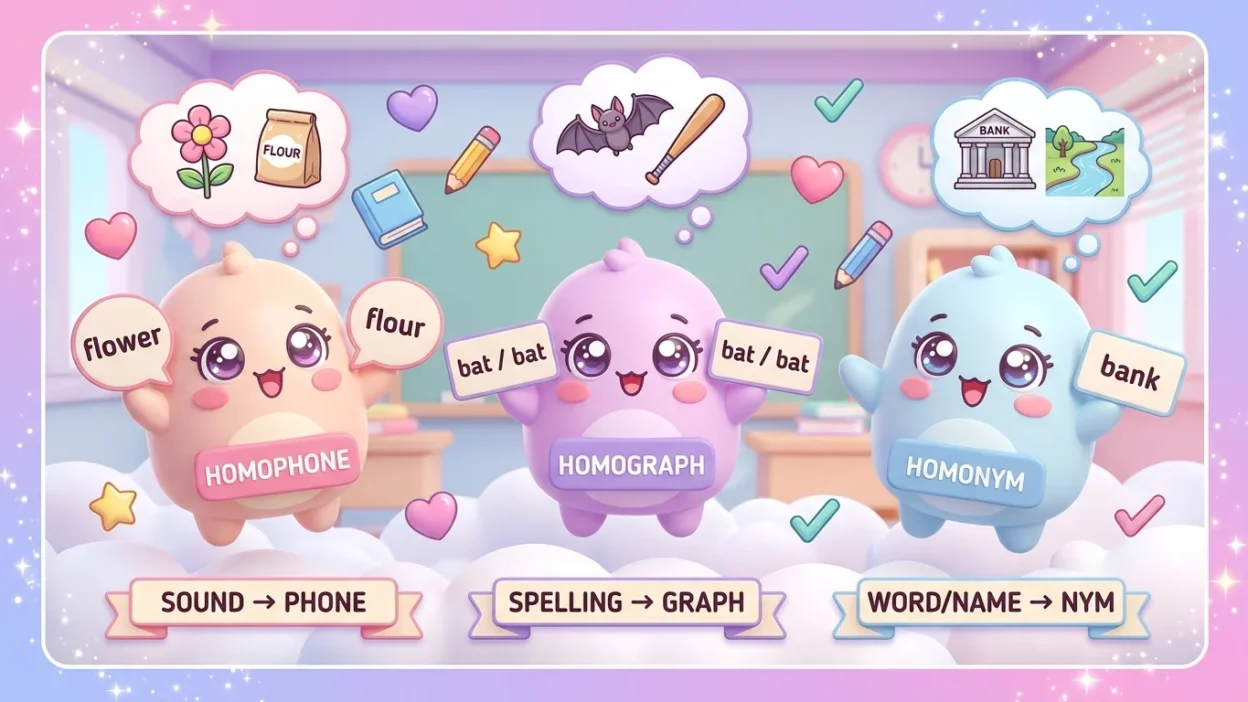
Homophone, homograph, and homonym sound similar as grammar terms, so learners often mix them up. However, each term focuses on a different relationship between words. Therefore, understanding one simple feature—sound, spelling, or meaning—can make the entire topic much easier.
A homophone describes words that sound the same but have different meanings and often different spellings. Meanwhile, a homograph describes words that share the same spelling but have different meanings. Finally, homonym works as a broader term for words that share a form while carrying different meanings. Consequently, the three terms overlap in some cases, but they do not always mean exactly the same thing.
Quick Answer
A homophone has the same sound but a different meaning, such as two and too. A homograph has the same spelling but a different meaning, such as bat for an animal and bat for sports. A homonym generally refers to words that share the same form but have different meanings.
Why People Confuse Them
People confuse these terms because all three involve words with different meanings.
However, each word emphasizes something different.
Homophone → sound
Homograph → spelling
Homonym → same word form, different meaning
Therefore, you can remember the three terms by focusing on their roots:
- Phone relates to sound.
- Graph relates to writing.
- Nym relates to a name or word.
Consequently, homophone focuses on how words sound, while homograph focuses on how words look.
Homophone: Meaning and Examples
A homophone describes words that sound the same but have different meanings.
Often, these words also have different spellings.
For example:
- two / too / to
- there / their / they’re
- flower / flour
- right / write
- sea / see
- pair / pear
- night / knight
For example:
I have two books.
I like this book too.
Although two and too sound alike, they have different meanings and spellings.
Therefore, context helps readers understand which word you mean.
Common Homophone Examples
| Word 1 | Word 2 | Meaning |
|---|---|---|
| to | too | Direction / also or excessively |
| right | write | Correct / produce words |
| flower | flour | Plant / baking ingredient |
| sea | see | Ocean / perceive with the eyes |
| pair | pear | Two things / fruit |
| night | knight | Darkness / armored warrior |
| son | sun | Male child / star |
| here | hear | Location / perceive sound |
Homograph: Meaning and Examples
A homograph describes words that share the same spelling but have different meanings.
Depending on the word, the pronunciation can remain the same or change.
For example:
bat
- A bat can mean a flying mammal.
- A bat can mean sports equipment.
The spelling remains identical, yet the meanings differ.
Another example involves lead:
- lead can refer to a metal.
- lead can mean to guide someone.
In these two meanings, pronunciation differs.
Therefore, homographs can involve either identical or different pronunciation.
Common Homograph Examples
| Word | Meaning 1 | Meaning 2 |
|---|---|---|
| bat | Flying mammal | Sports equipment |
| bank | Financial institution | Side of a river |
| bark | Tree covering | Dog’s sound |
| light | Not heavy | Illumination |
| match | Competition | Small stick for producing fire |
| park | Public green space | Leave a vehicle somewhere |
| watch | Timepiece | Look carefully |
| lead | Guide | Metal |
Homonym: Meaning and Examples
A homonym generally describes words that share the same form while carrying different meanings.
However, linguists and dictionaries sometimes use homonym differently.
In many general English explanations, people use homonym as an umbrella term for words that share spelling or pronunciation but have unrelated meanings.
For example:
bank
- bank can mean a financial institution.
- bank can mean the land beside a river.
Similarly:
bark
- bark can mean the outer covering of a tree.
- bark can mean the sound a dog makes.
Therefore, homonym often provides the broadest and most flexible term among the three.
Homophone vs Homograph vs Homonym: Comparison Table
| Term | Main Feature | Same Sound? | Same Spelling? | Example |
|---|---|---|---|---|
| Homophone | Same pronunciation | ✔ Usually | ❌ Often not | flower / flour |
| Homograph | Same spelling | Sometimes | ✔ Yes | bat / bat |
| Homonym | Same form, different meaning | ✔ or sometimes | ✔ or sometimes | bank / bank |
Because terminology can vary among linguistic sources, some classifications overlap. Nevertheless, the sound-versus-spelling distinction provides the easiest way for English learners to understand the terms.
When to Use Each Term
Use “Homophone” for Same Sound
Use homophone when two or more words sound alike but have different meanings.
For example:
- sea / see
- right / write
- one / won
Therefore, if the key feature involves pronunciation, think homophone.
Use “Homograph” for Same Spelling
Use homograph when two words share the same written form but carry different meanings.
For example:
- bat
- bark
- bank
- light
Therefore, if the key feature involves spelling, think homograph.
Use “Homonym” as a Broad Term
Use homonym when you discuss words that share a form but have unrelated meanings.
For example:
- bank
- bark
- match
However, remember that linguistic definitions can vary. Therefore, some sources classify particular words more narrowly as homophones or homographs.
Examples of Homophones
- To / too — direction / also or excessively
- There / their — location / belonging to them
- Right / write — correct / produce written words
- Sea / see — ocean / perceive visually
- Flower / flour — plant / baking ingredient
- Pair / pear — two items / fruit
- Night / knight — nighttime / medieval warrior
- Son / sun — male child / star
- Hear / here — perceive sound / location
- Weak / week — lacking strength / seven-day period
Examples of Homographs
- Bat — animal / sports equipment
- Bark — tree covering / dog sound
- Bank — financial institution / river edge
- Light — illumination / low weight
- Match — competition / fire-starting stick
- Park — public area / place a vehicle
- Watch — timepiece / observe
- Spring — season / coiled object
- Date — calendar day / fruit or romantic meeting
- Seal — marine animal / close something securely
Examples of Homonyms
Homonyms can include words that share the same spelling and pronunciation while carrying different meanings.
For example:
Bank
- I deposited money at the bank.
- We sat on the river bank.
Bark
- The dog began to bark.
- The tree has rough bark.
Match
- We watched a football match.
- He lit a match.
Bat
- A bat flew through the cave.
- He swung the bat during the game.
Therefore, context determines the intended meaning.
Common Mistakes
Mistake 1: Thinking All Three Terms Mean the Same Thing
Although the terms overlap, they highlight different characteristics.
Therefore, remember:
Homophone = sound
Homograph = spelling
Homonym = shared form
Mistake 2: Assuming Homographs Always Sound the Same
They do not.
For example, lead can have different pronunciations depending on its meaning.
Therefore, a homograph can have identical or different pronunciation.
Mistake 3: Thinking Every Homophone Has Identical Spelling
Most classic homophones have different spellings.
For example:
right / write
sea / see
However, words with the same spelling and sound can also fall into broader homonym classifications.
Mistake 4: Treating “Homonym” as One Completely Fixed Category
Different linguistic traditions use homonym somewhat differently.
Therefore, when precision matters, explain whether you mean same sound, same spelling, or both.
Memory Trick
Use the word endings to remember the difference.
HomoPHONE
Phone = sound
Therefore:
Homophone → same sound
HomoGRAPH
Graph = writing
Therefore:
Homograph → same spelling
HomoNYM
Nym = name or word
Therefore:
Homonym → words with the same form but different meanings
The fastest memory trick remains:
PHONE = SOUND
GRAPH = WRITING
NYM = WORD/NAME
American vs British English
American and British English use the terms homophone, homograph, and homonym with broadly similar meanings.
However, dictionaries and linguists can sometimes differ in how they classify borderline examples.
For example, one source may use homonym broadly, while another source may use more specific categories.
Therefore, the safest approach involves explaining the exact relationship when precision matters.
Similar Terms
Homophone vs Heteronym
A heteronym refers to a word with the same spelling as another word but a different pronunciation and meaning.
For example:
- lead — guide
- lead — metal
Therefore, heteronyms form a more specific category of homographs.
Homograph vs Homophone
A homograph focuses on spelling.
A homophone focuses on sound.
For example:
bat / bat → homograph
flower / flour → homophone
Homonym vs Homophone
A homophone specifically focuses on identical or near-identical pronunciation.
Meanwhile, homonym can function as a broader category depending on the linguistic definition.
Therefore, do not automatically treat the two terms as perfect synonyms.
Final Verdict
The easiest way to distinguish these terms involves one simple question:
What do the words have in common?
If they share a sound, think homophone.
If they share a spelling, think homograph.
If they share a word form while carrying different meanings, think homonym.
Therefore:
Homophone → sound
Homograph → spelling
Homonym → shared form
Once you remember those three ideas, the terminology becomes much easier.
Remember This
✔ Homophone = same sound
✔ Homograph = same spelling
✔ Homonym = same form, different meaning
For example:
flower / flour → homophones
bat / bat → homographs
bank / bank → homonyms
Therefore, whenever you feel confused, focus first on sound and spelling.
FAQs
1. What is the difference between a homophone and a homograph?
A homophone focuses on words that sound the same but have different meanings, while a homograph focuses on words that share the same spelling but have different meanings.
2. What is a homonym in simple words?
A homonym generally describes words that share the same form but have different meanings. However, different linguistic sources sometimes use the term more broadly or narrowly.
3. Is “two” and “too” a homophone?
Yes. Two and too sound the same but have different meanings and spellings, so they provide classic homophone examples.
4. Is “bat” a homograph?
Yes. Bat can refer to a flying mammal or sports equipment. The spelling remains the same, so it provides a common homograph example.
5. Can one word belong to more than one category?
Yes. Because the categories can overlap, a word pair can qualify as both a homograph and a homonym under broader definitions.
6. What is the easiest way to remember homophone and homograph?
Remember phone = sound and graph = writing. Therefore, homophone = same sound, while homograph = same spelling.
7. Are homonyms and homophones the same?
Not necessarily. Homophone specifically emphasizes sound, while homonym can function as a broader term for words with the same form and different meanings.
Conclusion
Homophone, homograph, and homonym describe different relationships between words. However, their definitions can overlap, especially when linguists use homonym as a broad category. Therefore, focusing on sound and spelling provides the clearest approach for everyday English learners.
Ultimately, remember the simple formula: homophone = sound, homograph = spelling, and homonym = shared form with different meaning. Consequently, once you connect each term to its key feature, you can identify these word relationships much more confidently.