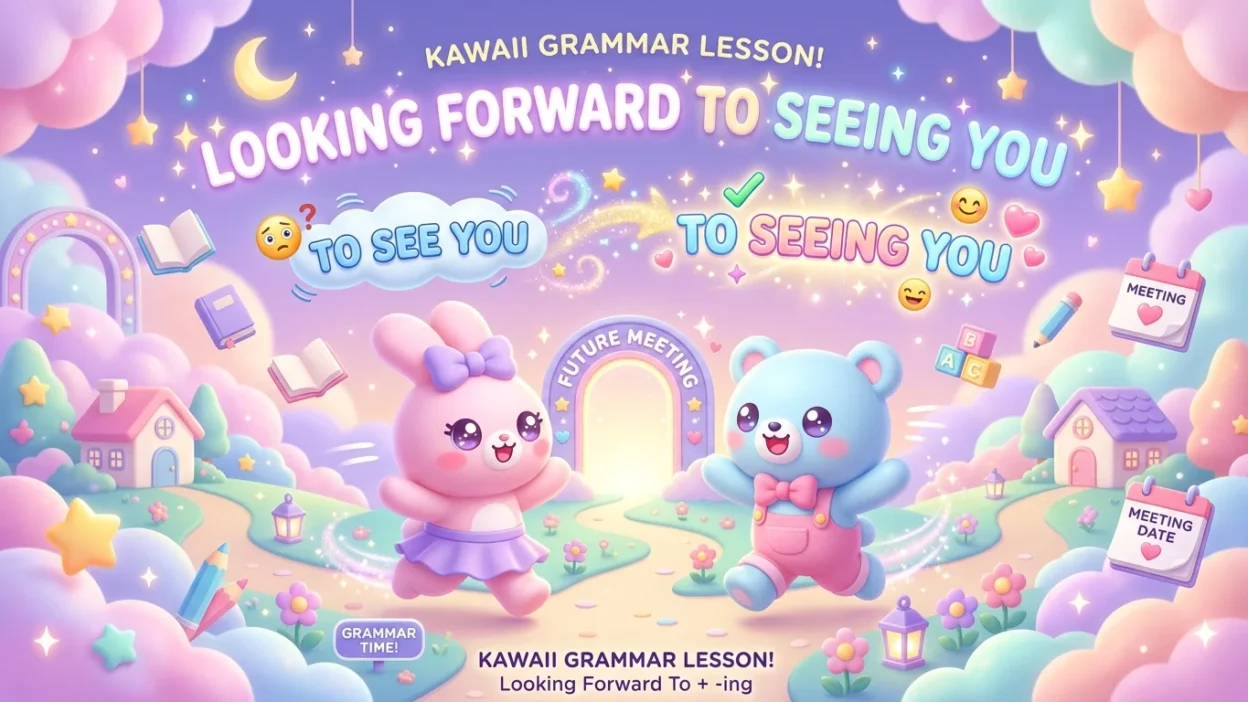
“Looking forward to seeing you” is a natural and correct English expression used when you are happy or excited about meeting someone in the future. It is especially common in emails, messages, letters, and professional communication.
Many English learners wonder whether the phrase should be “looking forward to see you” or “looking forward to seeing you.” The correct form is “looking forward to seeing you” because to is part of the expression look forward to, where to functions as a preposition and must be followed by a noun or an -ing form.
Quick Answer
“Looking forward to seeing you” is correct. Say “I’m looking forward to seeing you” when you feel pleased or excited about meeting someone in the future. Do not say “looking forward to see you” because to is a preposition here, so use seeing, not see.
Why People Confuse It
The confusion happens because English learners often associate to with the infinitive form of a verb:
- to see
- to meet
- to talk
However, in look forward to, the word to is a preposition, not part of an infinitive.
That means it should be followed by:
- A noun: I look forward to the meeting.
- A pronoun: I look forward to it.
- A verb ending in -ing: I look forward to seeing you.
Looking Forward to Seeing You: Meaning and Definition
Looking forward to seeing you means:
I am pleased, happy, or excited about seeing you in the future.
It is a friendly expression that shows positive anticipation.
For example:
- I’m looking forward to seeing you tomorrow.
- We’re looking forward to seeing you again.
- I look forward to seeing you at the event.
The phrase can be used for friends, family members, colleagues, clients, or other people, depending on the tone of the message.
Looking Forward to See You: Meaning and Definition
“Looking forward to see you” is grammatically incorrect in standard English.
❌ I’m looking forward to see you.
✔ I’m looking forward to seeing you.
Why? Because the phrase is look forward to + noun / -ing form.
The correct structure is:
look forward to + seeing
Not:
look forward to + see
Looking Forward to Seeing You vs Looking Forward to See You: Comparison Table
| Feature | Looking forward to seeing you | Looking forward to see you |
|---|---|---|
| Grammatically correct | ✔ Yes | ❌ No |
| Form after “to” | -ing form | Base verb |
| Standard English | ✔ Yes | ✘ Incorrect |
| Example | I’m looking forward to seeing you. | ❌ I’m looking forward to see you. |
| Best choice | Always use this form | Avoid |
When to Use “Looking Forward to Seeing You”
Use looking forward to seeing you when you expect or hope to meet someone in the future and want to express positive anticipation.
It works well in:
- Friendly messages
- Emails
- Professional communication
- Invitations
- Farewell messages
- Plans and appointments
Examples
- I’m looking forward to seeing you tomorrow.
- We’re looking forward to seeing you next week.
- I really look forward to seeing you again.
- Looking forward to seeing you at the meeting.
- I’m looking forward to seeing everyone soon.
Examples
Here are 14 natural examples:
- I’m looking forward to seeing you tomorrow.
- We are looking forward to seeing you next week.
- I really look forward to seeing you again.
- Looking forward to seeing you at the party!
- She is looking forward to seeing her family.
- We’re looking forward to seeing how the project develops.
- I’m looking forward to seeing the results.
- The team is looking forward to seeing you soon.
- I look forward to seeing you at the conference.
- They are looking forward to seeing their friends again.
- I can’t wait to see you, but I’m also looking forward to seeing you.
- Thank you for your invitation. I’m looking forward to seeing you.
- We’re all looking forward to seeing you there.
- I look forward to seeing you and hearing your ideas.
Common Mistakes
Mistake 1: Using “to see”
❌ I look forward to see you.
✔ I look forward to seeing you.
Remember: look forward to + -ing.
Mistake 2: Using the wrong pronoun after “to”
❌ I’m looking forward to seeing your.
✔ I’m looking forward to seeing you.
Use you as the object pronoun.
Mistake 3: Forgetting “I’m” in formal sentences
In a complete sentence, write:
✔ I’m looking forward to seeing you.
In informal emails or messages, this is also common:
✔ Looking forward to seeing you!
The shorter version omits the subject and auxiliary verb, but it is natural in informal communication.
Mistake 4: Overusing the phrase in formal writing
Looking forward to seeing you is friendly and natural, but a more formal email may use:
- I look forward to meeting you.
- I look forward to our meeting.
- I look forward to speaking with you.
Memory Trick
Remember this formula:
🌸 Look forward to + -ing
For example:
- Look forward to seeing
- Look forward to meeting
- Look forward to hearing
- Look forward to working
Think:
“To” here is a preposition, so the next verb wears -ing.
💖 Looking forward to seeing you = correct.
❌ Looking forward to see you = incorrect.
American vs British English
“Looking forward to seeing you” is correct and natural in both American English and British English.
However, there can be a small difference in formality:
- I’m looking forward to seeing you often sounds warm and conversational.
- I look forward to seeing you can sound slightly more formal, especially in professional emails.
Both are widely understood and accepted in American and British English.
Similar Words and Expressions
Looking Forward to Seeing You vs Looking Forward to Meeting You
Use seeing you when you expect to meet someone again or simply focus on the act of seeing them.
Use meeting you when meeting someone for the first time is especially emphasized.
- I’m looking forward to seeing you again.
- I’m looking forward to meeting you.
Looking Forward to Seeing You vs Can’t Wait to See You
- Looking forward to seeing you = polite and natural.
- Can’t wait to see you = more excited and informal.
Looking Forward to Seeing You vs Hope to See You
- Looking forward to seeing you suggests a planned or expected meeting.
- Hope to see you expresses a wish or possibility.
Looking Forward to Seeing You vs Excited to See You
- Looking forward to seeing you = calm, polite anticipation.
- Excited to see you = stronger enthusiasm.
Looking Forward to Seeing You vs Eager to See You
Eager to see you expresses strong enthusiasm, while looking forward to seeing you is usually more neutral and versatile.
Final Verdict
“Looking forward to seeing you” is the correct expression.
The phrase “looking forward to see you” is incorrect because to in look forward to is a preposition. After it, use a noun, pronoun, or verb ending in -ing.
Whether you are writing to a friend, colleague, customer, or family member, “I’m looking forward to seeing you” is a natural and reliable way to express happy anticipation.
Remember This
✨ Look forward to + -ing
✔ Looking forward to seeing you
✔ Looking forward to meeting you
✔ Looking forward to hearing from you
❌ Looking forward to see you
When you see look forward to, remember: the next verb takes -ing.
FAQs
1. Is “looking forward to seeing you” correct?
Yes. It is grammatically correct and natural English.
2. Is “looking forward to see you” correct?
No. The correct form is “looking forward to seeing you.”
3. Why do we say “seeing” instead of “see”?
Because to in look forward to is a preposition. Prepositions can be followed by an -ing form.
4. Is “I am looking forward to seeing you” formal?
It is polite and suitable for both professional and personal communication. I look forward to seeing you can sound slightly more formal.
5. Can I say “looking forward to seeing you soon”?
Yes. “I’m looking forward to seeing you soon” is completely natural.
6. What is a more formal alternative?
You can say:
- I look forward to meeting you.
- I look forward to our meeting.
- I look forward to speaking with you.
7. Can I write “Looking forward to seeing you!” by itself?
Yes. It is a natural informal closing in emails, messages, and chats. The full form is “I’m looking forward to seeing you!”
Conclusion
“Looking forward to seeing you” is the correct and natural expression when you want to say that you are pleased or excited about meeting someone in the future. The important grammar rule is simple: look forward to + noun or -ing form.
So, remember to say “looking forward to seeing you,” not “looking forward to see you.” Once you understand that to is a preposition in this expression, the rule becomes much easier to remember and use correctly in everyday conversations, emails, and professional writing.