Too and to are two of the most commonly confused words in English. They sound exactly the same, but their meanings and grammar are completely different. One extra o can change your sentence from correct to incorrect.
The good news is that the difference is easy to learn. To usually shows direction, purpose, or an infinitive, while too usually means also or more than necessary. Once you know what each word does, choosing the right spelling becomes much simpler.
Quick Answer
Use to for direction, a recipient, or before a base verb: go to school, talk to her, want to learn. Use too to mean also or excessively: I want to come too and It is too expensive. Remember: too has an extra O for “also.”
Why People Confuse It
The main reason is pronunciation. To and too are homophones, meaning they usually sound the same even though they have different spellings and meanings.
That means you cannot always choose the correct word by listening. You need to look at the word’s role in the sentence.
For example:
- I want to go home. → correct
- I want too go home. → incorrect
But:
- I want to go home too. → correct
To: Meaning and Definition
To has several important uses in English.
1. Direction or Destination
Use to when showing where someone or something is going.
- She went to school.
- We are traveling to London.
- Please come to my office.
2. A Person Receiving Something
Use to when something is given, sent, shown, or communicated to someone.
- I gave the book to Ali.
- She sent a message to her friend.
- Please explain it to me.
3. Before a Base Verb
Use to as part of the infinitive form.
- I want to learn.
- They decided to leave.
- She hopes to win.
4. Time or Range
To can also show a range.
- The office is open from 9 to 5.
- It is ten minutes to noon.
Too: Meaning and Definition
Too usually has two main meanings.
1. Also or As Well
Use too when you mean also.
- I like coffee too.
- She is coming too.
- Can I join too?
2. More Than Necessary or Acceptable
Use too when something is excessive.
- This bag is too heavy.
- The soup is too hot.
- You are driving too fast.
3. Very, in Some Informal Expressions
Too can sometimes add emphasis.
- That’s too kind of you!
- It’s too bad we missed the show.
Too vs To: Comparison Table
| Feature | To | Too |
|---|---|---|
| Main meaning | Direction, recipient, purpose, infinitive | Also or excessively |
| Before a verb | ✔ to eat | ❌ too eat |
| Means “also” | ❌ | ✔ |
| Means “more than necessary” | ❌ | ✔ |
| Example | I went to work. | I went too. |
When to Use Each
Use “To” When Talking About Direction, Purpose, or an Action
Choose to when it connects ideas or shows where something is going.
- Go to the store.
- Speak to your teacher.
- I need to sleep.
- This belongs to her.
- The score was 3 to 1.
Use “Too” When You Mean “Also” or “Excessively”
Choose too when you could replace it with also or when something is more than desired.
- I want one too. → also
- It’s too late. → excessively late
- He talks too much. → more than necessary
- They came too. → also
Examples
Here are 14 examples to make the difference clear:
- I want to learn English.
- I want to go too.
- She went to the market.
- The market was too crowded.
- Please give this to your brother.
- My brother wants one too.
- It is too cold to swim.
- We need to leave because it is getting too late.
- He drove to the airport.
- He arrived too early.
- I have to finish my work.
- I have too much work today.
- She wants to come too.
- This box is too heavy to lift.
Common Mistakes
Mistake 1: Using “too” Before a Base Verb
❌ I want too go.
✔ I want to go.
Use to + base verb for the infinitive.
Mistake 2: Using “to” When You Mean “Also”
❌ I want to come to.
✔ I want to come too.
If you mean also, use too.
Mistake 3: Using “to” for Excessive Amounts
❌ This coffee is to hot.
✔ This coffee is too hot.
If something is more than necessary, wanted, or acceptable, use too.
Mistake 4: Forgetting the Difference in “Too Much” and “To Much”
❌ To much noise.
✔ Too much noise.
Use too much to describe an excessive amount.
Memory Trick
Here is a simple way to remember:
🌸 TOO has an extra O because it means “extra.”
Think:
One O = TO
Extra O = TOO much / TOO = also
If something is extra, too has an extra letter O.
American vs British English
Both American English and British English use to and too in the same basic way.
There is no spelling difference:
✔ to
✔ too
The grammar and meanings are also essentially the same in both varieties of English.
Similar Words
Too vs Two
These three words are often confused because they can sound alike:
- to = direction or infinitive
- too = also or excessively
- two = the number 2
Example:
I gave two books to her, and she wanted two more too.
Too vs Also
Both can mean in addition.
- I want to come too.
- I also want to come.
Too often sounds more natural at the end of a sentence.
To vs For
These words can both show relationships, but they are not always interchangeable.
- I gave it to her.
- I bought it for her.
To often shows the recipient, while for often shows the intended beneficiary or purpose.
Too vs Very
Both can add emphasis, but too often suggests excess.
- It’s very hot. → strongly hot
- It’s too hot. → excessively hot; a problem
To vs Toward
- To often shows a destination: We walked to the door.
- Toward shows direction: We walked toward the door.
Final Verdict
The difference is simple once you know the meanings.
Use to for direction, recipients, relationships, ranges, and infinitives. Use too when you mean also or more than necessary.
If you can replace the word with also, choose too. If you can replace it with a direction, connect it to a person, or put it before a base verb, choose to.
Remember This
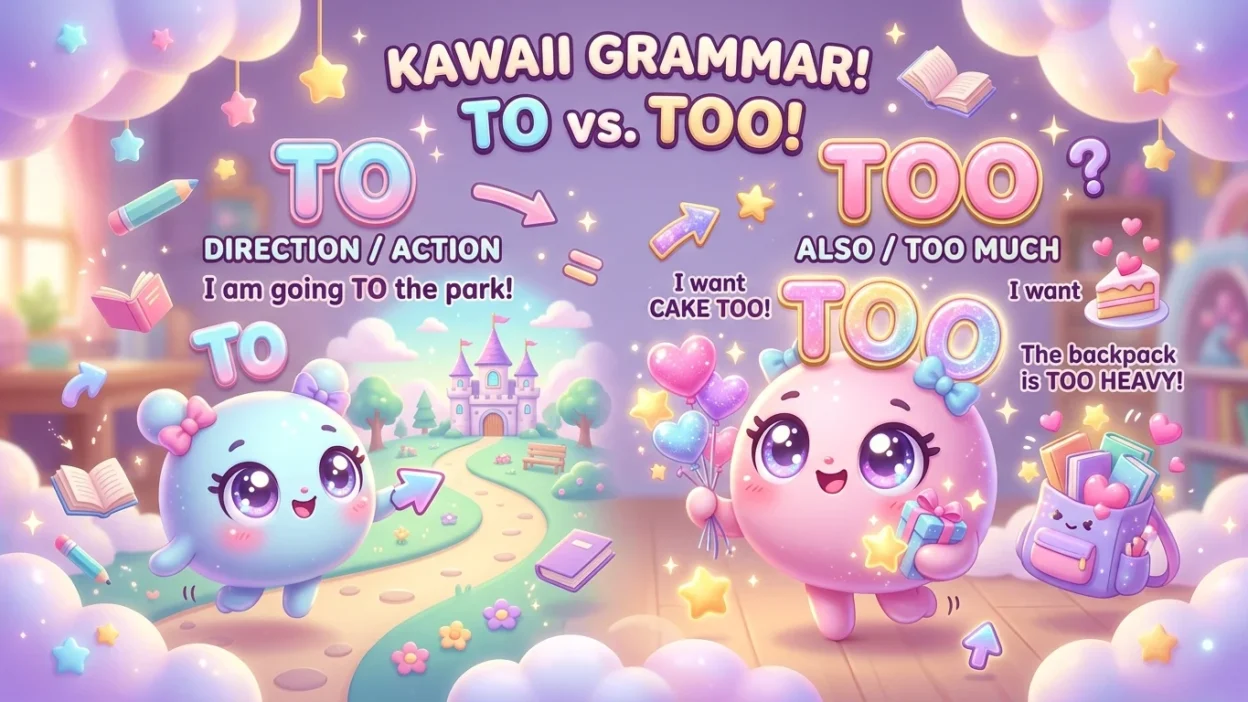
✨ TO = direction or action.
🌟 TOO = also or extra.
The easiest memory trick is:
TOO has an extra O for something extra.
✔ I want to learn.
✔ I want to learn too.
✔ It’s too difficult to learn without practice.
FAQs
1. What is the main difference between “to” and “too”?
To is usually a preposition or part of an infinitive, while too means also or more than necessary.
2. Is it “I want to” or “I want too”?
Use “I want to” before a verb: I want to leave.
Use “I want too” only when too means also, although the sentence may need additional context.
3. How do I know whether to use “too”?
Ask whether the word means also or excessively. If yes, use too.
4. Is “too much” always spelled with two O’s?
Yes. The correct phrase is too much, meaning more than necessary or desired.
5. Can “too” come at the end of a sentence?
Yes. This is very common.
Example: I would like to go too.
6. What is the difference between “very” and “too”?
Very means to a high degree, while too usually means more than is wanted, acceptable, or possible.
7. What is the difference between “to,” “too,” and “two”?
To shows direction or introduces an infinitive. Too means also or excessively. Two is the number 2.
Conclusion
Too vs to is a classic English spelling challenge because the words often sound the same. The key is understanding their function. To usually connects words, shows direction, or appears before a base verb, while too means also or more than necessary.
When you are unsure, remember the extra O in too. It can remind you of something extra or in addition. With this simple trick and a little practice, choosing between to and too will become quick and natural.

Narelle Merindah is a passionate author committed to delivering thoughtful, engaging, and well-structured content. With a keen eye for detail and a love for storytelling, Narelle creates informative articles that resonate with readers. Her dedication to clarity, creativity, and authenticity ensures meaningful and impactful writing.