If you have ever heard someone say mine as well, might as well, or mind as well, you may wonder which version is correct. Because people often pronounce this expression quickly, the three forms can sound surprisingly similar. However, only one works as the standard expression in this context.
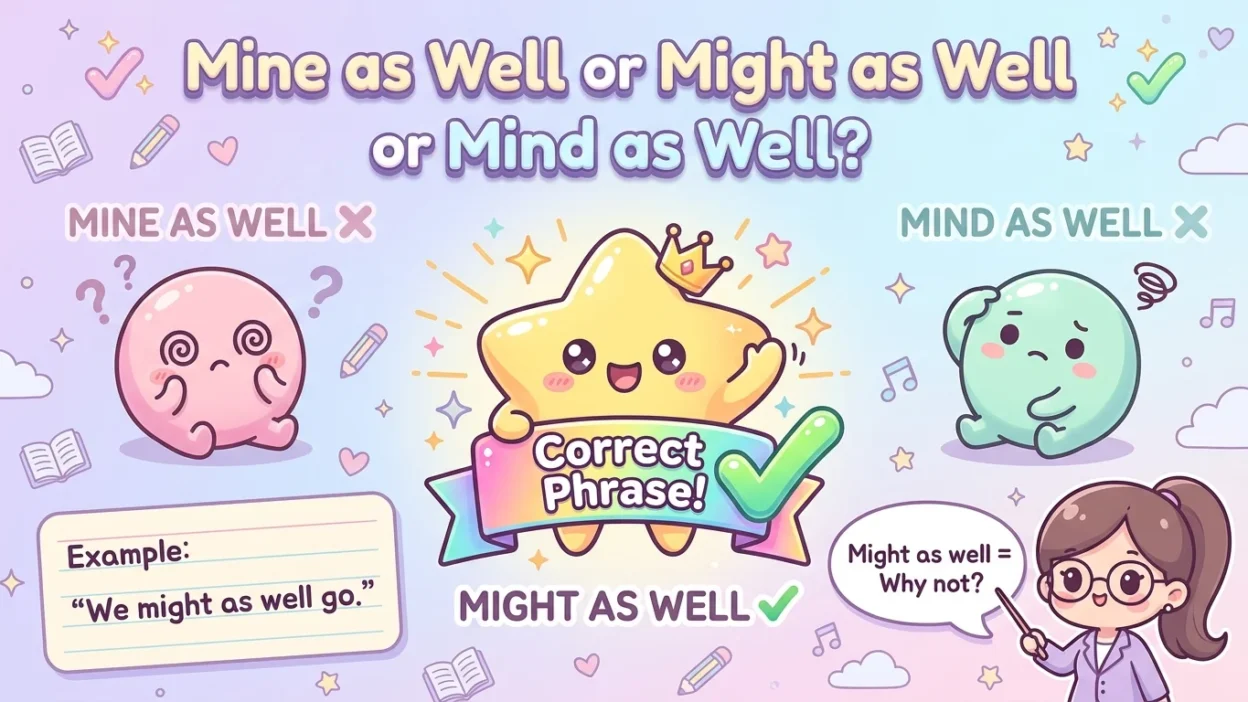
The correct phrase is might as well. People use it when an action seems reasonable, convenient, or worth doing because there is no strong reason to choose another option. For example, “We might as well leave now” means that leaving now seems like a sensible choice.
Meanwhile, mine as well and mind as well commonly appear because people mishear the correct expression. Although mine and mind are real English words, neither replaces might in this idiom. Therefore, when you mean “there is no reason not to,” always choose might as well.
Quick Answer: Mine as Well, Might as Well, or Mind as Well?
Might as well is the correct standard expression. It means that doing something seems sensible, convenient, or worthwhile because there is little reason not to do it. Mine as well and mind as well are generally incorrect when you intend this expression. Therefore, write “I might as well go.”
Why Do People Confuse Mine as Well, Might as Well, and Mind as Well?
People mainly confuse these expressions because might as well can sound different when someone says it quickly.
In natural speech, speakers may not pronounce the final t in might as distinctly as they would when saying the word by itself. Consequently, a listener might interpret the phrase as mine as well or mind as well.
Moreover, people often learn common expressions by hearing them before seeing them in writing. Therefore, someone may know exactly how to use the expression in conversation while spelling it incorrectly.
Additionally, mine and mind are legitimate English words. As a result, a basic spell-checker may recognize every individual word without identifying the phrase as an error.
However, the established expression is:
Might as well
Therefore, if your sentence means “why not?”, “there is no good reason not to,” or “this seems like the sensible option,” choose might as well.
What Does Might as Well Mean?
Might as well is an idiomatic expression that suggests an action seems reasonable, worthwhile, or acceptable under the circumstances.
For example:
“We might as well leave now.”
Here, the speaker believes that leaving now makes sense.
Similarly:
“Since you’re already at the store, you might as well buy some milk.”
In this example, the person is already at the store. Therefore, buying milk requires little additional effort.
Additionally, might as well can express mild resignation when no better alternative exists.
For example:
“The train is delayed for an hour, so we might as well get some coffee.”
The speakers cannot make the train arrive sooner. Consequently, getting coffee seems like a reasonable way to spend the time.
Therefore, might as well can communicate ideas such as:
- Why not?
- There is no reason not to.
- This seems like the sensible choice.
- We have little to lose.
- No better option exists.
- We already have the opportunity.
What Does Mine as Well Mean?
Mine as well is generally incorrect when someone intends to write might as well.
For example:
❌ I mine as well leave now.
✅ I might as well leave now.
Although mine is a real English word, it has different meanings.
As a possessive pronoun, mine means belonging to me:
“That phone is mine.”
As a noun, mine can refer to a place where people extract minerals or other materials:
“He worked in a coal mine.”
Furthermore, mine can function as a verb:
“The company plans to mine the area.”
However, none of these meanings replaces might in the expression might as well.
Therefore, if you want to express “why not?” or “there is no reason not to,” avoid mine as well and use might as well.
What Does Mind as Well Mean?
Mind as well is also generally incorrect when someone intends the expression might as well.
For example:
❌ We mind as well go home.
✅ We might as well go home.
Like mine, mind is a genuine English word. However, it carries completely different meanings.
As a noun, mind can refer to a person’s thoughts, intellect, or mental processes:
“She has a brilliant mind.”
As a verb, mind can mean to care about, object to, pay attention to, or look after something.
For example:
“Would you mind opening the window?”
However, mind does not replace might in the idiom might as well.
Therefore:
Might as well = correct expression
Mine as well = generally incorrect for this expression
Mind as well = generally incorrect for this expression
Mine as Well vs Might as Well vs Mind as Well: Comparison Table
| Expression | Correct for the Idiom? | Meaning | Example |
|---|---|---|---|
| Might as well | Yes | Doing something seems reasonable or worthwhile | We might as well leave. |
| Mine as well | No | Usually a mishearing or misspelling | We mine as well leave. ❌ |
| Mind as well | No | Usually a mishearing or misspelling | We mind as well leave. ❌ |
| Mine | Correct separately | Belonging to me; excavation site; extract minerals | That book is mine. |
| Mind | Correct separately | Thoughts, intellect, care, or object | Do you mind? |
| Might | Correct | A modal verb | We might leave. |
Therefore, when choosing among these three expressions, might as well is the standard form.
When Should You Use Might as Well?
Use might as well when doing something seems sensible because circumstances provide little reason not to do it.
For example:
“We’re already here, so we might as well stay.”
Here, staying makes sense because the people have already arrived.
Similarly:
“You might as well ask her.”
This sentence suggests that asking creates little disadvantage, so trying seems worthwhile.
You can also use might as well when two alternatives seem equally acceptable:
“Both restaurants are nearby, so we might as well choose this one.”
Furthermore, the expression can communicate resignation:
“It’s going to rain all afternoon, so we might as well stay inside.”
Therefore, might as well often expresses a practical decision based on existing circumstances.
When Should You Use Mine as Well?
Do not use mine as well when you mean might as well.
Incorrect:
“I mine as well finish my homework.”
Correct:
“I might as well finish my homework.”
However, mine remains perfectly correct in its normal grammatical roles.
For example:
“Her laptop works well, and mine does as well.”
Here, mine means my laptop, while as well means also.
Notice that this sentence does not contain the idiom mine as well. Instead, mine and as well perform separate grammatical jobs.
Therefore, always examine the complete sentence before deciding whether mine is actually incorrect.
When Should You Use Mind as Well?
Likewise, do not substitute mind as well for might as well.
Incorrect:
“You mind as well tell him.”
Correct:
“You might as well tell him.”
However, mind can naturally appear near as well in sentences where the words perform separate functions.
For example:
“She has a sharp mind as well as an excellent memory.”
Here, mind is a noun, while as well as introduces additional information.
Therefore, the word mind itself is not incorrect. It simply does not belong in the idiom might as well.
Mine as Well or Might as Well or Mind as Well: 18 Examples
Here are 18 practical examples of might as well in natural English.
- We might as well leave now.
- I might as well finish the project tonight.
- You might as well ask her for help.
- Since we’re here, we might as well look around.
- He might as well take the earlier train.
- They might as well stay for dinner.
- Since you opened the book, you might as well read the first chapter.
- I have nothing else planned, so I might as well come with you.
- We might as well order dessert while we’re here.
- She might as well apply for the position.
- You might as well bring an umbrella because rain looks likely.
- The movie starts soon, so we might as well wait.
- He might as well tell the truth now.
- Since the shop is nearby, we might as well stop there.
- I might as well clean my room while I have some free time.
- They might as well take a taxi instead of waiting another hour.
- We might as well start the meeting without him.
- You might as well try because you have nothing to lose.
In each example, might as well suggests that the action makes sense under the circumstances.
Incorrect vs Correct Examples
Here are several common errors:
❌ I mine as well go home.
✅ I might as well go home.
❌ You mind as well tell her.
✅ You might as well tell her.
❌ We mine as well start now.
✅ We might as well start now.
❌ They mind as well stay here.
✅ They might as well stay here.
❌ She mine as well apply for the job.
✅ She might as well apply for the job.
Therefore, whenever you mean “why not?” or “there is no strong reason not to,” write might as well.
Common Mistakes With Might as Well
Several mistakes commonly appear with this expression.
Mistake 1: Writing Mine as Well
Incorrect:
“I mine as well leave.”
Correct:
“I might as well leave.”
Although mine sounds somewhat similar in rapid speech, it does not belong in this idiom.
Mistake 2: Writing Mind as Well
Incorrect:
“We mind as well start.”
Correct:
“We might as well start.”
Again, the pronunciation may create confusion, but standard writing requires might.
Mistake 3: Writing Might of Well
Another possible mistake occurs when writers mishear the middle of the expression.
Incorrect:
“You might of well ask.”
Correct:
“You might as well ask.”
The expression always uses as, not of.
Mistake 4: Confusing Might As Well With May As Well
May as well also exists and can communicate a meaning similar to might as well.
For example:
“We may as well leave now.”
However, might as well is extremely common and often sounds natural when suggesting that an action seems reasonable under the circumstances.
Therefore, may as well is not the same type of mistake as mine as well or mind as well.
Mistake 5: Using Might As Well When You Mean Definitely
Might as well often carries a sense of practicality, limited alternatives, or mild resignation. Therefore, it does not necessarily communicate strong enthusiasm or certainty.
For example:
“I might as well go.”
This can sound less enthusiastic than:
“I definitely want to go.”
Consequently, consider the tone as well as the grammar.
A Simple Memory Trick
Remember this easy formula:
MIGHT + AS WELL = WHY NOT?
If you can replace the expression with “why not?” and keep roughly the same idea, you probably need might as well.
For example:
“We’re already here, so we might as well stay.”
Think:
“We’re already here, so why not stay?”
The meaning remains similar.
Therefore, remember:
MIGHT = correct
MINE = wrong for this idiom
MIND = wrong for this idiom
Another useful trick is to remember that might already works as a modal verb:
“I might go.”
“I might as well go.”
That connection makes the correct expression easier to remember.
Might as Well vs May as Well
Both might as well and may as well are standard expressions.
For example:
“We might as well leave.”
“We may as well leave.”
Both can suggest that leaving seems reasonable because there is little reason to stay.
However, preferences and nuances can vary according to context, dialect, and tone. Therefore, you do not need to treat may as well as an error.
Still, when choosing among mine as well, might as well, and mind as well, might as well is the correct expression.
Might As Well vs Might Well
Although these expressions look similar, they do not always mean the same thing.
Might as well often means that an action seems sensible because there is little reason not to do it.
For example:
“We might as well leave.”
Meanwhile, might well can mean that something is quite possible or understandable.
For example:
“She might well win the competition.”
Here, the sentence means that she has a reasonable possibility of winning.
Therefore, do not remove as from might as well unless you intend a different construction.
Might As Well vs Might Also
These expressions also serve different purposes.
Might as well suggests that doing something seems reasonable:
“You might as well stay.”
Meanwhile, might also introduces another possibility:
“You might also consider taking the train.”
Therefore, although both contain might, they communicate different ideas.
American vs British English
Both American and British English use might as well.
For example, speakers in either variety can say:
“We might as well go home.”
Likewise, mine as well and mind as well do not become standard alternatives to this idiom simply because you switch between American and British English.
However, pronunciation varies considerably among regions and speakers. Consequently, the phrase may sound different depending on accent and speaking speed.
Nevertheless, the standard written expression remains:
might as well
Similar Expressions to Might As Well
Several expressions can communicate related ideas, although their exact meanings and tones may differ:
- Why not?
- May as well
- No reason not to
- Might just as well
- It makes sense to
- We have nothing to lose
- Since we’re already here
- We might as well
- There’s no point in waiting
- It’s worth a try
For example:
“We might as well try.”
You could express a similar idea as:
“We have nothing to lose by trying.”
However, might as well often sounds shorter and more conversational.
Frequently Asked Questions
Is it mine as well or might as well?
The correct standard expression is might as well. For example, write “I might as well go.” Mine as well usually results from mishearing or misspelling the phrase.
Is it mind as well or might as well?
Use might as well when you mean that doing something seems reasonable because there is little reason not to do it. Therefore, “We might as well leave” is correct.
Is mine as well grammatically correct?
The individual words mine, as, and well can appear near one another in certain sentence structures. However, mine as well does not replace the idiom might as well. Therefore, “I mine as well leave” is incorrect in standard English.
Is mind as well a real phrase?
Mind as well is not the standard alternative to might as well. Although mind is a real word and can naturally occur near as well in other constructions, write might as well when expressing the familiar idiom.
What does might as well mean?
Might as well means that an action seems reasonable, convenient, or worthwhile because no strong reason exists not to do it. Depending on context, it can also express mild resignation or acceptance.
Is “I might as well” correct?
Yes. “I might as well” is correct. However, you will often add another verb afterward, such as “I might as well go,” “I might as well try,” or “I might as well stay.”
Is “may as well” correct?
Yes. May as well is also a standard expression and can carry a meaning similar to might as well. Therefore, do not confuse may as well with the incorrect substitutions mine as well and mind as well.
Why do people say mine as well?
People may write or appear to say mine as well because might as well can sound different in rapid connected speech. Consequently, someone who learns the phrase mainly by hearing it may interpret the sounds incorrectly.
Final Verdict: Mine as Well, Might as Well, or Mind as Well?
When choosing among mine as well, might as well, and mind as well, use might as well for the standard expression meaning that an action seems sensible, worthwhile, or reasonable because there is little reason not to do it.
Meanwhile, mine as well and mind as well usually result from mishearing the expression when writers intend this meaning. Although mine and mind are legitimate words in other contexts, neither substitutes for might in the idiom. Therefore, write “We might as well go,” not “We mine as well go” or “We mind as well go.”
Remember This
Use this simple memory trick:
MIGHT AS WELL = WHY NOT?
For example:
“We might as well try.”
Think:
“Why not try?”
Therefore:
Might as well ✓ = correct expression
Mine as well ✗ = incorrect for this idiom
Mind as well ✗ = incorrect for this idiom
Also, remember:
I might go → I might as well go.
Because might already functions naturally as a modal verb, this pattern can help you remember the correct phrase.
Conclusion
Ultimately, might as well is the standard expression you need when you want to say that doing something seems sensible, convenient, or worthwhile under the circumstances. Because rapid pronunciation can make might difficult to hear clearly, people sometimes mistakenly write mine as well or mind as well.
Therefore, remember the simple connection “might as well = why not?” If that meaning fits your sentence, choose might as well. Although mine and mind remain perfectly valid words elsewhere, they do not replace might in this common expression.

Lutana Maroochy is a creative author recognized for delivering engaging and well-researched content. With a passion for clear communication and storytelling, Lutana focuses on producing informative, reader-centered articles across various subjects. Dedicated to quality and originality, Lutana consistently connects with audiences through thoughtful insights and compelling narratives.