
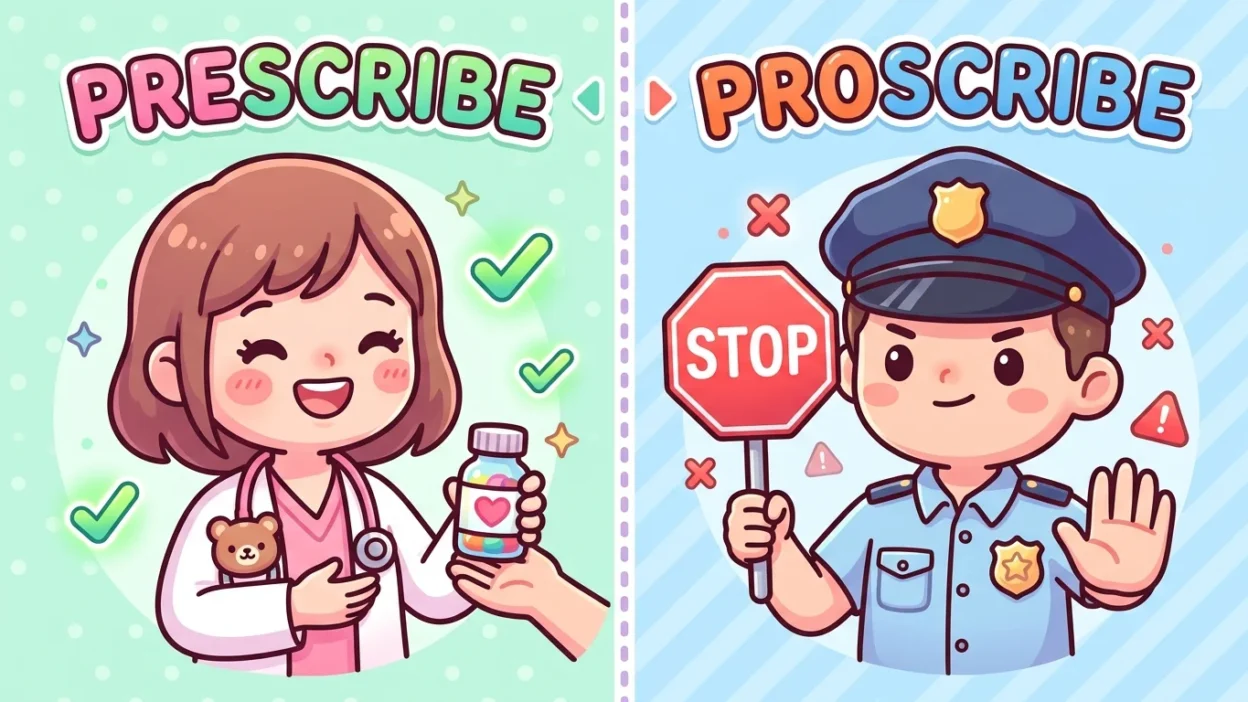
Many English learners confuse “prescribe” and “proscribe” because the words look very similar.
However, their meanings are completely different, so mixing them can create serious misunderstandings.
So, if you want accurate and natural English, you need to know when to use each word correctly. In this guide, you’ll learn the meanings, examples, differences, and easy tricks to remember them confidently.
Quick Answer
✨ Here’s the simple rule:
- ✅ Prescribe = recommend, authorize, or order officially
- ✅ Proscribe = forbid or ban officially
👉 Easy trick:
- Pre- = provide or permit
- Pro- = prohibit
🌟 Examples:
- Doctors prescribe medicine. ✔
- The law proscribes smoking here. ✔
What Does “Prescribe” Mean?
First of all, “prescribe” means to officially recommend, order, or authorize something. Therefore, people often connect it with doctors, rules, and instructions.
Common Uses:
- Medicine
- Official instructions
- Rules and treatments
Examples:
- The doctor prescribed antibiotics.
- Teachers prescribe reading assignments.
- The law prescribes safety procedures.
👉 So, “prescribe” usually involves giving permission, guidance, or instructions.
What Does “Proscribe” Mean?
On the other hand, “proscribe” means to forbid, ban, or officially prohibit something.
Common Uses:
- Laws
- Rules
- Official bans
Examples:
- The government proscribed illegal activities.
- School rules proscribe cheating.
- The policy proscribes discrimination.
👉 So, “proscribe” usually involves restriction or prohibition.
Key Differences Between “Prescribe” and “Proscribe”
| Word | Meaning | Main Idea |
|---|---|---|
| Prescribe | Recommend or authorize | Allow/instruct |
| Proscribe | Ban or forbid | Prohibit |
Common Mistakes to Avoid
Even though the words look similar, using the wrong one changes the meaning completely. So, let’s fix common errors:
❌ Incorrect:
- The doctor proscribed medicine.
✔ Correct: The doctor prescribed medicine.
❌ Incorrect:
- The law prescribed illegal gambling.
✔ Correct: The law proscribed illegal gambling.
👉 So, always check whether the meaning involves permission or prohibition.
Easy Trick to Remember
Whenever you feel unsure, remember:
- Prescribe → prescribe medicine
- Proscribe → prohibit
👉 Another easy clue:
- Proscribe sounds close to prohibit
Because of this trick, you will remember the difference more easily.
American vs British English
Interestingly, both American and British English use “prescribe” and “proscribe” with the same meanings and spellings.
Real-Life Examples
About Prescribe:
- Doctors prescribe treatment daily.
- The manual prescribes safety steps.
About Proscribe:
- The rules proscribe dangerous behavior.
- The organization proscribed harmful substances.
Why This Matters
Although these words differ by only one letter, the meanings are almost opposite. When you choose the correct word:
- You improve accuracy
- You avoid confusion
- You communicate more clearly
As a result, your English becomes more precise and professional.
FAQs
Which is correct: prescribe or proscribe?
Both are correct, but they have completely different meanings.
What does prescribe mean?
It means officially recommend, authorize, or order something.
What does proscribe mean?
It means officially forbid or ban something.
Is prescribe related to medicine?
Yes, doctors commonly prescribe medicine.
Which word means prohibit?
“Proscribe” means prohibit or ban.
What is the easiest way to remember this?
Prescribe gives permission, while proscribe prohibits.
Final Thoughts
Now you clearly understand the difference between “prescribe” and “proscribe.”
While “prescribe” means recommend or authorize, “proscribe” means forbid or ban.
Because these words have nearly opposite meanings, learning the distinction helps you communicate much more accurately.
As you continue practicing, you will naturally choose the correct word without hesitation. So, instead of mixing them up, you will write clearly and confidently every time.

Narelle Merindah is a passionate author committed to delivering thoughtful, engaging, and well-structured content. With a keen eye for detail and a love for storytelling, Narelle creates informative articles that resonate with readers. Her dedication to clarity, creativity, and authenticity ensures meaningful and impactful writing.