
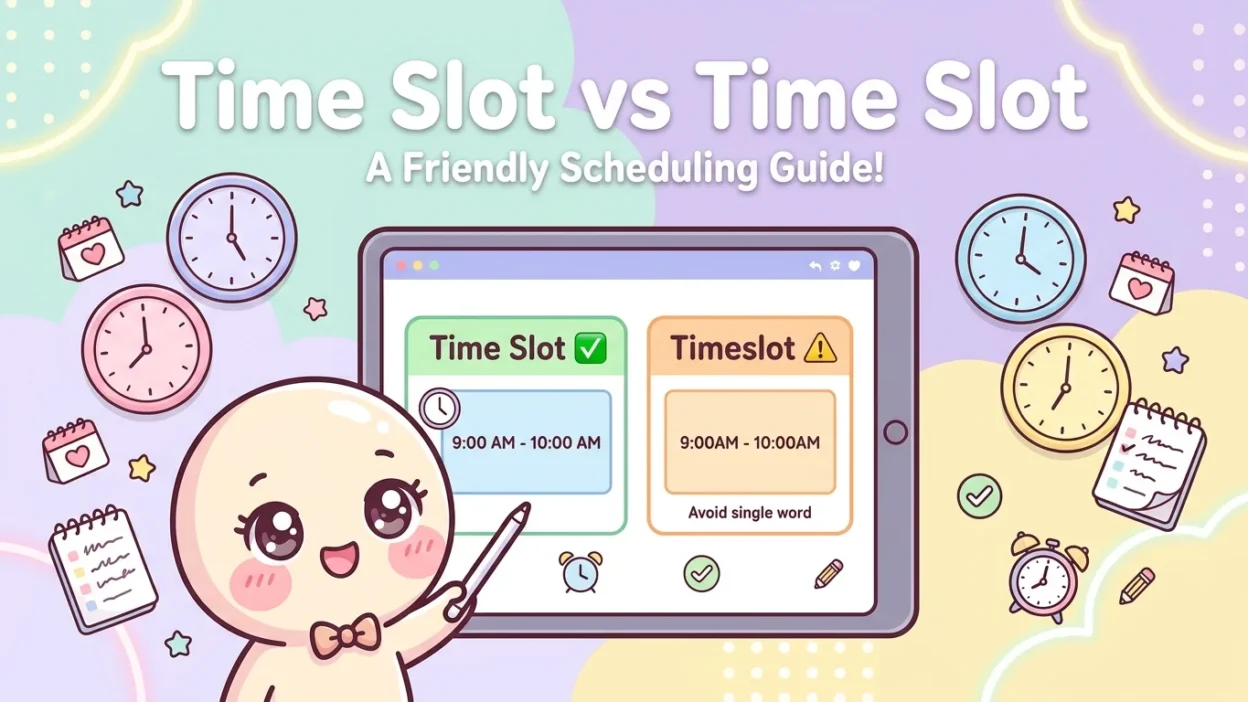
When you want to describe a specific period reserved for an appointment, meeting, class, interview, or activity, you may wonder whether “timeslot” or “time slot” is correct. Although people commonly write both forms, standard English generally prefers “time slot” as the two-word spelling.
However, “timeslot” appears frequently in informal writing, websites, scheduling systems, and business communication. Nevertheless, major style preferences generally favor time slot when you want the safest and clearest choice.
Therefore, if you are writing an email, application, professional message, academic assignment, or formal document, choose time slot. Once you understand this simple spelling rule, you can avoid unnecessary confusion.
Quick Answer
“Time slot” is the standard and safest spelling. Use it when you mean a specific period reserved for an activity, appointment, or event. Although “timeslot” appears in informal and specialized usage, “time slot” remains the better choice for standard professional English.
Why People Confuse “Timeslot” and “Time Slot”
People often confuse these forms because English frequently combines two words into compounds over time. For example, website, notebook, and classroom now function as established single words.
However, time slot commonly remains a two-word noun phrase. Therefore, writing “timeslot” can look natural even though “time slot” offers the more conventional spelling.
Moreover, scheduling software and online platforms sometimes display timeslot as a single word. Consequently, people may assume that the spelling works everywhere.
Time Slot: Meaning and Use
Time slot means a specific period available or reserved for a particular activity.
For example:
- I booked a time slot for my appointment.
- Please choose a time slot for the interview.
- We have an available time slot at 3 p.m.
- The doctor has one time slot available tomorrow.
- You can select your preferred time slot online.
Additionally, people use time slot across many situations, including appointments, television schedules, classes, meetings, interviews, and deliveries.
Timeslot: Meaning and Use
Timeslot carries the same basic meaning as time slot, but standard writing usually favors the two-word form.
You may encounter timeslot in:
- Scheduling software
- Business platforms
- Informal messages
- Technical systems
- Website interfaces
- Marketing content
- Internal company documents
However, if you want polished and widely accepted English, time slot provides the safer choice.
Comparison Table
| Form | Standard? | Meaning | Best Use |
|---|---|---|---|
| time slot | Yes | A specific period for an activity | Formal and general writing |
| timeslot | Less standard | Same basic meaning | Informal or specialized contexts |
| time-slot | Rare | Same basic meaning | Usually unnecessary |
When to Use “Time Slot”
Use “Time Slot” in Professional Writing
Choose time slot when writing professional emails, reports, applications, or workplace messages.
- Please let me know which time slot works for you.
- I would like to reserve a time slot for the meeting.
- The interview time slot starts at 10 a.m.
Use “Time Slot” for Appointments
When discussing appointments, time slot works naturally.
- I booked a time slot with the dentist.
- The clinic has an afternoon time slot available.
- Please select a convenient time slot.
Use “Time Slot” for Classes
You can also use time slot for classes and lessons.
- The morning time slot works best for me.
- Students can choose a time slot for their presentation.
- The instructor added another time slot.
Use “Time Slot” for Events
Similarly, use time slot when discussing events.
- The speaker received a 30-minute time slot.
- Our presentation has a 2 p.m. time slot.
- The organizers assigned each team a time slot.
Examples of “Time Slot”
Here are several natural examples:
- Please choose a time slot for your appointment.
- I booked the 10 a.m. time slot.
- Which time slot works best for you?
- We have one time slot available this afternoon.
- The interview time slot lasts 30 minutes.
- She selected an evening time slot.
- The doctor opened another time slot.
- Please confirm your preferred time slot.
- The meeting has a flexible time slot.
- I reserved a time slot for tomorrow.
- The delivery company offered several time slots.
- Students can choose their presentation time slot.
- We need to find a suitable time slot.
- The afternoon time slot is already full.
- I changed my time slot to Friday.
- The interviewers assigned each candidate a time slot.
- You can select another time slot if necessary.
- The morning time slot fills quickly.
Common Mistakes
Mistake 1: Writing “Timeslot” in Formal Writing
Less preferred: Please select your timeslot.
Better: Please select your time slot.
Therefore, use the two-word form when you want a polished and conventional style.
Mistake 2: Using a Hyphen
Less preferred: Please choose a time-slot.
Better: Please choose a time slot.
Generally, you do not need a hyphen when time slot functions as a noun phrase.
Mistake 3: Treating “Time Slot” as One Word
Because compound words often merge over time, writers sometimes automatically write timeslot. However, time slot remains the safer standard choice.
Mistake 4: Using “Time Slot” Without a Clear Context
Although time slot works broadly, sometimes another phrase sounds more natural.
For example:
- appointment time
- meeting time
- scheduled time
- available time
Therefore, choose the phrase that best matches your specific context.
Mistake 5: Confusing “Time Slot” With “Time”
These expressions can differ slightly.
- What time is the meeting?
- What time slot is available?
The first question asks about a particular time, while the second asks about an available period.
Memory Trick
Use this simple rule:
Time + Slot = Time Slot
Think of a slot as an opening or space. Therefore, a time slot means an available space in a schedule.
For example:
Time slot → appointment period
Time slot → meeting period
Time slot → available schedule period
So, whenever you need the noun for a scheduled period, remember the two-word form: time slot.
American vs British English
Both American and British English commonly use time slot as the standard spelling.
Therefore:
- American English: time slot
- British English: time slot
The spelling generally does not change between these varieties.
However, individual organizations, software platforms, or publications may choose timeslot as a house style. Nevertheless, time slot remains the safest general choice.
Similar Words
Time Slot vs Appointment
A time slot refers to a period available for an activity, while an appointment refers to the scheduled arrangement itself.
- I selected a time slot.
- I have an appointment at 3 p.m.
Time Slot vs Schedule
A schedule describes a broader plan of activities and times. In contrast, a time slot describes one particular period within that schedule.
- Check the schedule.
- Choose an available time slot.
Time Slot vs Time Frame
A time frame usually describes a broader period during which something should happen. Meanwhile, a time slot usually describes a specific scheduled period.
- We have a two-week time frame.
- I booked a 30-minute time slot.
Final Verdict
“Time slot” is the safest and most standard choice.
Therefore, write:
Time slot ✅
Rather than:
Timeslot ⚠️
Although you may encounter timeslot in software, informal writing, or specialized contexts, time slot works reliably in professional, academic, and everyday English.
Remember This
Time slot = standard and safest
Timeslot = less standard and context-dependent
If you are unsure, choose time slot. It gives your writing a clear, conventional, and professional appearance.
FAQs
Is “timeslot” one word or two words?
The standard spelling is generally time slot, written as two words. Although “timeslot” appears in some informal and technical contexts, “time slot” remains the safer choice.
Is “time slot” grammatically correct?
Yes. Time slot functions as a noun phrase that describes a specific period reserved or available for an activity.
Should I write “timeslot” or “time slot” in an email?
Choose time slot in an email, especially when you want professional and polished English. For example, write, “Please let me know which time slot works for you.”
Is “timeslot” acceptable?
You may encounter timeslot, particularly in software, informal writing, and organizational terminology. However, time slot offers the more conventional choice for general English.
Should “time slot” have a hyphen?
Usually, no. Write time slot as two separate words when it functions as a noun phrase.
What does “time slot” mean?
A time slot means a specific period allocated or available for an activity, such as an appointment, meeting, interview, class, or event.
What is another word for “time slot”?
Depending on the context, you can use appointment time, scheduled time, period, window, or available time. However, each expression can carry a slightly different meaning.
Conclusion
Overall, time slot provides the clearest and safest choice in standard English. Although timeslot appears in some modern digital and informal contexts, you should generally choose the two-word form for professional and academic writing.
Therefore, whenever you need to describe a specific period in a schedule, write time slot. For example, “Please select your preferred time slot” sounds natural, clear, and professional.