When you want to describe someone’s location, you may wonder whether “at the house” or “in the house” sounds correct. Although both expressions can work, they communicate slightly different ideas. Therefore, understanding the context helps you choose the right phrase naturally.
Generally, “at the house” focuses on someone’s location at or around a particular house. In contrast, “in the house” specifically emphasizes being inside the building. Consequently, the two expressions can describe the same general location while highlighting different aspects.
Moreover, English speakers often choose between these phrases based on what they want to emphasize. If you simply identify someone’s location, at the house can work well. However, if you want to emphasize that someone sits or stays inside, in the house usually works better.
Quick Answer
“At the house” focuses on being at a particular house or its location, while “in the house” specifically means being inside the building. Therefore, say “She is at the house” for the general location and “She is in the house” when you want to emphasize that she is inside.
Why People Confuse “At the House” and “In the House”
People often confuse these expressions because both can answer the question “Where is someone?”
However, the prepositions at and in create different meanings.
At generally identifies a location or point. Meanwhile, in usually indicates that someone or something exists inside an enclosed space.
For example:
- He is at the house.
- He is in the house.
Both sentences can describe the same general situation. Nevertheless, the first focuses on the house as a location, while the second emphasizes the inside of the house.
At the House: Meaning and Use
At the house generally means that someone is located at a particular house. The person may stand outside, sit in the yard, stay inside, or simply occupy the general location.
For example:
- She is at the house.
- I will meet you at the house.
- They are waiting at the house.
- We stayed at the house all afternoon.
Therefore, at the house works especially well when the exact position within the property does not matter.
“At the House” for a General Location
Use at the house when you simply want to identify where someone is.
- Dad is at the house.
- The kids are at the house.
- I left my bag at the house.
Here, the speaker focuses on the house as a location rather than the interior.
“At the House” for Meetings
Similarly, at the house works when someone meets another person at a particular home.
- Let’s meet at the house.
- I’ll see you at the house tonight.
- Everyone will gather at the house.
In the House: Meaning and Use
In the house specifically emphasizes the inside of the building.
For example:
- She is in the house.
- Someone is in the house.
- The children are playing in the house.
- I left my phone in the house.
Therefore, choose in the house when the distinction between inside and outside matters.
“In the House” for Physical Location
Use in the house when someone or something physically exists inside the building.
- My brother is in the house.
- The dog is in the house.
- There is someone in the house.
“In the House” for Activities
Likewise, use in the house when an activity happens inside.
- We cooked in the house.
- The children played in the house.
- She stayed in the house during the storm.
Comparison Table
| Expression | Main Meaning | Focus | Example |
|---|---|---|---|
| At the house | At the location of a particular house | General location | I am at the house. |
| In the house | Inside a particular house | Interior | I am in the house. |
| At home | At one’s own or usual home | Home as a place | I am at home. |
| In the home | Inside a home | Interior space | The children are in the home. |
When to Use “At the House”
Use “At the House” When Location Matters
If you only want to identify the general location, choose at the house.
- She is at the house.
- I’ll wait at the house.
- They are at the house.
Use “At the House” for a Particular Property
When you refer to a specific house rather than the inside of it, at the house works naturally.
- We met at the house.
- The workers arrived at the house.
- I’ll leave the package at the house.
Use “At the House” When the Exact Position Does Not Matter
For example:
“Where is John?”
“He’s at the house.”
The answer tells you John’s general location. It does not specify whether he stands in the yard, sits on the porch, or stays inside.
When to Use “In the House”
Use “In the House” for the Interior
If you want to emphasize that someone or something sits inside, use in the house.
- John is in the house.
- The children are in the house.
- The cat is in the house.
Use “In the House” When Contrasting Inside and Outside
This distinction becomes especially clear when you compare two locations.
- John is in the house, but Sarah is outside.
- The children are in the house, while the adults are in the garden.
- I left my shoes in the house, not in the garage.
Therefore, in provides a stronger inside-versus-outside contrast.
At the House vs In the House Examples
- I am at the house right now.
- I am in the house right now.
- She is waiting at the house.
- She is sitting in the house.
- We will meet at the house.
- The children are playing in the house.
- He arrived at the house early.
- He is already in the house.
- They stayed at the house overnight.
- They stayed in the house during the storm.
- I’ll see you at the house later.
- I’ll look for you in the house.
- The workers are at the house.
- The workers are working in the house.
- There is someone at the house.
- There is someone in the house.
- We gathered at the house before dinner.
- Everyone gathered in the house after it started raining.
Common Mistakes
Mistake 1: Thinking Only One Expression Is Correct
Neither expression automatically works in every situation. Instead, choose according to your intended meaning.
At the house focuses on the general location.
In the house focuses on the interior.
Mistake 2: Using “In” for Every Location
You do not always need in simply because someone visits a house.
For example:
“I’ll meet you at the house.”
This sentence sounds natural because the speaker focuses on the meeting location.
Mistake 3: Using “At” When You Need to Emphasize the Interior
If you specifically want to say someone sits inside, in the house gives clearer information.
For example:
“The children are in the house.”
This sentence clearly contrasts the interior with the outside.
Mistake 4: Confusing “At the House” With “At Home”
These expressions can overlap, but they do not always mean exactly the same thing.
At home usually refers to someone’s own home or usual residence.
At the house usually refers to a particular house identified by context.
For example:
- I’m at home.
- I’m at my friend’s house.
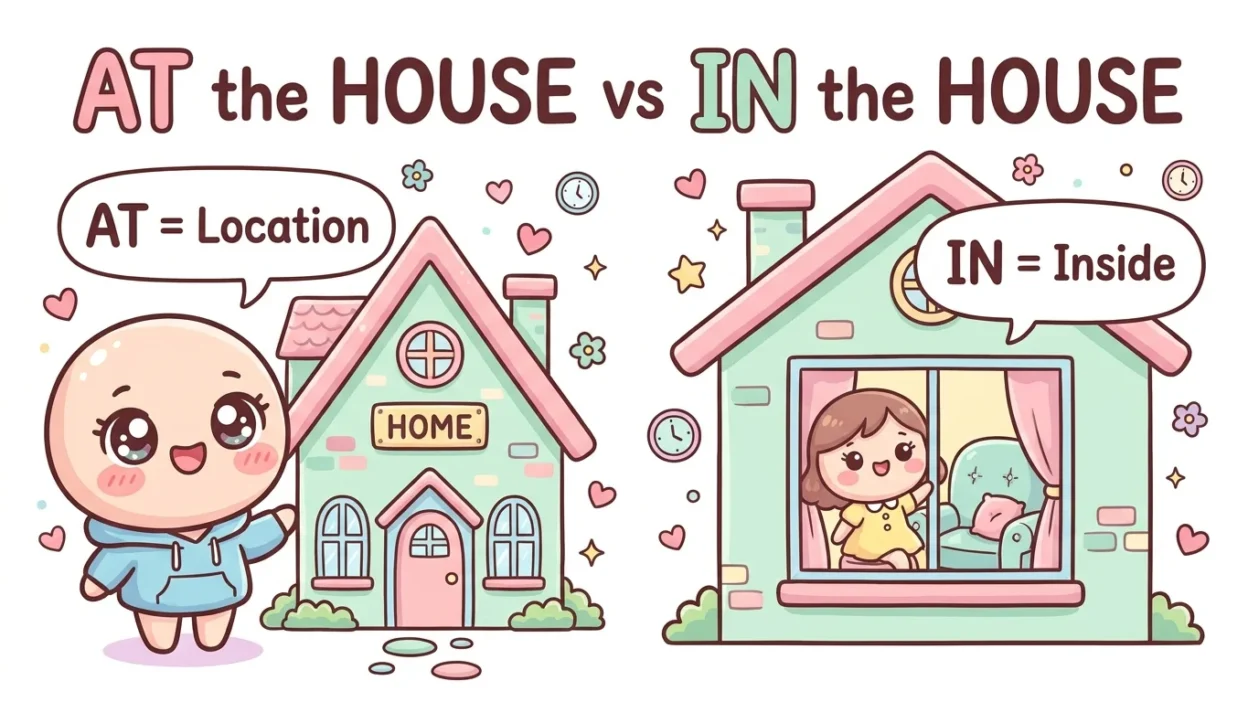
Memory Trick
Use this simple rule:
AT = location
IN = inside
Therefore:
At the house → focus on the house as a location.
In the house → focus on the inside of the house.
For example, imagine someone asks:
“Where is Sarah?”
You can answer:
“She’s at the house.”
If you want to emphasize that Sarah is indoors, say:
“She’s in the house.”
American vs British English
Both American and British English commonly use at the house and in the house.
Therefore, the main difference does not involve American versus British grammar. Instead, the difference comes from the meaning you want to communicate.
For example:
- American English: “I’m at the house.”
- British English: “I’m at the house.”
Likewise:
- American English: “I’m in the house.”
- British English: “I’m in the house.”
Similar Expressions
At the House vs At Home
At home usually refers to someone’s own home or normal residence.
- I’m at home.
- I’m at my friend’s house.
In the House vs Inside the House
Both expressions emphasize the interior.
- She is in the house.
- She is inside the house.
However, inside the house creates stronger emphasis on the interior.
At the House vs By the House
At the house identifies the general location.
Meanwhile, by the house usually means near or beside the house.
- We are at the house.
- We are standing by the house.
Final Verdict
Both “at the house” and “in the house” are correct. However, they emphasize different ideas.
Therefore, use at the house when you mean someone is at the location of a particular house. In contrast, use in the house when you specifically mean someone or something is inside the building.
So, remember the simple distinction: at = location, in = inside.
Remember This
At the house = general location
In the house = inside the building
For example:
“I’m at the house.” → My general location is the house.
“I’m in the house.” → I am specifically inside the house.
FAQs
Is “at the house” correct?
Yes. At the house is grammatically correct and usually focuses on someone’s general location at a particular house.
Is “in the house” correct?
Yes. In the house is also correct. It specifically emphasizes someone’s or something’s location inside the building.
What is the difference between “at the house” and “in the house”?
At the house focuses on the house as a location, while in the house focuses on the interior. Therefore, the best choice depends on what you want to emphasize.
Should I say “I’m at the house” or “I’m in the house”?
Both can work. Say “I’m at the house” when you mean the general location. However, say “I’m in the house” when you want to emphasize that you are indoors.
Is “at the house” the same as “at home”?
Not always. At home generally refers to your own or usual residence, while at the house can refer to any particular house that the context identifies.
Can I say “I left my phone at the house”?
Yes. “I left my phone at the house” sounds natural when you mean you left it somewhere at that property. However, if you specifically mean inside, you can say “I left my phone in the house.”
Which sounds more natural: “at the house” or “in the house”?
Neither expression always sounds more natural because they communicate different meanings. Generally, at the house works for a general location, while in the house works for an interior location.
Conclusion
Overall, at the house and in the house both work correctly, but they highlight different locations. At the house gives a broader sense of place, while in the house clearly places someone or something inside the building.
Therefore, whenever you feel unsure, remember the simple rule: at points to a location, whereas in emphasizes an enclosed space. Consequently, choosing between these phrases becomes much easier when you focus on the meaning you want to express.