
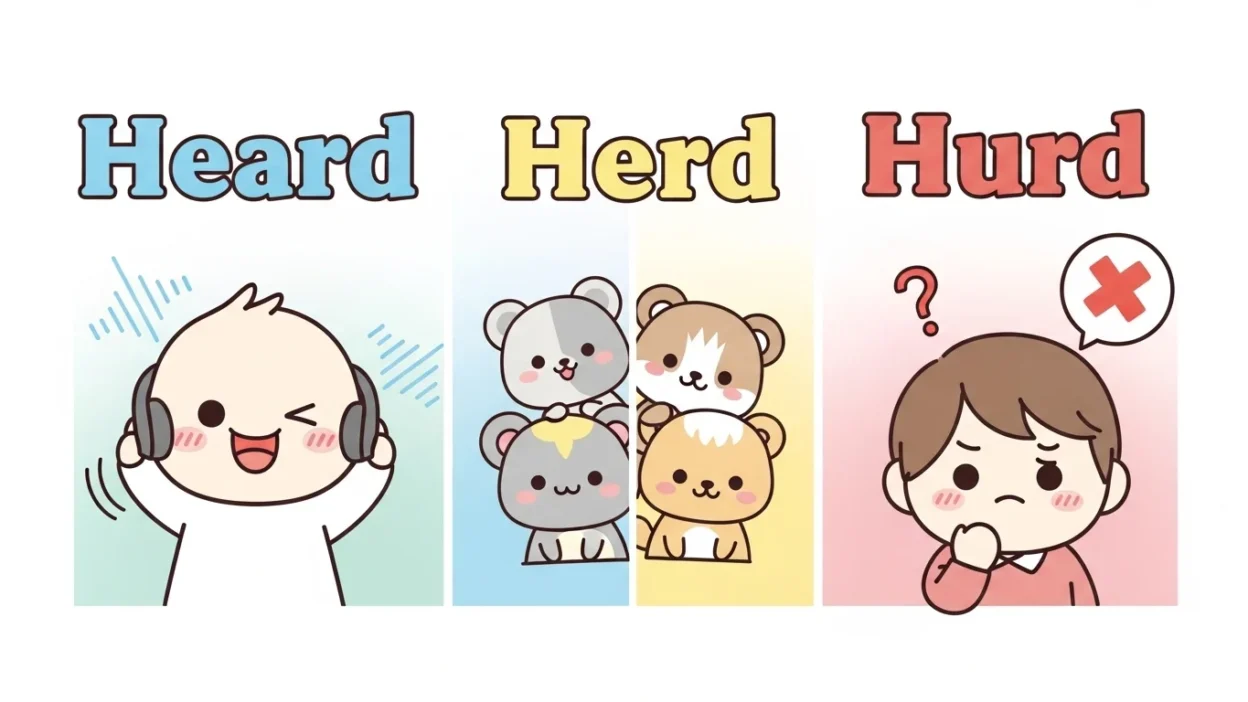
Many learners mix up “heard,” “herd,” and “hurd” because they sound similar. However, each word has a completely different meaning, so using the wrong one can quickly confuse your reader.
So, if you want clear and confident English, you need to know how each word works. In this guide, you’ll learn the meanings, see simple examples, and avoid common mistakes easily.
Quick Answer
✨ Let’s make it super clear:
- ✅ Heard = past of hear (sound)
- ✅ Herd = group of animals
- ❌ Hurd = incorrect spelling
👉 Easy trick:
- Heard = ear (sound)
- Herd = animals together
🌟 Examples:
- I heard a noise. ✔
- A herd of cows passed by. ✔
- I hurd a noise. ❌
What Does “Heard” Mean?
First of all, “heard” is the past tense of “hear.” Therefore, it relates to sound and listening.
Common Uses:
- Listening to sounds
- Conversations
- News or information
Examples:
- I heard your voice.
- She heard the music clearly.
- We heard the announcement.
👉 So, whenever you talk about sound, you should use “heard.”
What Does “Herd” Mean?
On the other hand, “herd” refers to a group of animals. Therefore, it appears in nature or farming contexts.
Common Uses:
- Animals like cows, sheep, or elephants
- Groups moving together
Examples:
- A herd of sheep crossed the road.
- The farmer owns a large herd.
- We saw a herd of elephants.
👉 So, whenever you talk about animals in a group, you should use “herd.”
Why “Hurd” Is Incorrect
Now, “hurd” is not a correct standard English word in this context. Although it sounds similar, it is simply a misspelling of “heard.”
👉 Because:
- English spelling uses “ea” in “heard”
- “Hurd” does not match correct spelling rules
Correct vs Wrong:
- Heard ✔
- Herd ✔
- Hurd ❌
Key Differences Between “Heard,” “Herd,” and “Hurd”
| Feature | Heard | Herd | Hurd |
|---|---|---|---|
| Meaning | Sound (past of hear) | Group of animals | Incorrect |
| Usage | Listening | Nature | Not used |
| Example | I heard a sound | A herd of cows | ❌ Not correct |
Common Mistakes to Avoid
Even though the words sound similar, mistakes happen often. So, let’s fix them:
❌ Incorrect:
- I herd a noise.
✔ Correct: I heard a noise.
👉 Because it relates to sound.
❌ Incorrect:
- A heard of cows moved fast.
✔ Correct: A herd of cows moved fast.
👉 Because it refers to animals.
❌ Incorrect:
- I hurd something outside.
✔ Correct: I heard something outside.
👉 Because “hurd” is wrong spelling.
Easy Trick to Remember
Whenever you feel confused, try this:
- Talking about sound? → Use heard
- Talking about animals? → Use herd
👉 Bonus memory:
- Heard has “ear” inside → sound
Because of this trick, you can quickly choose the right word.
American vs British English
Interestingly, both American and British English use these words the same way. So, you don’t need to worry about differences.
- Heard a sound ✔
- Herd of animals ✔
Real-Life Examples
In Daily Life:
- I heard a strange noise.
- She heard the news today.
In Nature:
- A herd of deer ran across the field.
- The herd moved together.
Why This Matters
Although these words sound alike, they change the meaning completely. So, when you use the correct one:
- You avoid confusion
- You improve clarity
- You sound more natural
As a result, your writing becomes clearer and more professional.
FAQs
What is the difference between heard and herd?
“Heard” relates to sound, while “herd” refers to a group of animals.
Is hurd a real word?
No, “hurd” is not correct in this context.
Which is correct: I heard or I herd?
“I heard” is correct because it refers to listening.
Why do people confuse these words?
Because they sound similar but have different meanings.
What is the easiest way to remember this?
Think “heard has ear = sound” and “herd = animals.”
Can herd be used for people?
Usually no, but sometimes figuratively.
Final Thoughts
Now you clearly understand the difference between “heard,” “herd,” and “hurd.”
While one relates to sound, another refers to animals, and the last one is simply incorrect. Because of this clarity, you can avoid confusion easily.
As you continue practicing, you will naturally choose the correct word without hesitation. So, instead of guessing, you will write clearly and confidently every time.

Lutana Maroochy is a creative author recognized for delivering engaging and well-researched content. With a passion for clear communication and storytelling, Lutana focuses on producing informative, reader-centered articles across various subjects. Dedicated to quality and originality, Lutana consistently connects with audiences through thoughtful insights and compelling narratives.