Sell and sale look and sound similar, so English learners often confuse them. However, they perform different grammatical jobs. Therefore, knowing whether you need a verb or a noun will help you choose the correct word quickly.
Sell works as a verb, meaning to exchange something for money. For example, you can say, “They sell fresh fruit.” On the other hand, sale works as a noun and refers to the act of selling or an event where a business offers products at reduced prices. Consequently, you should choose sell when someone performs the action and sale when you discuss the event or transaction.
Quick Answer
Sell is a verb, while sale is a noun. Therefore, say “They sell clothes online” when describing the action. However, say “The store has a big sale” when describing a special event or reduced-price promotion. Remember: sell = action, while sale = event or transaction.
Why People Confuse It
People often confuse sell and sale because the words have similar sounds and meanings.
However, their grammatical roles differ.
Sell = verb
Sale = noun
For example:
- They sell shoes.
- The store has a shoe sale.
Therefore, whenever you describe what someone does, choose sell.
Meanwhile, whenever you describe an event, transaction, or discount promotion, choose sale.
Sell: Meaning and Use
Sell means to give something to another person in exchange for money.
Because sell works as a verb, you can change its form according to tense.
For example:
- I sell books.
- She sells clothes.
- They sold their car.
- He has sold his house.
- We will sell the old furniture.
Therefore, sell describes the action of transferring something to a buyer for money.
Sale: Meaning and Use
Sale works as a noun.
It can describe the act of selling something. Additionally, it can describe a special event where stores offer products at lower prices.
For example:
- The house is for sale.
- The store has a sale.
- We bought the shoes during the sale.
- The company announced a summer sale.
Therefore, sale names the event, transaction, or opportunity rather than describing the action itself.
Sell vs Sale: Comparison Table
| Word | Part of Speech | Meaning | Example |
|---|---|---|---|
| Sell | Verb | Exchange something for money | They sell furniture. |
| Sale | Noun | An act, transaction, or event involving selling | The furniture is on sale. |
| Sold | Past tense / past participle | Past form of sell | They sold the furniture. |
| Selling | Present participle | Ongoing action of selling | They are selling furniture. |
When to Use “Sell”
Use “Sell” for an Action
Use sell when someone performs the action of offering something to a buyer.
- I sell handmade jewelry.
- They sell fresh vegetables.
- She sells paintings online.
- We sell computer accessories.
Therefore, if you can replace the word with another action verb such as offer, trade, or market, sell may fit.
Use “Sell” With “Will”
Use sell after will.
- I will sell my old phone.
- They will sell the property.
- She will sell her artwork.
Therefore:
❌ I will sale my car.
✔ I will sell my car.
Use “Sell” With “Can”
Use sell after modal verbs such as can.
- We can sell these products.
- He can sell the house.
- They can sell their tickets.
Consequently:
❌ They can sale tickets.
✔ They can sell tickets.
When to Use “Sale”
Use “Sale” for a Discount Event
Use sale when a store offers products at reduced prices.
- The store has a sale.
- The summer sale starts tomorrow.
- I bought this shirt during the sale.
Therefore, sale commonly appears in shopping and advertising.
Use “For Sale”
Use for sale when something remains available for purchase.
- The house is for sale.
- My old car is for sale.
- These paintings are for sale.
Therefore, remember this common phrase:
For sale = available to buy
Use “On Sale”
Use on sale when a product has a reduced price or when a store actively offers it for purchase.
- These shoes are on sale.
- The laptop is on sale this week.
- Everything is on sale today.
However, context can determine whether on sale means “available for purchase” or “available at a discounted price.”
Examples
- They sell fresh fruit.
- She sells handmade candles.
- I want to sell my old laptop.
- We sell clothes online.
- He sold his car last month.
- The store has a big sale.
- These shoes are on sale.
- The house is for sale.
- We bought the television during the sale.
- The summer sale starts tomorrow.
- They will sell their old furniture.
- She plans to sell her artwork.
- The company announced a holiday sale.
- Everything in the shop is on sale.
- They sold all the tickets.
- The tickets are for sale online.
- We can sell these products quickly.
- The store’s annual sale attracts many customers.
Common Mistakes
Mistake 1: “For Sell”
❌ The house is for sell.
✔ The house is for sale.
Because for sale functions as a noun phrase, use sale.
Mistake 2: “On Sell”
❌ These shoes are on sell.
✔ These shoes are on sale.
Therefore, remember the fixed expression on sale.
Mistake 3: “I Will Sale It”
❌ I will sale my car.
✔ I will sell my car.
Because will requires the base verb, choose sell.
Mistake 4: “They Sale Products”
❌ They sale computers.
✔ They sell computers.
Because the sentence describes an action, choose the verb sell.
Mistake 5: “Big Sell”
❌ The store has a big sell.
✔ The store has a big sale.
Because the sentence describes a promotional event, choose sale.
Memory Trick
Remember:
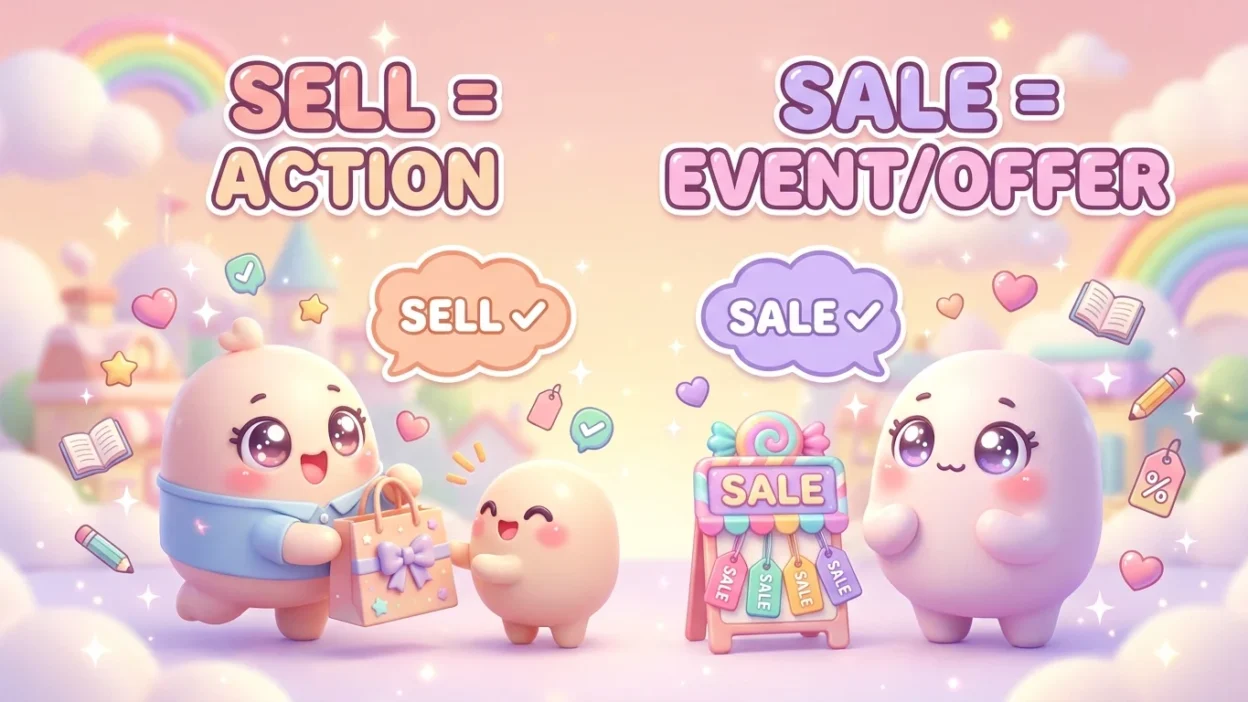
SELL = DO
SALE = THING/EVENT
If someone does the action, use sell.
If you name the event or transaction, use sale.
For example:
They sell shoes.
The store has a shoe sale.
Another easy trick involves the final sound:
Sell → verb
Sale → noun
Therefore, whenever you see for, think:
for sale ✔
Whenever you see will, think:
will sell ✔
American vs British English
American English uses sell and sale in the same basic way.
British English also uses sell and sale in the same way.
Therefore, the distinction does not change between the two major varieties.
For example:
American: The shop is having a sale.
British: The shop is having a sale.
Similarly:
American: They sell clothes online.
British: They sell clothes online.
Consequently, you can follow the same rule in both varieties.
Similar Words
Sell vs Sold
Sell provides the present/base form.
Sold provides the past form.
- I sell cars.
- I sold a car yesterday.
Therefore:
sell → sold
Sale vs Selling
Sale works as a noun.
Selling works as a verb form or gerund.
- The sale starts tomorrow.
- Selling products online can be profitable.
Sale vs Sellout
A sale refers to selling or a promotional event.
A sellout can describe a situation where all available tickets or products have sold.
- The store has a sale.
- The concert was a sellout.
Final Verdict
Sell and sale have related meanings, but they serve different grammatical purposes.
Use sell as a verb:
They sell clothes.
Use sale as a noun:
The clothes are on sale.
Therefore, remember the easiest rule:
SELL = ACTION
SALE = EVENT, TRANSACTION, OR OFFER
If you can ask “What does someone do?”, choose sell. However, if you can ask “What event or transaction are we talking about?”, choose sale.
Remember This
✔ Sell = verb
✔ Sale = noun
✔ I want to sell my car.
✔ My car is for sale.
✔ They sell shoes.
✔ The shoes are on sale.
Therefore:
Sell = action
Sale = event or transaction
FAQs
1. Is it “for sell” or “for sale”?
For sale is correct. For example, “The house is for sale.”
2. Is it “on sell” or “on sale”?
On sale is correct. For example, “These shoes are on sale.”
3. Is “sell” a noun or a verb?
Sell primarily works as a verb. It describes the action of exchanging something for money.
4. Is “sale” a noun or a verb?
Sale works as a noun. It can describe an act of selling, a transaction, or a promotional event.
5. Should I say “I will sell” or “I will sale”?
Say “I will sell.” The modal verb will takes the base verb sell.
6. What is the past tense of sell?
The past tense of sell is sold. For example, “She sold her car yesterday.”
7. What is the easiest way to remember sell vs sale?
Remember sell = action and sale = event or transaction. Therefore, say “They sell products” but “The products are on sale.”
Conclusion
Sell and sale share a connection because both relate to exchanging products or services for money. However, their grammatical roles differ. Sell functions as a verb, while sale functions as a noun. Therefore, the sentence structure should guide your choice.
Ultimately, remember sell = action and sale = event, transaction, or offer. So, you can say “They sell clothes,” but you should say “The clothes are on sale.” With this simple distinction, you can avoid common mistakes such as “for sell” and “on sell.”

Narelle Merindah is a passionate author committed to delivering thoughtful, engaging, and well-structured content. With a keen eye for detail and a love for storytelling, Narelle creates informative articles that resonate with readers. Her dedication to clarity, creativity, and authenticity ensures meaningful and impactful writing.